Texas TEKS 2.1
TEKS Knowledge Statement (Expectation Cluster)
Scientific and engineering practices. The student asks questions, identifies problems, and plans and safely conducts classroom, laboratory, and field investigations to answer questions, explain phenomena, or design solutions using appropriate tools and models. The student is expected to: ask questions and define problems based on observations or information from text, phenomena, models, or investigations; use scientific practices to plan and conduct simple descriptive investigations and use engineering practices to design solutions to problems; identify, describe, and demonstrate safe practices during classroom and field investigations as outlined in Texas Education Agency-approved safety standards; use tools, including hand lenses, goggles, heat-resistant gloves, trays, cups, bowls, beakers, notebooks, stream tables, soil, sand, gravel, flowering plants, student thermometer, demonstration thermometer, rain gauge, flashlights, ramps, balls, spinning tops, drums, tuning forks, sandpaper, wax paper, items that are flexible, non-flexible items, magnets, hot plate, aluminum foil, Sun-Moon-Earth model, and frog and butterfly life cycle models to observe, measure, test, and compare; collect observations and measurements as evidence; record and organize data using pictures, numbers, words, symbols, and simple graphs; and develop and use models to represent phenomena, objects, and processes or design a prototype for a solution to a problem.
Texas Essential Knowledge and Skills for Science
Cluster contents
Student Expectations in This Statement
2.1 is a TEKS knowledge and skills statement. These are the student expectations under it.
- 2.1.A
ask questions and define problems based on observations or information from text, phenomena, models, or investigations
- 2.1.B
use scientific practices to plan and conduct simple descriptive investigations and use engineering practices to design solutions to problems
- 2.1.C
identify, describe, and demonstrate safe practices during classroom and field investigations as outlined in Texas Education Agency-approved safety standards
- 2.1.D
use tools, including hand lenses, goggles, heat-resistant gloves, trays, cups, bowls, beakers, notebooks, stream tables, soil, sand, gravel, flowering plants, s...
- 2.1.E
collect observations and measurements as evidence
- 2.1.F
record and organize data using pictures, numbers, words, symbols, and simple graphs
- 2.1.G
develop and use models to represent phenomena, objects, and processes or design a prototype for a solution to a problem.
Teacher's field guide
What This Cluster Means
What Students Need to Do
- Students ask questions from what they observe, then plan a simple test or design a solution. They use tools safely, collect measurements and observations, organize data, and make models or prototypes.
What Mastery Looks Like
- Students can choose suitable tools, follow safety steps, and explain how their plan answers a question. They record accurate evidence with pictures, words, numbers, or graphs and use it to explain results.
Common Misconceptions
- Students may ask questions that cannot be tested or change several conditions at once. They may treat guesses as evidence, record only expected results, or choose tools without considering safety.
How to Assess It
- Show a toy car and ramp. Ask students to write a testable question, name one tool and one safety step, and draw a data table.
Lesson moves
Ways to Teach It
In teams, test how ramp height changes a ball’s travel, keep the path clear, measure distances, and graph the results.
Show a wilted plant and ask students to write one question, one possible cause, and one fair test.
Play Tool Match: students draw a task card, choose the safest useful tool, and explain their choice.
Design and build a foil shade for a playground thermometer, then compare temperatures in sunlight and shade.
Free download
Printable 2.1 Worksheet
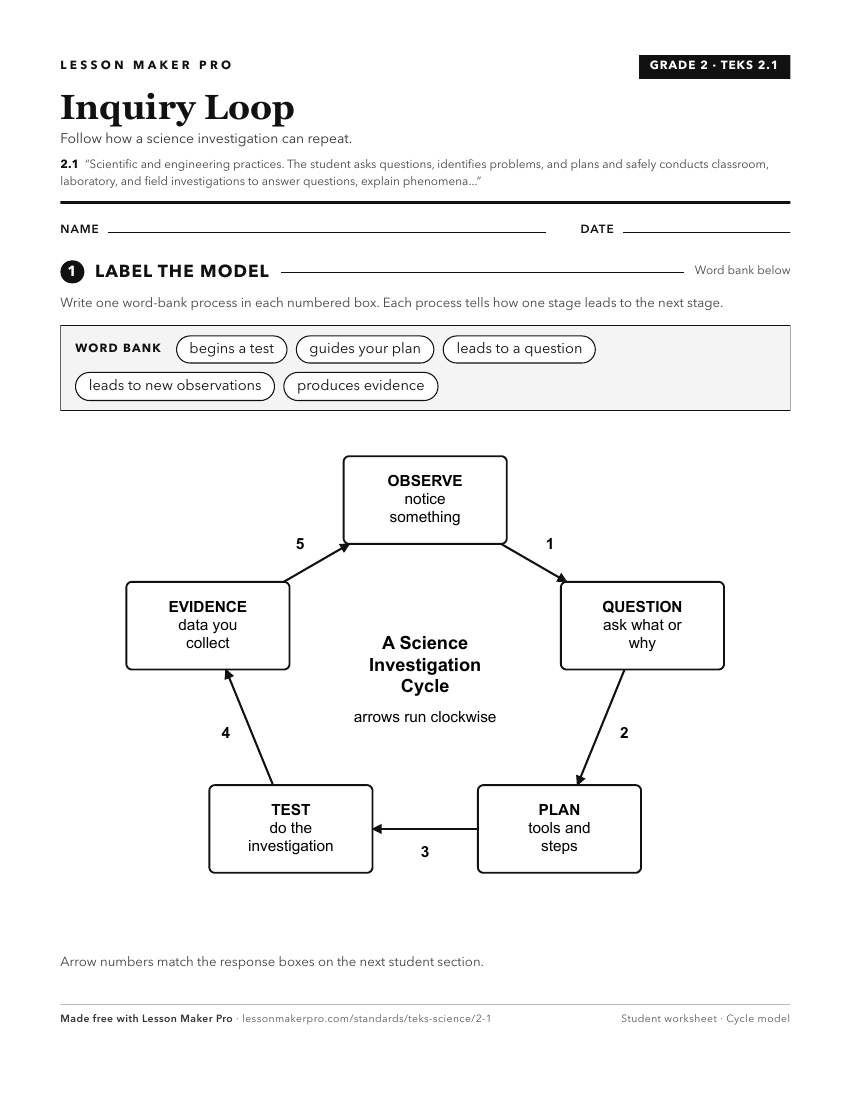
A ready-to-print activity worksheet aligned to 2.1, with an answer key for the teacher on its own page. No account needed.
PDF, US Letter, prints cleanly in black and white.
Download the worksheetKeep exploring
Related Standards
Turn this cluster into a lesson
Grade, subject, topic, and the complete cluster are prefilled. Create one free, no account needed.
Also for this cluster:Make a WorksheetMake a QuizMake a Sub Lesson