Texas TEKS K.1
TEKS Knowledge Statement (Expectation Cluster)
Scientific and engineering practices. The student asks questions, identifies problems, and plans and safely conducts classroom, laboratory, and field investigations to answer questions, explain phenomena, or design solutions using appropriate tools and models. The student is expected to: ask questions and define problems based on observations or information from text, phenomena, models, or investigations; use scientific practices to plan and conduct simple descriptive investigations and use engineering practices to design solutions to problems; identify, describe, and demonstrate safe practices during classroom and field investigations as outlined in Texas Education Agency-approved safety standards; use tools, including hand lenses, goggles, trays, cups, bowls, sieves or sifters, notebooks, terrariums, aquariums, samples (rocks, sand, soil, loam, gravel, clay, seeds, and plants), windsock, demonstration thermometer, rain gauge, straws, ribbons, non-standard measuring items, blocks or cubes, tuning fork, various flashlights, small paper cups, items that roll, noise makers, hot plate, opaque objects, transparent objects, foil pie pans, foil muffin cups, wax paper, Sun-Moon-Earth model, and plant life cycle model to observe, measure, test, and compare; collect observations and measurements as evidence; record and organize data using pictures, numbers, words, symbols, and simple graphs; and develop and use models to represent phenomena, objects, and processes or design a prototype for a solution to a problem.
Texas Essential Knowledge and Skills for Science
Cluster contents
Student Expectations in This Statement
K.1 is a TEKS knowledge and skills statement. These are the student expectations under it.
- K.1.A
ask questions and define problems based on observations or information from text, phenomena, models, or investigations
- K.1.B
use scientific practices to plan and conduct simple descriptive investigations and use engineering practices to design solutions to problems
- K.1.C
identify, describe, and demonstrate safe practices during classroom and field investigations as outlined in Texas Education Agency-approved safety standards
- K.1.D
use tools, including hand lenses, goggles, trays, cups, bowls, sieves or sifters, notebooks, terrariums, aquariums, samples (rocks, sand, soil, loam, gravel, cl...
- K.1.E
collect observations and measurements as evidence
- K.1.F
record and organize data using pictures, numbers, words, symbols, and simple graphs
- K.1.G
develop and use models to represent phenomena, objects, and processes or design a prototype for a solution to a problem.
Teacher's field guide
What This Cluster Means
What Students Need to Do
- Students ask questions about what they observe and plan simple ways to find answers. They use tools safely, collect observations or measurements, and record data. They also make models or simple prototypes to show ideas and solve problems.
What Mastery Looks Like
- A student can ask an investigable question, choose a useful tool, and explain how to use it safely. The student records evidence with pictures, numbers, words, symbols, or a simple graph, then uses it to explain a finding.
Common Misconceptions
- Students may give a guess instead of asking a question, or rely on memory instead of recording evidence. They may treat tools as toys or think tasting and touching are always safe. They may see a model as an exact copy rather than a way to show an idea or process.
How to Assess It
- Give each student a rock, hand lens, and recording card. Ask the student to demonstrate safe tool use, draw two observations, and state one question that could be investigated.
Lesson moves
Ways to Teach It
Give groups sand, gravel, trays, cups, and sieves to separate materials, then record each material with pictures and tally marks.
Show a classroom plant and ask, "What do you notice, what do you wonder, and how could we investigate safely?"
Play a tool-match game where students pair picture cards of tools with tasks such as measuring rain, viewing seeds, or holding samples.
Place a rain gauge outside, record the water level after rain, and build a class picture graph of weekly rainfall.
Free download
Printable K.1 Worksheet
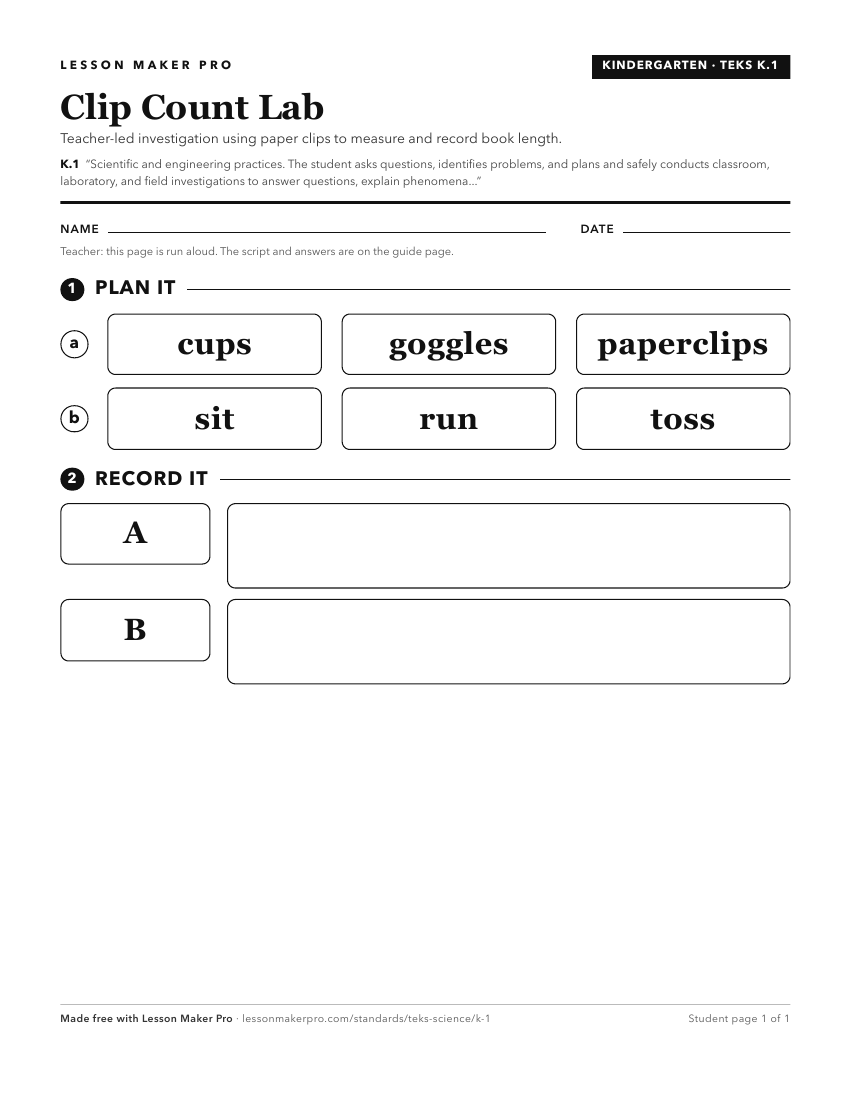
A ready-to-print activity worksheet aligned to K.1, with an answer key for the teacher on its own page. No account needed.
PDF, US Letter, prints cleanly in black and white.
Download the worksheetKeep exploring
Related Standards
Turn this cluster into a lesson
Grade, subject, topic, and the complete cluster are prefilled. Create one free, no account needed.
Also for this cluster:Make a WorksheetMake a QuizMake a Sub Lesson