Texas TEKS 5.1
TEKS Knowledge Statement (Expectation Cluster)
Scientific and engineering practices. The student asks questions, identifies problems, and plans and safely conducts classroom, laboratory, and field investigations to answer questions, explain phenomena, or design solutions using appropriate tools and models. The student is expected to: ask questions and define problems based on observations or information from text, phenomena, models, or investigations; use scientific practices to plan and conduct descriptive and simple experimental investigations and use engineering practices to design solutions to problems; demonstrate safe practices and the use of safety equipment during classroom and field investigations as outlined in Texas Education Agency-approved safety standards; use tools, including calculators, microscopes, hand lenses, metric rulers, Celsius thermometers, prisms, concave and convex lenses, laser pointers, mirrors, digital scales, balances, spring scales, graduated cylinders, beakers, hot plates, meter sticks, magnets, collecting nets, notebooks, timing devices, materials for building circuits, materials to support observations of habitats or organisms such as terrariums and aquariums, and materials to support digital data collection such as computers, tablets, and cameras to observe, measure, test, and analyze information; collect observations and measurements as evidence; construct appropriate graphic organizers used to collect data, including tables, bar graphs, line graphs, tree maps, concept maps, Venn diagrams, flow charts or sequence maps, and input-output tables that show cause and effect; and develop and use models to represent phenomena, objects, and processes or design a prototype for a solution to a problem.
Texas Essential Knowledge and Skills for Science
Cluster contents
Student Expectations in This Statement
5.1 is a TEKS knowledge and skills statement. These are the student expectations under it.
- 5.1.A
ask questions and define problems based on observations or information from text, phenomena, models, or investigations
- 5.1.B
use scientific practices to plan and conduct descriptive and simple experimental investigations and use engineering practices to design solutions to problems
- 5.1.C
demonstrate safe practices and the use of safety equipment during classroom and field investigations as outlined in Texas Education Agency-approved safety stand...
- 5.1.D
use tools, including calculators, microscopes, hand lenses, metric rulers, Celsius thermometers, prisms, concave and convex lenses, laser pointers, mirrors, dig...
- 5.1.E
collect observations and measurements as evidence
- 5.1.F
construct appropriate graphic organizers used to collect data, including tables, bar graphs, line graphs, tree maps, concept maps, Venn diagrams, flow charts or...
- 5.1.G
develop and use models to represent phenomena, objects, and processes or design a prototype for a solution to a problem.
Teacher's field guide
What This Cluster Means
What Students Need to Do
- Students turn observations or information into testable questions or clearly defined problems. They plan and safely carry out investigations, select tools, and record observations and measurements. They organize evidence in graphs or tables, then build models or prototypes to explain results or solve problems.
What Mastery Looks Like
- Students can write a clear question, choose suitable tools, and describe safe investigation steps. They collect accurate measurements and select a table, graph, or organizer that fits the data. They use evidence to explain a model or improve a prototype.
Common Misconceptions
- Students may ask questions that cannot be tested or change several conditions at once. They may record guesses instead of measurements, choose the wrong graph, or leave units off data. Some treat models as exact copies rather than useful representations.
How to Assess It
- Exit ticket: A class wants to learn which soil holds the most water. Have students write a testable question, list tools and safety steps, and draw a labeled data table.
Lesson moves
Ways to Teach It
Test which paper towel absorbs the most water using graduated cylinders, digital scales, goggles, and a student-made data table.
Show a wilted plant and ask students to write one testable question, one possible cause, and evidence they would collect.
Run a tool-match relay where teams pair investigation cards with microscopes, thermometers, rulers, balances, lenses, or timing devices.
Build a model irrigation system from cups, straws, and clay, then measure water delivery and revise the design.
Free download
Printable 5.1 Worksheet
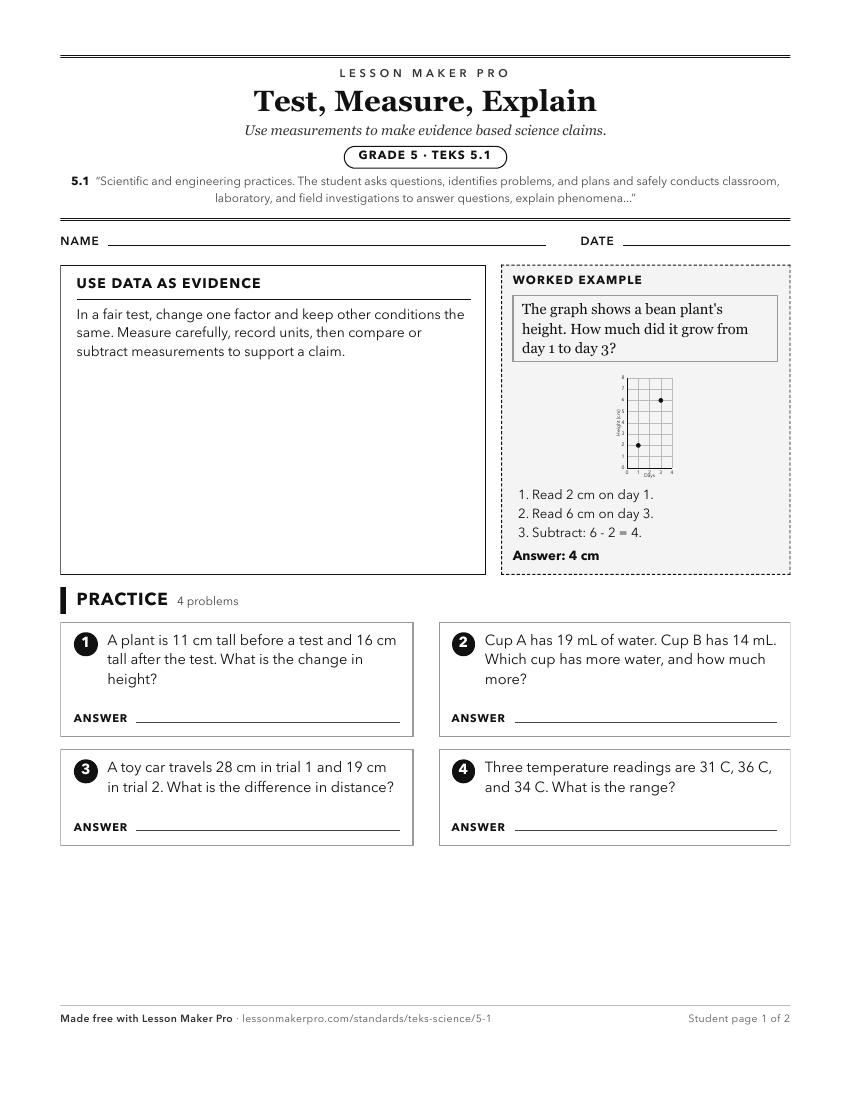
A ready-to-print activity worksheet aligned to 5.1, with an answer key for the teacher on its own page. No account needed.
PDF, US Letter, prints cleanly in black and white.
Download the worksheetKeep exploring
Related Standards
Turn this cluster into a lesson
Grade, subject, topic, and the complete cluster are prefilled. Create one free, no account needed.
Also for this cluster:Make a WorksheetMake a QuizMake a Sub Lesson