Texas TEKS 5.1.D
The Standard
- 5.1
- Scientific and engineering practices. The student asks questions, identifies problems, and plans and safely conducts classroom, laboratory, and field investigations to answer questions, explain phenomena, or design solutions using appropriate tools and models. The student is expected to:
use tools, including calculators, microscopes, hand lenses, metric rulers, Celsius thermometers, prisms, concave and convex lenses, laser pointers, mirrors, digital scales, balances, spring scales, graduated cylinders, beakers, hot plates, meter sticks, magnets, collecting nets, notebooks, timing devices, materials for building circuits, materials to support observations of habitats or organisms such as terrariums and aquariums, and materials to support digital data collection such as computers, tablets, and cameras to observe, measure, test, and analyze information
Texas Essential Knowledge and Skills for Science
Teacher's field guide
What This Standard Means
What Students Need to Do
- Students choose a tool that fits the investigation, use it safely, and record accurate observations or measurements. They read scales correctly and use collected data to compare results or support a conclusion.
What Mastery Looks Like
- Given a science question, a student selects an appropriate tool and explains the choice. The student uses correct units, records precise data, and identifies patterns in the results.
Common Misconceptions
- Students may start ruler measurements at the ruler's edge instead of zero or read a graduated cylinder from the wrong angle. They may confuse mass and force, mix Celsius with Fahrenheit, or treat beaker markings as precise measurements.
How to Assess It
- Give students a rock, ruler, hand lens, and digital scale. Ask them to choose two useful tools, collect one observation and one measurement, then explain each choice.
Lesson moves
Ways to Teach It
Set up tool stations where students measure length, mass, volume, temperature, and force, then record each result with the correct unit.
Ask students to write which tool they would choose to compare two soil samples and explain why it fits the question.
Play a matching game with tool cards and investigation cards, requiring students to defend each match before keeping the pair.
Survey a schoolyard habitat using hand lenses, thermometers, rulers, and cameras, then compare conditions in sunny and shaded locations.
Free download
Printable 5.1.D Worksheet
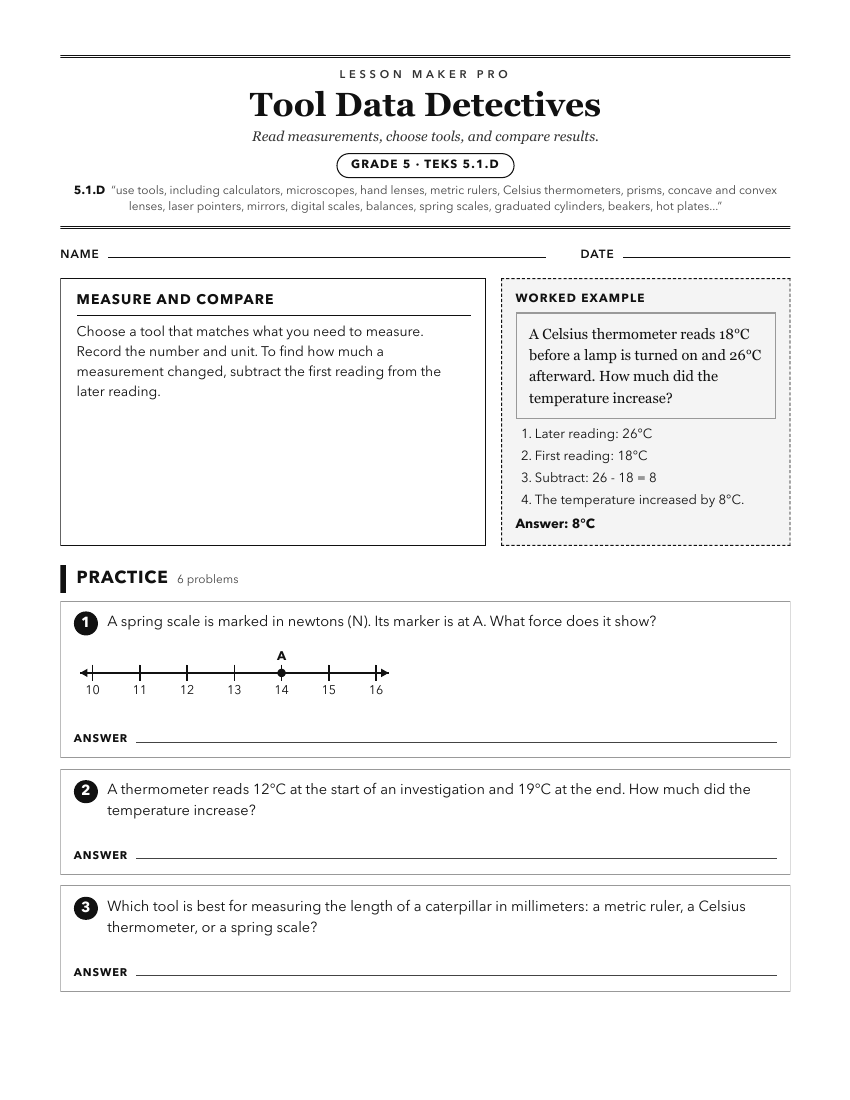
A ready-to-print activity worksheet aligned to 5.1.D, with an answer key for the teacher on its own page. No account needed.
PDF, US Letter, prints cleanly in black and white.
Download the worksheetKeep exploring
Related Standards
- 1.1.D
use tools, including hand lenses, goggles, heat-resistant gloves, trays, cups, bowls, beakers, sieves/sifters, tweezers, primary balance, notebooks, terrariums,...
- 4.1.D
use tools, including hand lenses; metric rulers; Celsius thermometers; calculators; laser pointers; mirrors; digital scales; balances; graduated cylinders; beak...
- K.1.D
use tools, including hand lenses, goggles, trays, cups, bowls, sieves or sifters, notebooks, terrariums, aquariums, samples (rocks, sand, soil, loam, gravel, cl...
- 3.1.D
use tools, including hand lenses; metric rulers; Celsius thermometers; wind vanes; rain gauges; graduated cylinders; beakers; digital scales; hot plates; meter ...
Turn this exact standard into a lesson
Grade, subject, topic, and the complete standard are prefilled. Create one free, no account needed.
Also for this standard:Make a WorksheetMake a QuizMake a Sub Lesson