TEKS Math 5.3
Knowledge and Skills Statement (Standard Cluster)
The student applies mathematical process standards to develop and use strategies and methods for positive rational number computations in order to solve problems with efficiency and accuracy
Texas Essential Knowledge and Skills for Mathematics
Cluster contents
Student Expectations in This Statement
5.3 is a knowledge and skills statement. These are the student expectations under it.
- 5.3.A
estimate to determine solutions to mathematical and real-world problems involving addition, subtraction, multiplication, or division
- 5.3.B
multiply with fluency a three-digit number by a two-digit number using the standard algorithm
- 5.3.C
solve with proficiency for quotients of up to a four-digit dividend by a two-digit divisor using strategies and the standard algorithm
- 5.3.D
represent multiplication of decimals with products to the hundredths using objects and pictorial models, including area models
- 5.3.E
solve for products of decimals to the hundredths, including situations involving money, using strategies based on place-value understandings, properties of oper...
- 5.3.F
represent quotients of decimals to the hundredths, up to four-digit dividends and two-digit whole number divisors, using objects and pictorial models, including...
- 5.3.G
solve for quotients of decimals to the hundredths, up to four-digit dividends and two-digit whole number divisors, using strategies and algorithms, including th...
- 5.3.H
represent and solve addition and subtraction of fractions with unequal denominators referring to the same whole using objects and pictorial models and propertie...
- 5.3.I
represent and solve multiplication of a whole number and a fraction that refers to the same whole using objects and pictorial models, including area models
- 5.3.J
represent division of a unit fraction by a whole number and the division of a whole number by a unit fraction such as 1/3 ÷ 7 and 7 ÷ 1/3 using objects and pict...
- 5.3.K
add and subtract positive rational numbers fluently
- 5.3.L
divide whole numbers by unit fractions and unit fractions by whole numbers
Teacher's field guide
What This Cluster Means
What Students Need to Do
- Students estimate and solve addition, subtraction, multiplication, and division problems with whole numbers, decimals, and fractions. They use objects, drawings, place-value strategies, and standard algorithms, then check that each answer makes sense.
What Mastery Looks Like
- Students choose an efficient strategy, show accurate work, and use estimates to check whether answers are reasonable. They connect models to algorithms for whole numbers, decimals, and fractions, including division with unit fractions.
Common Misconceptions
- Students may align decimal points when multiplying instead of using place value to locate the product. They may add unlike denominators directly, confuse 7 ÷ 1/3 with 1/3 ÷ 7, or ignore remainders and unreasonable answers.
How to Assess It
- Give a four-part exit ticket: estimate 298 × 41, solve 6.4 ÷ 16, find 3/4 + 2/5, and draw a model for 4 ÷ 1/3.
Lesson moves
Ways to Teach It
Use base-ten blocks and fraction strips to model 2.4 × 0.3, 3/4 + 2/3, and 5 ÷ 1/4.
Ask students to explain why 7 ÷ 1/3 is greater than 7, while 1/3 ÷ 7 is less than 1/3.
Play an operation sort where pairs match expression cards, estimate cards, model cards, and exact-answer cards.
Give students a grocery receipt and budget to estimate totals, calculate exact costs, and divide quantities among several people.
Free download
Printable 5.3 Worksheet
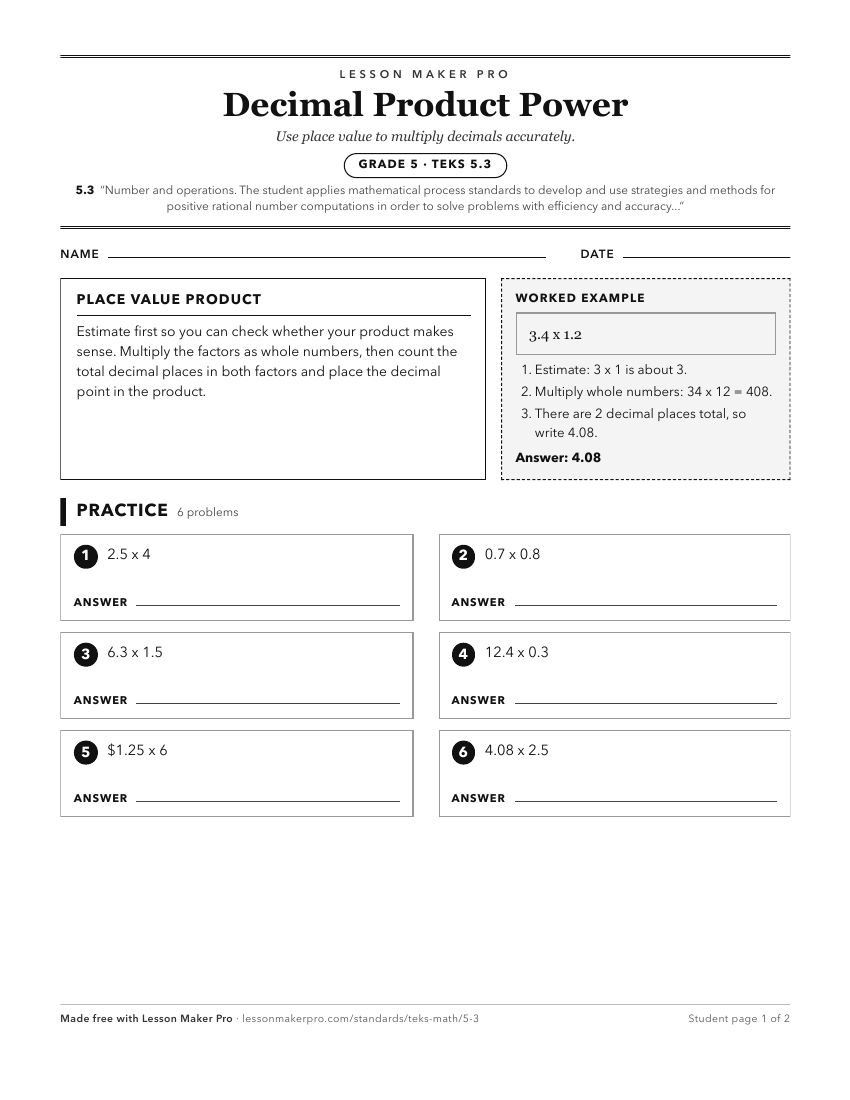
A ready-to-print activity worksheet aligned to 5.3, with an answer key for the teacher on its own page. No account needed.
PDF, US Letter, prints cleanly in black and white.
Download the worksheetKeep exploring
Related Standards
- 5.2
The student applies mathematical process standards to represent, compare, and order positive rational numbers and understand relationships as related to place v...
- 6.2
The student applies mathematical process standards to represent and use rational numbers in a variety of forms
- 4.4
The student applies mathematical process standards to develop and use strategies and methods for whole number computations and decimal sums and differences in o...
- 1.3
The student applies mathematical process standards to develop and use strategies for whole number addition and subtraction computations in order to solve proble...
Turn this cluster into a lesson
Grade, subject, topic, and the complete cluster are prefilled. Create one free, no account needed.
Also for this cluster:Make a WorksheetMake a QuizMake a Sub Lesson