TEKS Math 5.3.E
The Standard
solve for products of decimals to the hundredths, including situations involving money, using strategies based on place-value understandings, properties of operations, and the relationship to the multiplication of whole numbers
Texas Essential Knowledge and Skills for Mathematics
Teacher's field guide
What This Standard Means
What Students Need to Do
- Students multiply decimals when the product extends to the hundredths place. They use place value, operation properties, and related whole-number facts to place the decimal and explain why.
What Mastery Looks Like
- A student can accurately solve problems such as 2.4 × 1.3 and $3.25 × 4. They estimate first, show a valid strategy, and check that the decimal placement is reasonable.
Common Misconceptions
- Students may line up decimal points before multiplying, as they do in addition. They may ignore place value or place the decimal without checking the product’s size. Some read $4.50 as 4 dollars and 5 cents.
How to Assess It
- Exit ticket: Ribbon costs $2.35 per yard. Find the cost of 1.4 yards, show your strategy, and use an estimate to check your answer.
Lesson moves
Ways to Teach It
Overlay two transparent hundred grids to model 0.6 × 0.4, then record the overlap as 24 hundredths.
Write how 24 × 13 helps solve 2.4 × 1.3, including an estimate that supports 3.12.
Deal two decimal cards to each pair; students multiply, estimate, and earn a point when a partner verifies the decimal placement.
Give students a price list and quantities, such as 1.5 pounds at $2.40 per pound, and have them calculate each cost.
Free download
Printable 5.3.E Worksheet
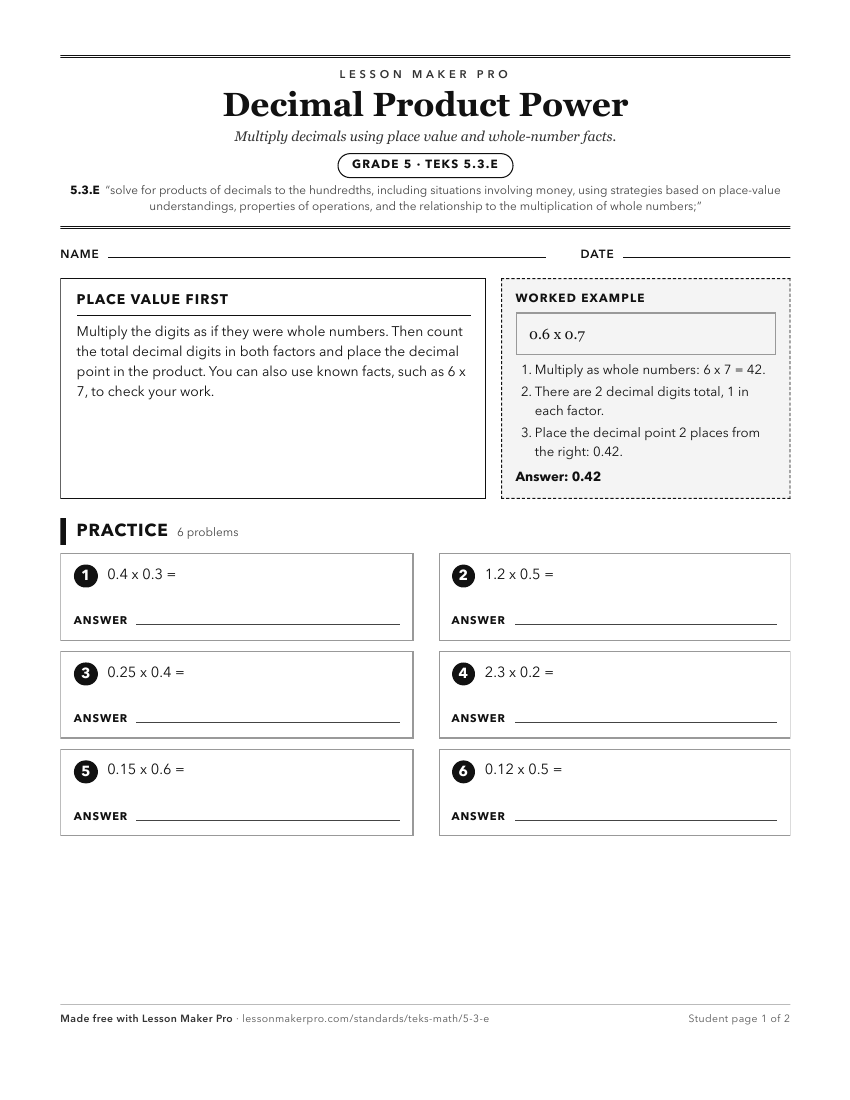
A ready-to-print activity worksheet aligned to 5.3.E, with an answer key for the teacher on its own page. No account needed.
PDF, US Letter, prints cleanly in black and white.
Download the worksheetKeep exploring
Related Standards
- 4.2.E
represent decimals, including tenths and hundredths, using concrete and visual models and money
- 5.3.G
solve for quotients of decimals to the hundredths, up to four-digit dividends and two-digit whole number divisors, using strategies and algorithms, including th...
- 5.3.D
represent multiplication of decimals with products to the hundredths using objects and pictorial models, including area models
- 4.4.B
determine products of a number and 10 or 100 using properties of operations and place value understandings
Turn this exact standard into a lesson
Grade, subject, topic, and the complete standard are prefilled. Create one free, no account needed.
Also for this standard:Make a WorksheetMake a QuizMake a Sub Lesson