TEKS Math 5.3.D
The Standard
represent multiplication of decimals with products to the hundredths using objects and pictorial models, including area models
Texas Essential Knowledge and Skills for Mathematics
Teacher's field guide
What This Standard Means
What Students Need to Do
- Students use hundred grids, base-ten pieces, or rectangles to show what happens when one decimal amount is taken a decimal number of times. They connect the model's side lengths and shaded parts to a product written in hundredths.
What Mastery Looks Like
- A student can model a problem such as 0.4 × 0.6 by shading an overlapping region on a hundred grid. The student labels both factors, counts 24 hundredths, and connects the model to 0.24.
Common Misconceptions
- Students may shade both factors but count every shaded part instead of only the overlap. They may also treat each small square as one tenth rather than one hundredth, or misplace the decimal point.
How to Assess It
- Give students this exit ticket: Draw and label an area model for 0.3 × 0.7, then explain why the product is 0.21.
Lesson moves
Ways to Teach It
Overlay two transparent hundred grids, shading 0.4 vertically and 0.6 horizontally, then count the squares where the shading overlaps.
Ask students to write why 0.3 × 0.8 is smaller than either factor, using an area model as evidence.
Play Model Match with cards showing decimal expressions, shaded hundred grids, and products, with students finding sets of three.
Model a garden measuring 0.8 meter by 0.6 meter, then draw its area and calculate the square meters.
Free download
Printable 5.3.D Worksheet
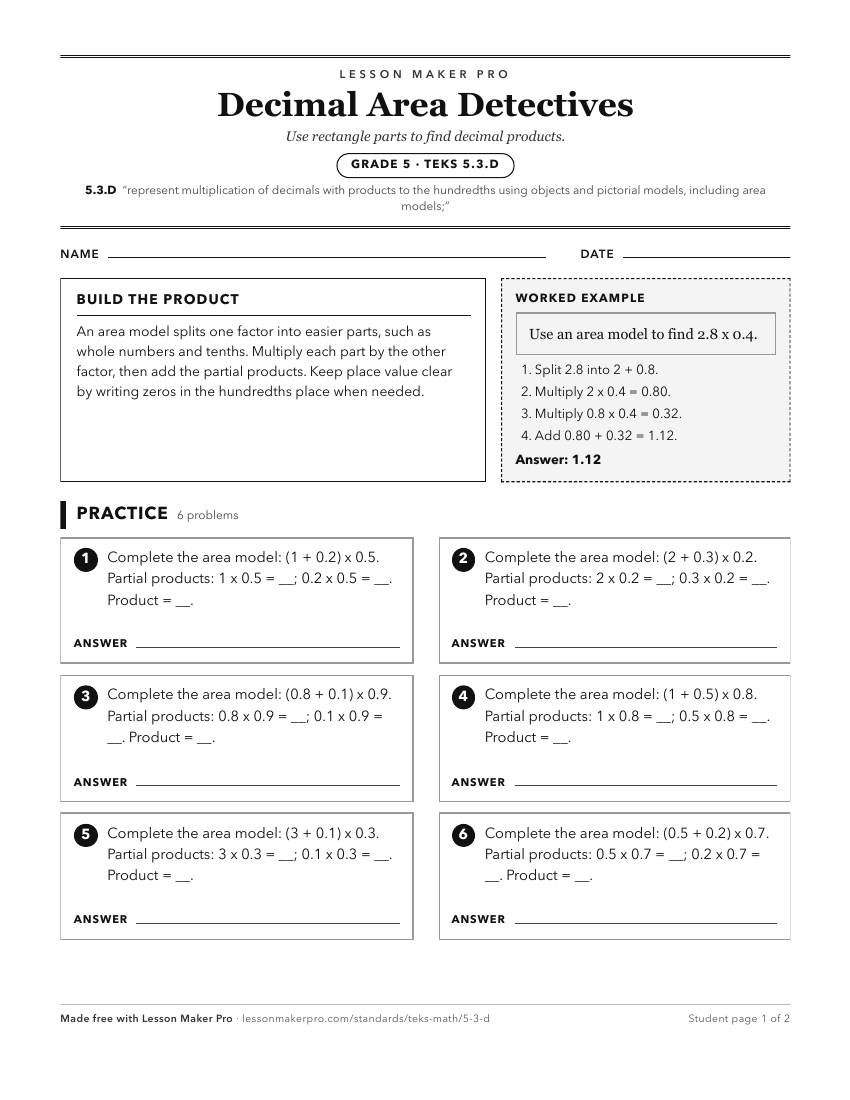
A ready-to-print activity worksheet aligned to 5.3.D, with an answer key for the teacher on its own page. No account needed.
PDF, US Letter, prints cleanly in black and white.
Download the worksheetKeep exploring
Related Standards
- 4.2.E
represent decimals, including tenths and hundredths, using concrete and visual models and money
- 5.3.F
represent quotients of decimals to the hundredths, up to four-digit dividends and two-digit whole number divisors, using objects and pictorial models, including...
- 5.3.I
represent and solve multiplication of a whole number and a fraction that refers to the same whole using objects and pictorial models, including area models
- 5.3.E
solve for products of decimals to the hundredths, including situations involving money, using strategies based on place-value understandings, properties of oper...
Turn this exact standard into a lesson
Grade, subject, topic, and the complete standard are prefilled. Create one free, no account needed.
Also for this standard:Make a WorksheetMake a QuizMake a Sub Lesson