TEKS Math 5.3.F
The Standard
represent quotients of decimals to the hundredths, up to four-digit dividends and two-digit whole number divisors, using objects and pictorial models, including area models
Texas Essential Knowledge and Skills for Mathematics
Teacher's field guide
What This Standard Means
What Students Need to Do
- Students use base-ten blocks, grids, or area models to show decimal division. They divide into equal groups and regroup ones, tenths, and hundredths when needed.
What Mastery Looks Like
- Students can model a problem such as 18.36 ÷ 12 and identify the quotient as 1.53. They label ones, tenths, and hundredths and explain each regrouping step.
Common Misconceptions
- Students may place the decimal point by guessing or divide by the divisor's digits separately. They may also regroup ones as tenths incorrectly or make unequal groups in a model.
How to Assess It
- Ask students to draw an area model for 18.36 ÷ 12, label each part, and write the quotient. Have them verify it with multiplication.
Lesson moves
Ways to Teach It
Build 18.36 with base-ten blocks, share it among 12 groups, and regroup ones and tenths as needed.
Ask students to explain where each digit in 1.53 comes from when modeling 18.36 ÷ 12.
Give pairs matching cards with division expressions, area models, and quotients, then have them justify each completed set.
Share $18.36 equally among 12 students, using play money or drawings to find each student's amount.
Free download
Printable 5.3.F Worksheet
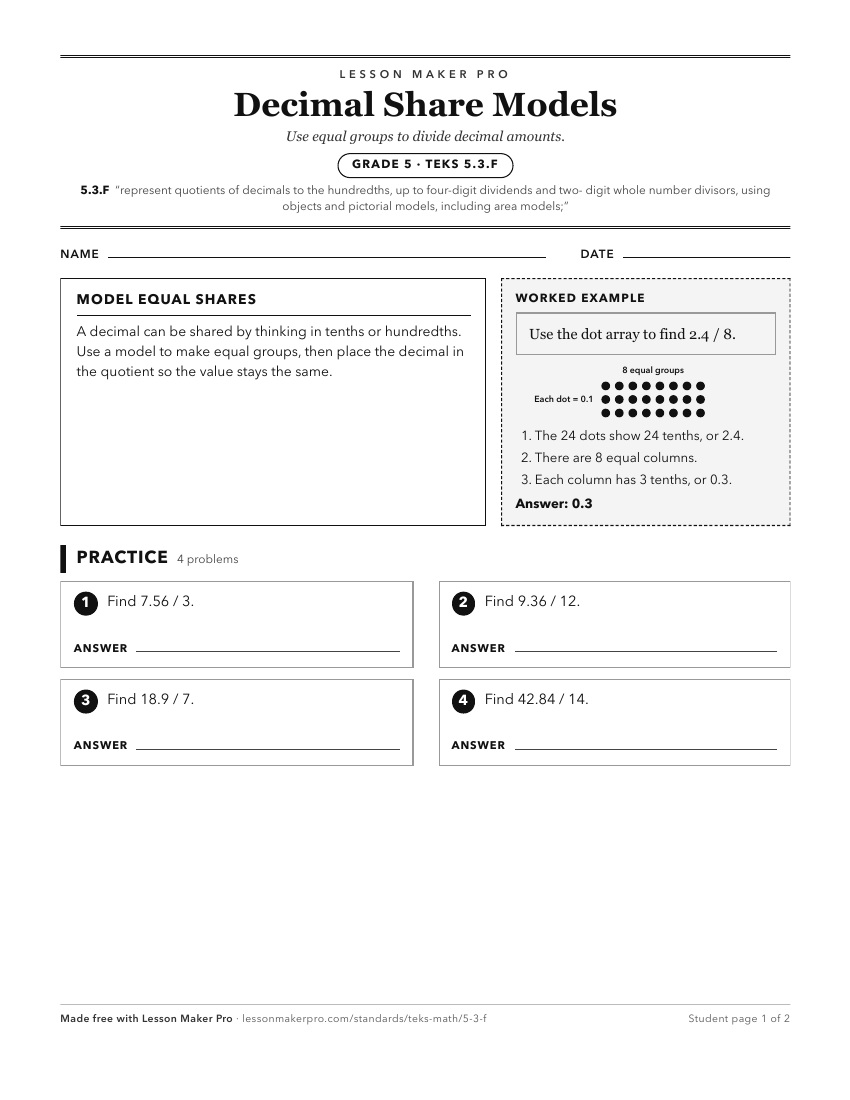
A ready-to-print activity worksheet aligned to 5.3.F, with an answer key for the teacher on its own page. No account needed.
PDF, US Letter, prints cleanly in black and white.
Download the worksheetKeep exploring
Related Standards
- 5.3.J
represent division of a unit fraction by a whole number and the division of a whole number by a unit fraction such as 1/3 ÷ 7 and 7 ÷ 1/3 using objects and pict...
- 5.3.G
solve for quotients of decimals to the hundredths, up to four-digit dividends and two-digit whole number divisors, using strategies and algorithms, including th...
- 5.3.D
represent multiplication of decimals with products to the hundredths using objects and pictorial models, including area models
- 4.4.E
represent the quotient of up to a four-digit whole number divided by a one-digit whole number using arrays, area models, or equations
Turn this exact standard into a lesson
Grade, subject, topic, and the complete standard are prefilled. Create one free, no account needed.
Also for this standard:Make a WorksheetMake a QuizMake a Sub Lesson