TEKS Math 5.3.J
The Standard
represent division of a unit fraction by a whole number and the division of a whole number by a unit fraction such as 1/3 ÷ 7 and 7 ÷ 1/3 using objects and pictorial models, including area models
Texas Essential Knowledge and Skills for Mathematics
Teacher's field guide
What This Standard Means
What Students Need to Do
- Students show two division situations with fraction strips, counters, or area drawings. They split one fractional piece into equal shares, and they count how many unit fractions fit inside a whole number.
What Mastery Looks Like
- A student can show that splitting 1/3 into seven equal parts makes pieces of size 1/21. The student can also show that seven wholes contain twenty-one groups of 1/3.
Common Misconceptions
- Students may assume division always makes a number smaller. They may reverse the two numbers, or claim that 1/3 ÷ 7 equals 7/3 instead of 1/21.
How to Assess It
- Ask students to solve 1/4 ÷ 3 and 3 ÷ 1/4. Require a labeled area model and one sentence explaining each quotient.
Lesson moves
Ways to Teach It
Fold a paper strip into fourths, shade one fourth, then split the shaded section into three equal parts to model 1/4 ÷ 3.
Compare 1/5 ÷ 2 and 2 ÷ 1/5, then explain why one quotient is less than one and the other is greater.
Match equation cards with area model cards and quotient cards, then check each match with a partner.
A four-yard ribbon is cut into 1/3-yard pieces. Draw a model and find how many pieces can be cut.
Free download
Printable 5.3.J Worksheet
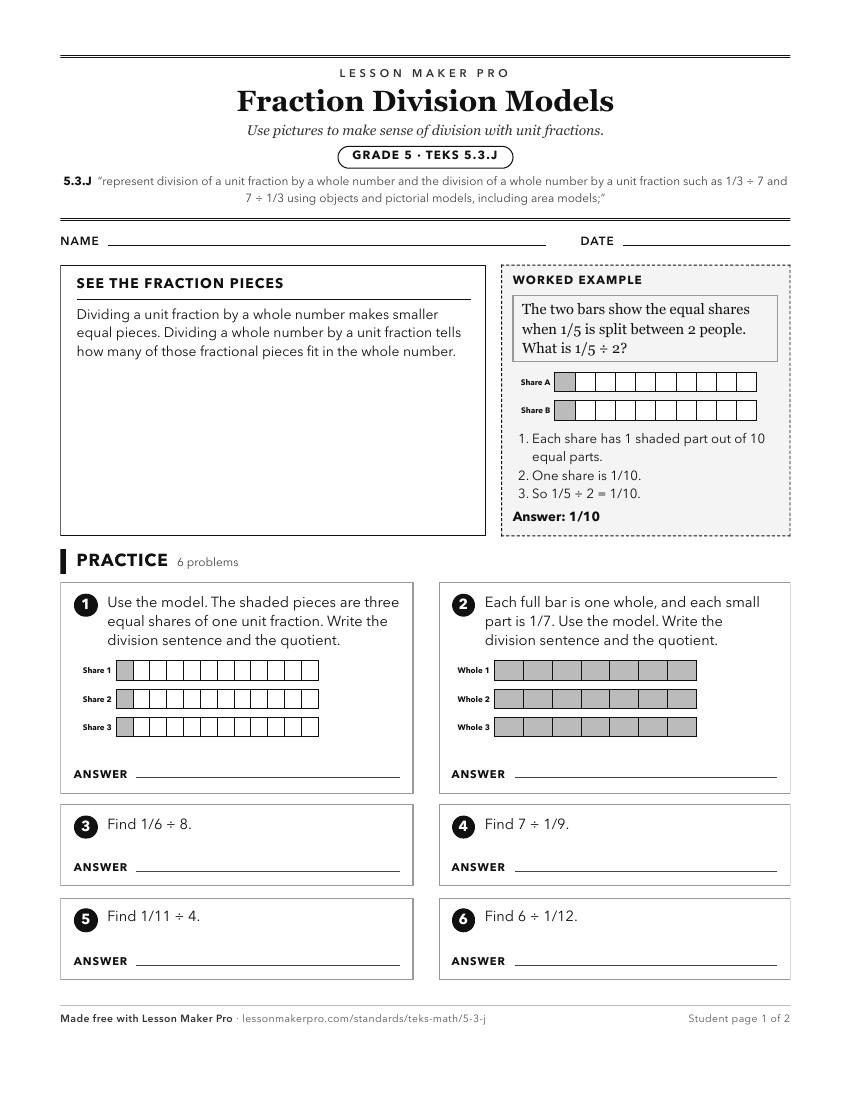
A ready-to-print activity worksheet aligned to 5.3.J, with an answer key for the teacher on its own page. No account needed.
PDF, US Letter, prints cleanly in black and white.
Download the worksheetKeep exploring
Related Standards
- 3.3.F
represent equivalent fractions with denominators of 2, 3, 4, 6, and 8 using a variety of objects and pictorial models, including number lines
- 5.3.L
divide whole numbers by unit fractions and unit fractions by whole numbers
- 5.3.F
represent quotients of decimals to the hundredths, up to four-digit dividends and two-digit whole number divisors, using objects and pictorial models, including...
- 5.3.I
represent and solve multiplication of a whole number and a fraction that refers to the same whole using objects and pictorial models, including area models
Turn this exact standard into a lesson
Grade, subject, topic, and the complete standard are prefilled. Create one free, no account needed.
Also for this standard:Make a WorksheetMake a QuizMake a Sub Lesson