TEKS Math 4.2.E
The Standard
represent decimals, including tenths and hundredths, using concrete and visual models and money
Texas Essential Knowledge and Skills for Mathematics
Teacher's field guide
What This Standard Means
What Students Need to Do
- Students connect decimal numbers to shaded grids, base-ten blocks, and coin amounts. They show how each digit represents tenths or hundredths of one whole.
What Mastery Looks Like
- A student can shade 37 squares on a hundred grid for 0.37 and show the same amount as 37 cents. The student explains that 3 tenths equal 30 hundredths.
Common Misconceptions
- Students may think 0.25 is greater than 0.5 because 25 is greater than 5. They may read 0.5 as five cents or change the value when adding a zero, as in 0.50.
How to Assess It
- Give students 0.46. Ask them to shade a hundred grid, show the value with coins, and label the tenths and hundredths.
Lesson moves
Ways to Teach It
Use base-ten blocks with a flat as one whole, then have students build decimals drawn from number cards.
Ask students to draw models for 0.4 and 0.40, then write why the values are equal.
Play a matching game using decimal cards, shaded grids, base-ten block pictures, and money amounts.
Give students store prices under one dollar and have them show each price with coins and a hundred grid.
Free download
Printable 4.2.E Worksheet
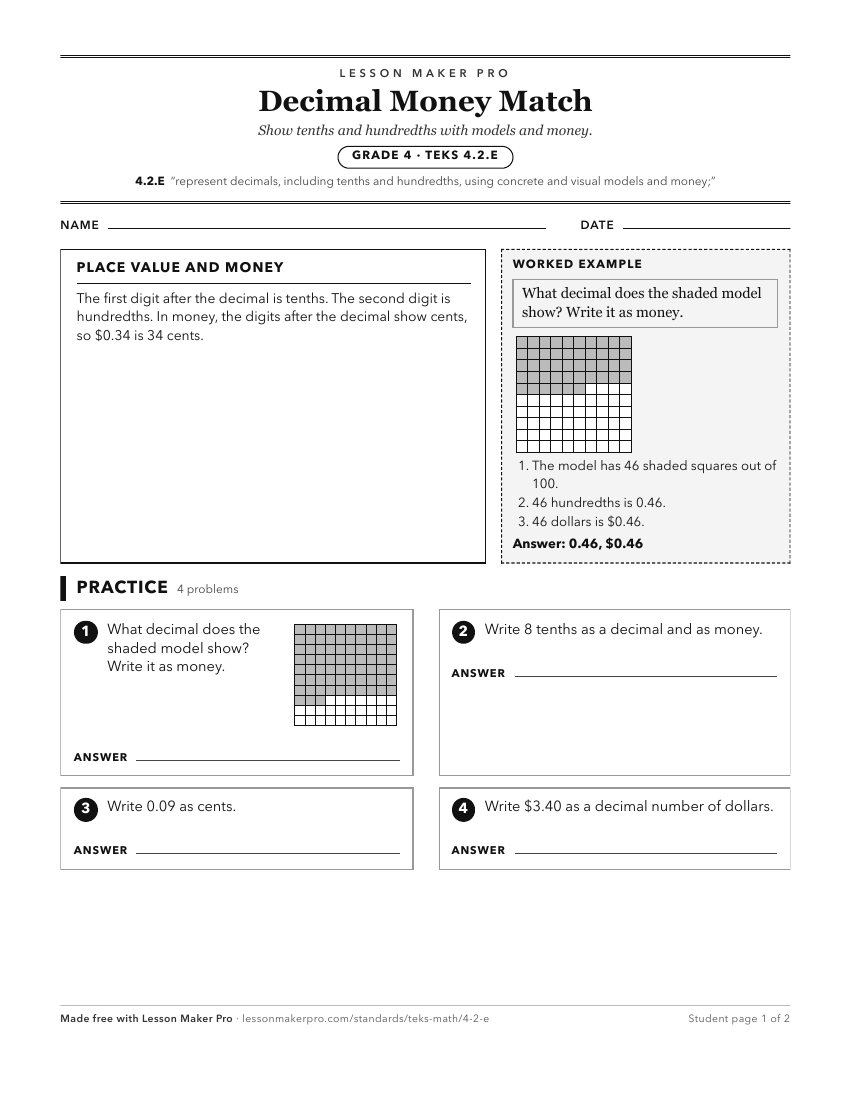
A ready-to-print activity worksheet aligned to 4.2.E, with an answer key for the teacher on its own page. No account needed.
PDF, US Letter, prints cleanly in black and white.
Download the worksheetKeep exploring
Related Standards
- 6.4.E
represent ratios and percents with concrete models, fractions, and decimals
- 5.3.F
represent quotients of decimals to the hundredths, up to four-digit dividends and two-digit whole number divisors, using objects and pictorial models, including...
- 4.2.F
compare and order decimals using concrete and visual models to the hundredths
- 5.3.D
represent multiplication of decimals with products to the hundredths using objects and pictorial models, including area models
Turn this exact standard into a lesson
Grade, subject, topic, and the complete standard are prefilled. Create one free, no account needed.
Also for this standard:Make a WorksheetMake a QuizMake a Sub Lesson