TEKS Math 4.4.B
The Standard
determine products of a number and 10 or 100 using properties of operations and place value understandings
Texas Essential Knowledge and Skills for Mathematics
Teacher's field guide
What This Standard Means
What Students Need to Do
- Students multiply whole numbers by 10 and 100 by reasoning about place value. They explain how each digit’s value changes and record the resulting product.
What Mastery Looks Like
- A student quickly finds products such as 47 × 10 = 470 and 306 × 100 = 30,600. They justify each answer with place value or an equation, not only an “add zeros” rule.
Common Misconceptions
- Students may add 10 or 100 instead of multiplying, or use one place-value shift for both multipliers. Some drop an internal zero, writing 205 × 100 as 2,500, because they follow an “add zeros” shortcut without checking digit values.
How to Assess It
- Exit ticket: Solve 64 × 10 and 205 × 100. Use a place-value chart or two sentences to explain what happened to each digit’s value.
Lesson moves
Ways to Teach It
Build 34 on a place-value mat with digit cards, then move each card one or two columns left to compare ×10 and ×100.
Ask, “Why does 46 × 100 equal 4,600?” and require students to explain the changed value of 4 and 6.
Play Product Match with cards showing expressions, products, and place-value explanations; students collect a set only when all three match.
Use a school supply order: find total costs for 10 or 100 packs when one pack costs $7, $24, or $105.
Free download
Printable 4.4.B Worksheet
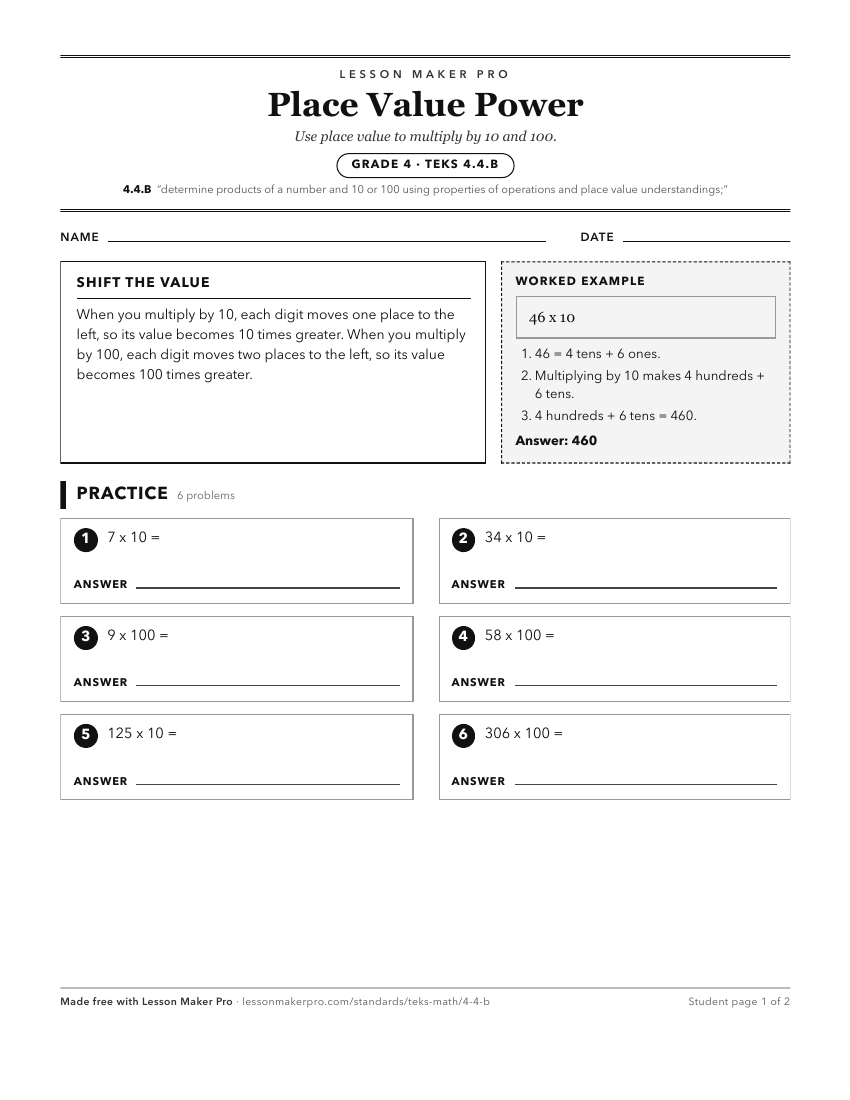
A ready-to-print activity worksheet aligned to 4.4.B, with an answer key for the teacher on its own page. No account needed.
PDF, US Letter, prints cleanly in black and white.
Download the worksheetKeep exploring
Related Standards
- 3.4.K
solve one-step and two-step problems involving multiplication and division within 100 using strategies based on objects; pictorial models, including arrays, are...
- 2.7.B
use an understanding of place value to determine the number that is 10 or 100 more or less than a given number up to 1,200
- 5.3.E
solve for products of decimals to the hundredths, including situations involving money, using strategies based on place-value understandings, properties of oper...
- 4.2
The student applies mathematical process standards to represent, compare, and order whole numbers and decimals and understand relationships related to place val...
Turn this exact standard into a lesson
Grade, subject, topic, and the complete standard are prefilled. Create one free, no account needed.
Also for this standard:Make a WorksheetMake a QuizMake a Sub Lesson