TEKS Math 3.4.K
The Standard
solve one-step and two-step problems involving multiplication and division within 100 using strategies based on objects; pictorial models, including arrays, area models, and equal groups; properties of operations; or recall of facts
Texas Essential Knowledge and Skills for Mathematics
Teacher's field guide
What This Standard Means
What Students Need to Do
- Students decide whether a situation calls for multiplication, division, or both. They represent the quantities with counters, drawings, arrays, area models, or equations, then find and check the answer.
What Mastery Looks Like
- A student can solve story problems with one or two operations when all quantities stay within 100. The student labels the answer, explains each step, and checks division with related multiplication.
Common Misconceptions
- Students may multiply every pair of numbers without using the story context. They may reverse a division equation, stop after the first step, or combine quantities in the wrong order.
How to Assess It
- Exit ticket: "There are 4 boxes with 6 pencils in each box. The pencils are shared equally among 8 students. How many pencils does each student get?" Ask students to show a model and two equations.
Lesson moves
Ways to Teach It
Give pairs 24 counters and cups; have them build 4 groups of 6, then redistribute the counters equally among 8 cups.
Ask students to explain how 7 × 8 = 56 and 56 ÷ 7 = 8 describe the same array.
Play Model Match with cards showing stories, equations, and arrays; students collect a set only when all three representations agree.
Have students plan snack bags for 6 tables, using 48 crackers to find equal shares and writing the matching equation.
Free download
Printable 3.4.K Worksheet
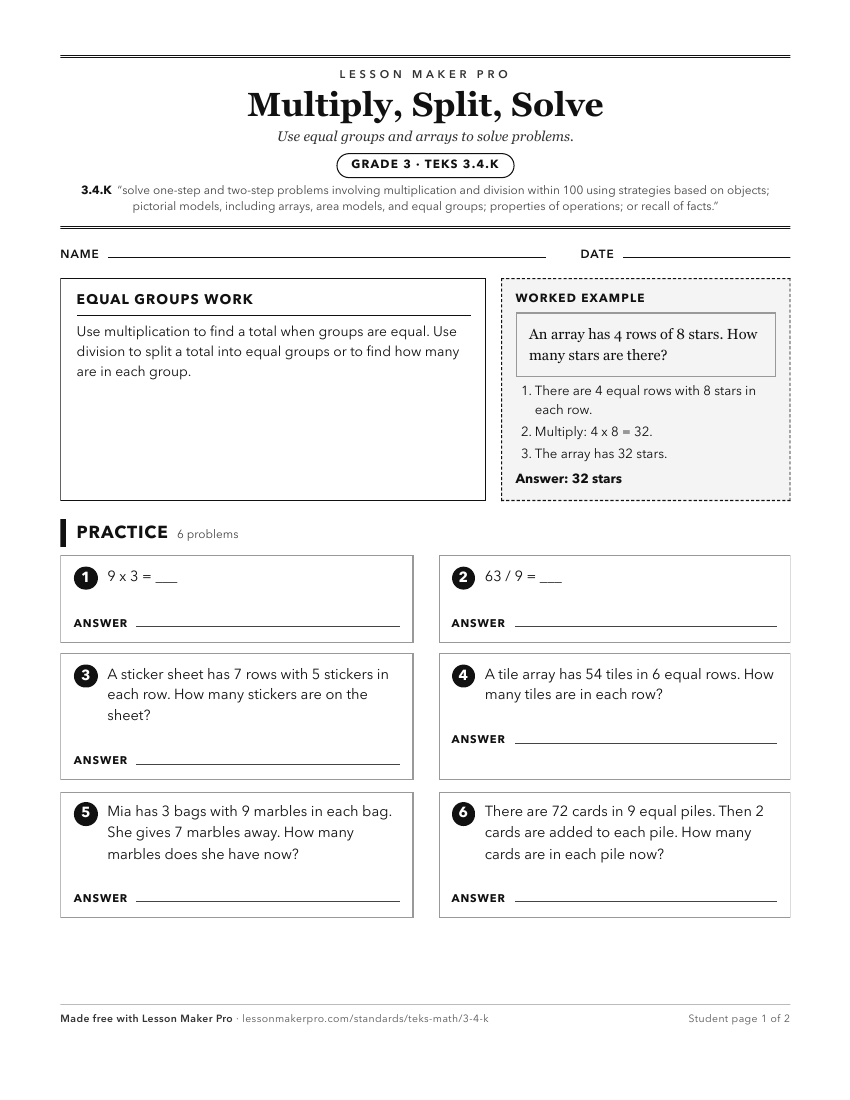
A ready-to-print activity worksheet aligned to 3.4.K, with an answer key for the teacher on its own page. No account needed.
PDF, US Letter, prints cleanly in black and white.
Download the worksheetKeep exploring
Related Standards
- 3.4.E
represent multiplication facts by using a variety of approaches such as repeated addition, equal-sized groups, arrays, area models, equal jumps on a number line...
- 3.5.B
represent and solve one- and two-step multiplication and division problems within 100 using arrays, strip diagrams, and equations
- 3.5.A
represent one- and two-step problems involving addition and subtraction of whole numbers to 1,000 using pictorial models, number lines, and equations
- 5.3.I
represent and solve multiplication of a whole number and a fraction that refers to the same whole using objects and pictorial models, including area models
Turn this exact standard into a lesson
Grade, subject, topic, and the complete standard are prefilled. Create one free, no account needed.
Also for this standard:Make a WorksheetMake a QuizMake a Sub Lesson