TEKS Math 3.5.A
The Standard
represent one- and two-step problems involving addition and subtraction of whole numbers to 1,000 using pictorial models, number lines, and equations
Texas Essential Knowledge and Skills for Mathematics
Teacher's field guide
What This Standard Means
What Students Need to Do
- Students read one-step and two-step story problems and decide which quantities are being joined, separated, or compared. They represent the relationships with drawings, number lines, and equations, using numbers through 1,000.
What Mastery Looks Like
- Students choose addition or subtraction based on the quantities and identify what each step finds. Their pictorial model, number line, and equation show the same relationships and lead to a reasonable answer.
Common Misconceptions
- Students may combine every number using one operation or rely on keywords instead of the situation. They may reverse subtraction, skip the first result in a two-step problem, or write an equation that does not match their model.
How to Assess It
- Use this exit ticket: A library had 368 books, received 145 more, then lent out 92. Show the situation with a strip diagram, number line, and equation.
Lesson moves
Ways to Teach It
Give pairs base-ten blocks and a two-step story card, then have them build each step and sketch what they built.
Have students explain in writing how a number line jump matches one part of a two-step story problem.
Play Model Match by having students pair story cards with the correct strip diagrams, number lines, and equations.
Use a classroom supply order and budget to model items added, items used, and the amount remaining.
Free download
Printable 3.5.A Worksheet
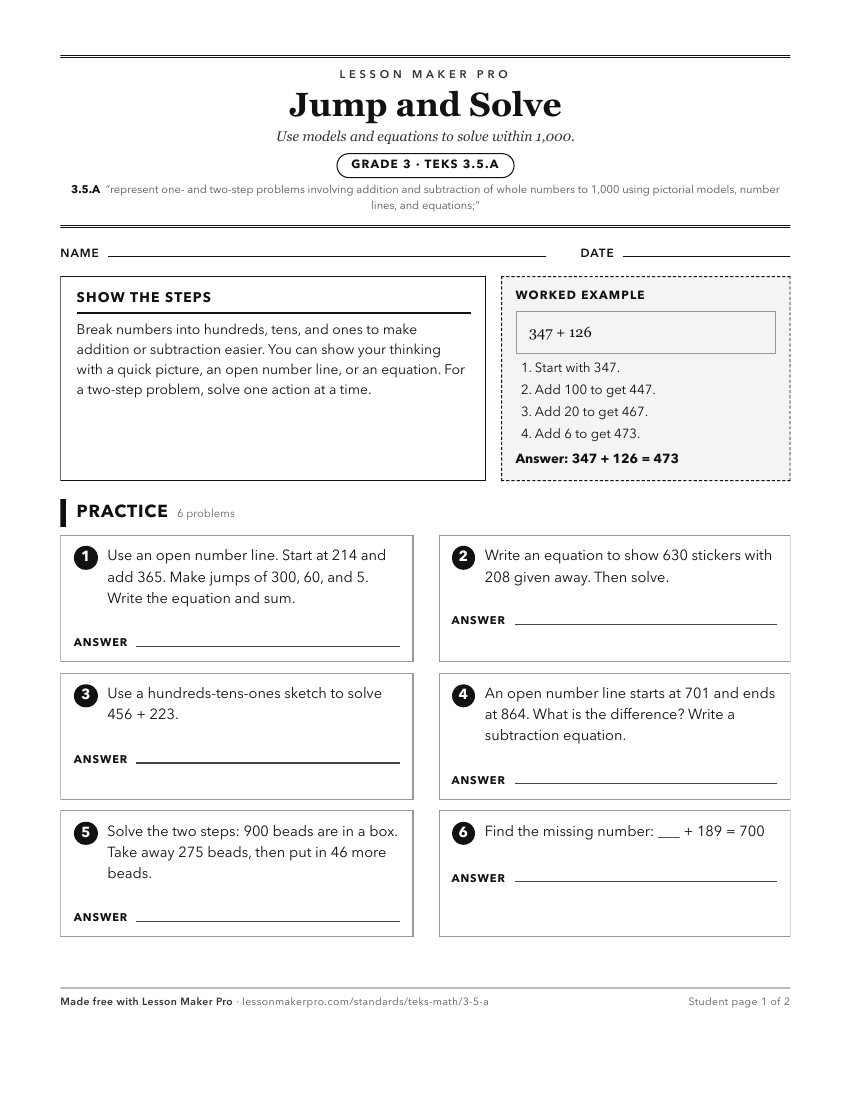
A ready-to-print activity worksheet aligned to 3.5.A, with an answer key for the teacher on its own page. No account needed.
PDF, US Letter, prints cleanly in black and white.
Download the worksheetKeep exploring
Related Standards
- 4.3.E
represent and solve addition and subtraction of fractions with equal denominators using objects and pictorial models that build to the number line and propertie...
- 3.4.A
solve with fluency one-step and two-step problems involving addition and subtraction within 1,000 using strategies based on place value, properties of operation...
- 1.5.D
represent word problems involving addition and subtraction of whole numbers up to 20 using concrete and pictorial models and number sentences
- 2.4.C
solve one-step and multi-step word problems involving addition and subtraction within 1,000 using a variety of strategies based on place value, including algori...
Turn this exact standard into a lesson
Grade, subject, topic, and the complete standard are prefilled. Create one free, no account needed.
Also for this standard:Make a WorksheetMake a QuizMake a Sub Lesson