TEKS Math 3.4.E
The Standard
represent multiplication facts by using a variety of approaches such as repeated addition, equal-sized groups, arrays, area models, equal jumps on a number line, and skip counting
Texas Essential Knowledge and Skills for Mathematics
Teacher's field guide
What This Standard Means
What Students Need to Do
- Students show the same multiplication fact with objects, drawings, equations, and number lines. They explain how the factors match the number of groups and the amount in each group.
What Mastery Looks Like
- A student can represent a fact such as 4 × 6 in at least three ways and label each model correctly. The student can explain how each model shows the same product.
Common Misconceptions
- Students may confuse the number of groups with the number in each group. They may make unequal groups, count number line marks instead of jumps, or miscount array rows and columns.
How to Assess It
- Exit ticket: Show 5 × 4 with an array, repeated addition, and equal jumps on a number line. Label the factors and product.
Lesson moves
Ways to Teach It
Give pairs 24 counters and cups, then have them build and record every equal-group arrangement they can make.
Ask students to draw 3 × 5 and 5 × 3, then write how the models are alike and different.
Play a matching game with cards showing equations, arrays, repeated addition, skip-counting sequences, and number lines.
Have students arrange 20 classroom chairs in equal rows, then draw the arrangement and write its multiplication fact.
Free download
Printable 3.4.E Worksheet
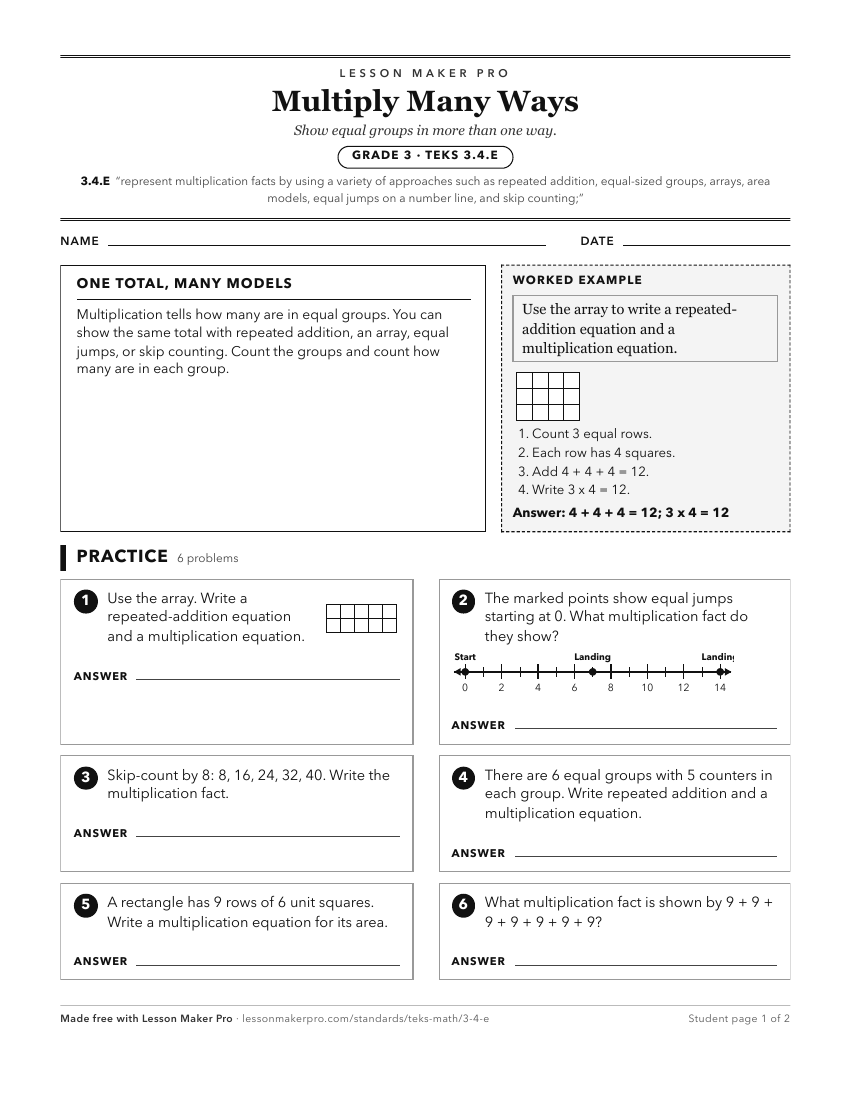
A ready-to-print activity worksheet aligned to 3.4.E, with an answer key for the teacher on its own page. No account needed.
PDF, US Letter, prints cleanly in black and white.
Download the worksheetKeep exploring
Related Standards
- 3.4.K
solve one-step and two-step problems involving multiplication and division within 100 using strategies based on objects; pictorial models, including arrays, are...
- 4.3.E
represent and solve addition and subtraction of fractions with equal denominators using objects and pictorial models that build to the number line and propertie...
- 5.3.I
represent and solve multiplication of a whole number and a fraction that refers to the same whole using objects and pictorial models, including area models
- 5.3.D
represent multiplication of decimals with products to the hundredths using objects and pictorial models, including area models
Turn this exact standard into a lesson
Grade, subject, topic, and the complete standard are prefilled. Create one free, no account needed.
Also for this standard:Make a WorksheetMake a QuizMake a Sub Lesson