TEKS Math 2.7.B
The Standard
use an understanding of place value to determine the number that is 10 or 100 more or less than a given number up to 1,200
Texas Essential Knowledge and Skills for Mathematics
Teacher's field guide
What This Standard Means
What Students Need to Do
- Students use place value to change a number by one ten or one hundred. They track how the tens, hundreds, or thousands places change when crossing a place-value boundary.
What Mastery Looks Like
- Students answer accurately, including when a change crosses into a new hundred or thousand. They can explain which place changed and why the other places stayed the same.
Common Misconceptions
- Students may change the wrong digit or change every digit. They may also reverse more and less or miss place-value changes across boundaries, such as finding 10 more than 396.
How to Assess It
- Give this exit ticket: “Start with 398. Write the numbers that are 10 more, 10 less, 100 more, and 100 less. Explain one answer.”
Lesson moves
Ways to Teach It
Build 486 with base-ten blocks, add or remove one ten or hundred, then record each new number.
Ask students to explain why 10 more than 795 is 805 instead of 705.
Play a card game where students draw a number, spin 10 or 100 more or less, and state the result.
Use a library count of 735 books, then find the new totals after receiving 100 books or removing 10 books.
Free download
Printable 2.7.B Worksheet
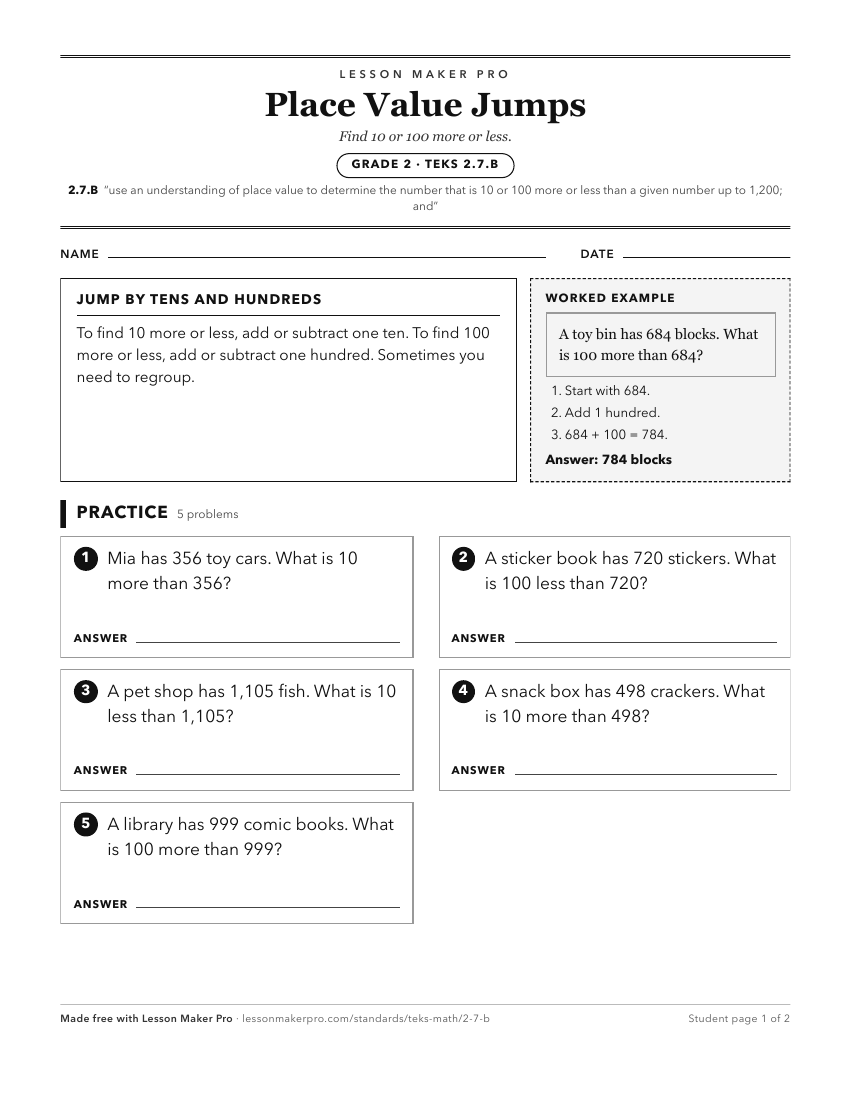
A ready-to-print activity worksheet aligned to 2.7.B, with an answer key for the teacher on its own page. No account needed.
PDF, US Letter, prints cleanly in black and white.
Download the worksheetKeep exploring
Related Standards
- 1.5.C
use relationships to determine the number that is 10 more and 10 less than a given number up to 120
- 4.4.B
determine products of a number and 10 or 100 using properties of operations and place value understandings
- 2.2.D
use place value to compare and order whole numbers up to 1,200 using comparative language, numbers, and symbols (>, <, or =)
- 1.2.E
use place value to compare whole numbers up to 120 using comparative language
Turn this exact standard into a lesson
Grade, subject, topic, and the complete standard are prefilled. Create one free, no account needed.
Also for this standard:Make a WorksheetMake a QuizMake a Sub Lesson