TEKS Math 1.2.E
The Standard
use place value to compare whole numbers up to 120 using comparative language
Texas Essential Knowledge and Skills for Mathematics
Teacher's field guide
What This Standard Means
What Students Need to Do
- Students decide which of two numbers represents more, less, or the same amount. They use the hundreds, tens, and ones to explain their comparison.
What Mastery Looks Like
- A student correctly compares two numbers and states the relationship using greater than, less than, or equal to. The student explains the choice by comparing hundreds, tens, then ones.
Common Misconceptions
- Students may compare only the ones digits, claiming 47 is greater than 52 because 7 is greater than 2. They may also confuse the phrases greater than and less than, especially when numbers are close.
How to Assess It
- Exit ticket: Complete with greater than, less than, or equal to: 68 ___ 86, 107 ___ 112, and 95 ___ 95. Explain one answer using place value.
Lesson moves
Ways to Teach It
Give pairs base-ten blocks and number cards, then have students build each number and say which number is greater or less.
Ask: Which is greater, 79 or 97, and how do the tens digits prove your answer?
Play Number War with cards from 0 to 120, awarding each pair only after the winner states a correct comparison sentence.
Compare two classroom supply counts, such as 84 crayons and 48 pencils, then write a sentence describing which amount is greater.
Free download
Printable 1.2.E Worksheet
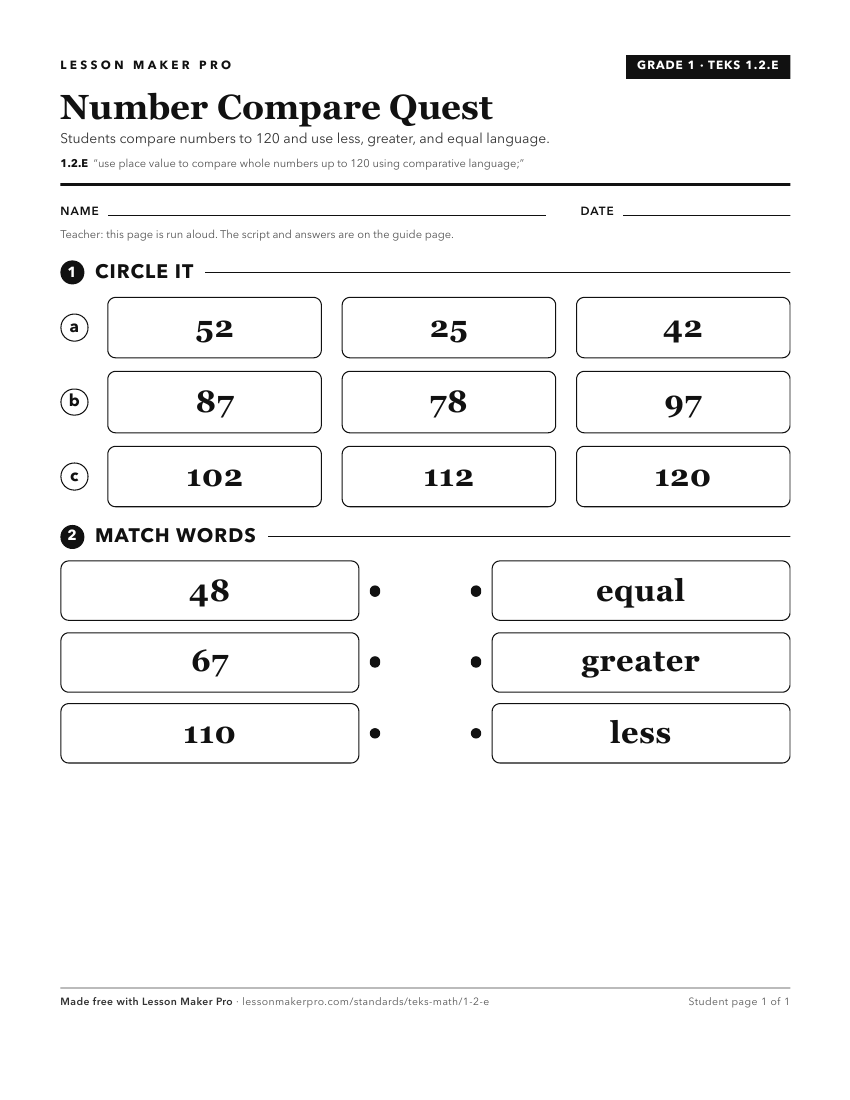
A ready-to-print activity worksheet aligned to 1.2.E, with an answer key for the teacher on its own page. No account needed.
PDF, US Letter, prints cleanly in black and white.
Download the worksheetKeep exploring
Related Standards
- 3.2.D
compare and order whole numbers up to 100,000 and represent comparisons using the symbols >, <, or =
- K.2.H
use comparative language to describe two numbers up to 20 presented as written numerals
- 2.2.D
use place value to compare and order whole numbers up to 1,200 using comparative language, numbers, and symbols (>, <, or =)
- 1.2.F
order whole numbers up to 120 using place value and open number lines
Turn this exact standard into a lesson
Grade, subject, topic, and the complete standard are prefilled. Create one free, no account needed.
Also for this standard:Make a WorksheetMake a QuizMake a Sub Lesson