TEKS Math 4.2
Knowledge and Skills Statement (Standard Cluster)
The student applies mathematical process standards to represent, compare, and order whole numbers and decimals and understand relationships related to place value
Texas Essential Knowledge and Skills for Mathematics
Cluster contents
Student Expectations in This Statement
4.2 is a knowledge and skills statement. These are the student expectations under it.
- 4.2.A
interpret the value of each place-value position as 10 times the position to the right and as one-tenth of the value of the place to its left
- 4.2.B
represent the value of the digit in whole numbers through 1,000,000,000 and decimals to the hundredths using expanded notation and numerals
- 4.2.C
compare and order whole numbers to 1,000,000,000 and represent comparisons using the symbols >, <, or =
- 4.2.D
round whole numbers to a given place value through the hundred thousands place
- 4.2.E
represent decimals, including tenths and hundredths, using concrete and visual models and money
- 4.2.F
compare and order decimals using concrete and visual models to the hundredths
- 4.2.G
relate decimals to fractions that name tenths and hundredths
- 4.2.H
determine the corresponding decimal to the tenths or hundredths place of a specified point on a number line
Teacher's field guide
What This Cluster Means
What Students Need to Do
- Students read, write, expand, compare, order, and round whole numbers through one billion. They model tenths and hundredths with grids, money, and number lines. They connect decimals to fractions and explain how values change by a factor of 10 between places.
What Mastery Looks Like
- Given whole numbers through one billion, a student writes, compares, orders, and rounds them accurately. Given decimals to hundredths, the student models, compares, and locates them. The student matches decimals with fractions and explains place relationships using factors of 10.
Common Misconceptions
- Students may claim 0.8 is less than 0.35 because 8 is less than 35. They often confuse a digit with its value or misalign places in expanded notation. When rounding, they may check the wrong neighboring digit or change digits left of the rounding place.
How to Assess It
- Give an exit ticket with 406,072,519 and 0.47. Ask students to expand and round the whole number, write 0.47 as a fraction, compare it with 0.5, and plot it on a number line.
Lesson moves
Ways to Teach It
Build 3.46 with a ones mat, tenths strips, and hundredths squares, then trade pieces to show the factor of 10 between places.
Ask, “Which is greater, 0.6 or 0.56?” Students choose a model, defend their answer, and respond to a partner’s reasoning.
Play place-value draw: teams draw digit cards, build the greatest possible number, compare results, then round to a called place.
Give students store prices to order, compare, and represent as dollars, cents, decimals, and fractions of a dollar.
Free download
Printable 4.2 Worksheet
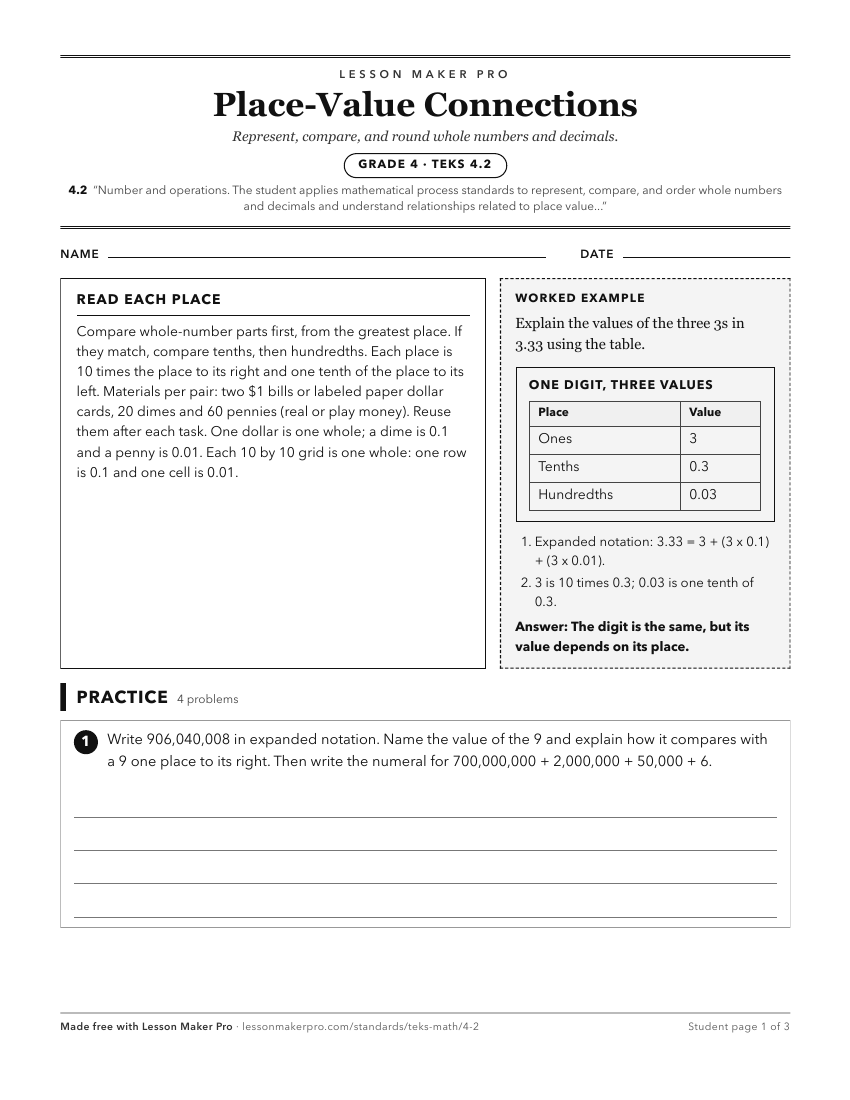
A ready-to-print activity worksheet aligned to 4.2, with an answer key for the teacher on its own page. No account needed.
PDF, US Letter, prints cleanly in black and white.
Download the worksheetKeep exploring
Related Standards
- 5.2
The student applies mathematical process standards to represent, compare, and order positive rational numbers and understand relationships as related to place v...
- K.2
The student applies mathematical process standards to understand how to represent and compare whole numbers, the relative position and magnitude of whole number...
- 4.4
The student applies mathematical process standards to develop and use strategies and methods for whole number computations and decimal sums and differences in o...
- 1.2
The student applies mathematical process standards to represent and compare whole numbers, the relative position and magnitude of whole numbers, and relationsh...
Turn this cluster into a lesson
Grade, subject, topic, and the complete cluster are prefilled. Create one free, no account needed.
Also for this cluster:Make a WorksheetMake a QuizMake a Sub Lesson