TEKS Math K.2
Knowledge and Skills Statement (Standard Cluster)
The student applies mathematical process standards to understand how to represent and compare whole numbers, the relative position and magnitude of whole numbers, and relationships within the numeration system
Texas Essential Knowledge and Skills for Mathematics
Cluster contents
Student Expectations in This Statement
K.2 is a knowledge and skills statement. These are the student expectations under it.
- K.2.A
count forward and backward to at least 20 with and without objects
- K.2.B
read, write, and represent whole numbers from 0 to at least 20 with and without objects or pictures
- K.2.C
count a set of objects up to at least 20 and demonstrate that the last number said tells the number of objects in the set regardless of their arrangement or ord...
- K.2.D
recognize instantly the quantity of a small group of objects in organized and random arrangements
- K.2.E
generate a set using concrete and pictorial models that represents a number that is more than, less than, and equal to a given number up to 20
- K.2.F
generate a number that is one more than or one less than another number up to at least 20
- K.2.G
compare sets of objects up to at least 20 in each set using comparative language
- K.2.H
use comparative language to describe two numbers up to 20 presented as written numerals
- K.2.I
compose and decompose numbers up to 10 with objects and pictures
Teacher's field guide
What This Cluster Means
What Students Need to Do
- Students count, read, write, and model numbers from 0 to 20. They compare quantities and numerals, find one more or one less, and recognize small groups without counting. They also break numbers through 10 into smaller parts and put the parts back together.
What Mastery Looks Like
- Students count forward and backward to 20 and match numerals to quantities. They compare two sets or numerals using more, less, and equal. They can quickly name small quantities and show different ways to make numbers through 10.
Common Misconceptions
- Students may skip numbers, reverse numerals, or count an object more than once. They may think a spread-out set has more objects than a close group. Some confuse one more with one less or cannot see that 7 can be split into 5 and 2.
How to Assess It
- Give each student a numeral card and counters. Ask them to build the number, name one more and one less, compare it with another set, and split it into two parts.
Lesson moves
Ways to Teach It
Give students 20 counters and numeral cards, then have them build, rearrange, recount, compare, and split each quantity.
Show two dot cards and ask, “Which has more, how do you know, and would rearranging the dots change the amount?”
Play Number Neighbor Bingo, calling a number while students cover the numeral that is one more or one less.
Set up a snack table where students count crackers, compare portions, and divide quantities through 10 between two plates.
Free download
Printable K.2 Worksheet
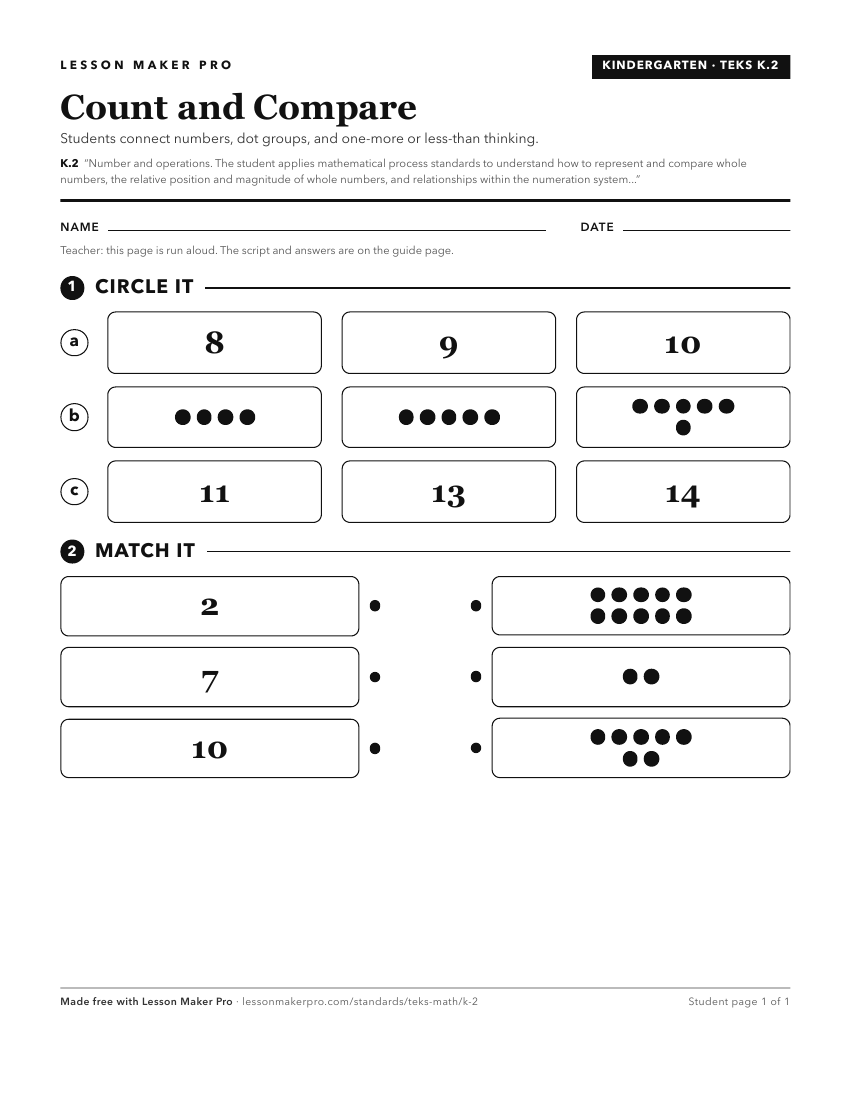
A ready-to-print activity worksheet aligned to K.2, with an answer key for the teacher on its own page. No account needed.
PDF, US Letter, prints cleanly in black and white.
Download the worksheetKeep exploring
Related Standards
- 5.2
The student applies mathematical process standards to represent, compare, and order positive rational numbers and understand relationships as related to place v...
- 1.5
The student applies mathematical process standards to identify and apply number patterns within properties of numbers and operations in order to describe relati...
- 1.2
The student applies mathematical process standards to represent and compare whole numbers, the relative position and magnitude of whole numbers, and relationsh...
- 4.2
The student applies mathematical process standards to represent, compare, and order whole numbers and decimals and understand relationships related to place val...
Turn this cluster into a lesson
Grade, subject, topic, and the complete cluster are prefilled. Create one free, no account needed.
Also for this cluster:Make a WorksheetMake a QuizMake a Sub Lesson