TEKS Math 1.5
Knowledge and Skills Statement (Standard Cluster)
The student applies mathematical process standards to identify and apply number patterns within properties of numbers and operations in order to describe relationships
Texas Essential Knowledge and Skills for Mathematics
Cluster contents
Student Expectations in This Statement
1.5 is a knowledge and skills statement. These are the student expectations under it.
- 1.5.A
recite numbers forward and backward from any given number between 1 and 120
- 1.5.B
skip count by twos, fives, and tens to determine the total number of objects up to 120 in a set
- 1.5.C
use relationships to determine the number that is 10 more and 10 less than a given number up to 120
- 1.5.D
represent word problems involving addition and subtraction of whole numbers up to 20 using concrete and pictorial models and number sentences
- 1.5.E
understand that the equal sign represents a relationship where expressions on each side of the equal sign represent the same value(s)
- 1.5.F
determine the unknown whole number in an addition or subtraction equation when the unknown may be any one of the three or four terms in the equation
- 1.5.G
apply properties of operations to add and subtract two or three numbers
Teacher's field guide
What This Cluster Means
What Students Need to Do
- Students count forward and backward, skip-count sets by 2s, 5s, and 10s, and find 10 more or 10 less. They model addition and subtraction stories within 20 with objects, drawings, and equations. They compare both sides of equations, find missing numbers in any position, and use grouping or order to calculate.
What Mastery Looks Like
- A student can start at 76 and count either direction, count a grouped set efficiently, and name 10 more or less. The student matches a story to a model and equation, then solves blanks in any equation position. The student explains why reordered or regrouped addends keep the same total.
Common Misconceptions
- Students may restart at 1, skip objects in grouped sets, or miscount across decade changes such as 60 to 59. They often read the equal sign as meaning the answer comes next, so 7 = 3 + 4 looks wrong. A blank at the beginning or middle may trigger guessing, and some students think reordered addends change the sum.
How to Assess It
- Give a six-box exit ticket: count backward from 63 for five numbers; count 30 dots by fives; find 10 more than 47; draw 14 - 6; solve 8 + __ = 15; decide whether 9 + 2 = 6 + 5.
Lesson moves
Ways to Teach It
Give pairs 40 counters and cups; students make groups of 2, 5, and 10, then record each total.
Post 6 + 7 = 8 + 5 and ask, “How can both sides be equal?” Students draw, discuss, and write one explanation.
Play Mystery Number on a 120 chart: cover a number and give clues using counting direction, 10 more, and 10 less.
Set up a snack order with 20 paper crackers; students act out orders eaten or added, then write equations with blanks.
Free download
Printable 1.5 Worksheet
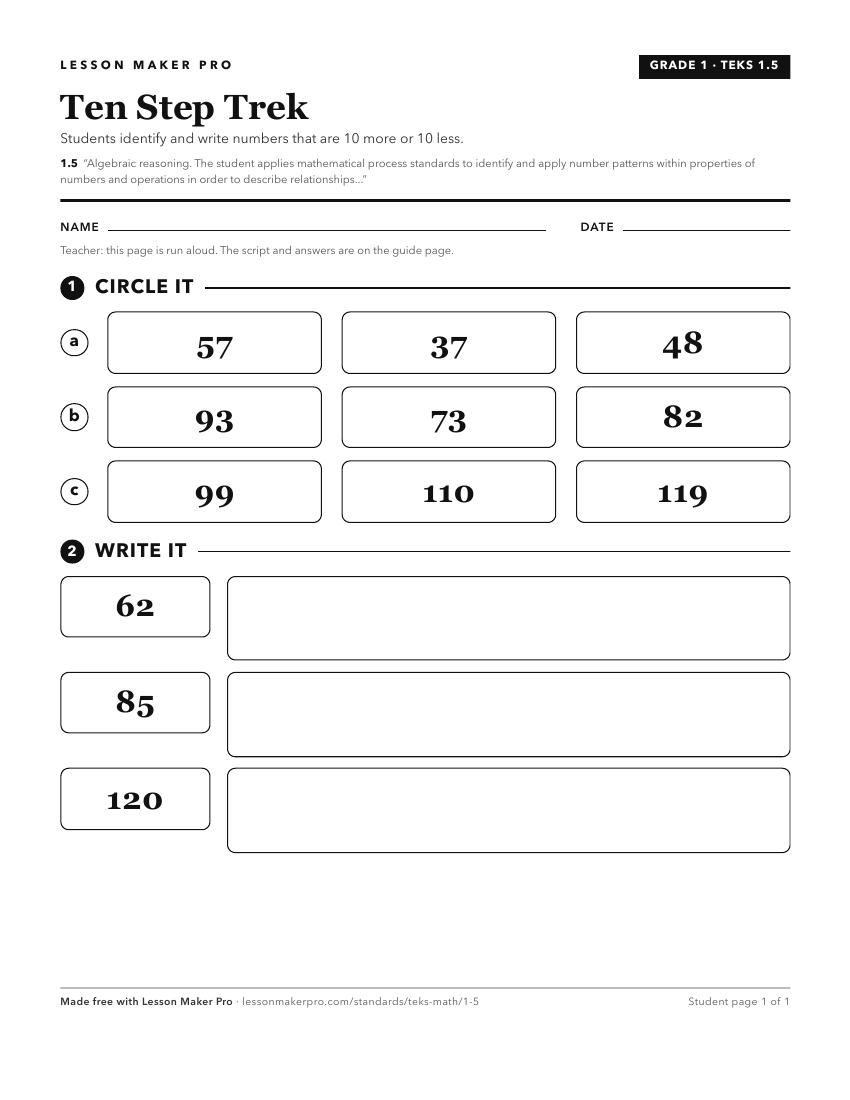
A ready-to-print activity worksheet aligned to 1.5, with an answer key for the teacher on its own page. No account needed.
PDF, US Letter, prints cleanly in black and white.
Download the worksheetKeep exploring
Related Standards
- K.2
The student applies mathematical process standards to understand how to represent and compare whole numbers, the relative position and magnitude of whole number...
- 3.5
The student applies mathematical process standards to analyze and create patterns and relationships
- 4.2
The student applies mathematical process standards to represent, compare, and order whole numbers and decimals and understand relationships related to place val...
- 8.2
The student applies mathematical process standards to represent and use real numbers in a variety of forms
Turn this cluster into a lesson
Grade, subject, topic, and the complete cluster are prefilled. Create one free, no account needed.
Also for this cluster:Make a WorksheetMake a QuizMake a Sub Lesson