TEKS Math 1.5.A
The Standard
recite numbers forward and backward from any given number between 1 and 120
Texas Essential Knowledge and Skills for Mathematics
Teacher's field guide
What This Standard Means
What Students Need to Do
- Students begin at a number the teacher gives and say the number sequence in the requested direction. They keep the sequence correct when moving across decades and past 100.
What Mastery Looks Like
- A student begins with the named number and continues smoothly in the correct direction. The student handles changes such as 99 to 100 and 110 to 109 without help.
Common Misconceptions
- Students may skip a number when crossing a decade, such as saying 79, 80, 82. They may reverse digits, stop at 100, or count up when asked to count down.
How to Assess It
- Ask each student to say ten numbers forward starting at 96, then ten numbers backward starting at 114. Note skipped numbers and errors at decade changes.
Lesson moves
Ways to Teach It
Build a floor number line with cards 1 through 120, then have students step forward or backward while naming each number.
Ask, “What changes when you count backward from 103 to 97, and where might someone make a mistake?”
In pairs, draw a start-number card and direction card, then take turns saying ten correct numbers without pausing.
Use a book with 120 pages, choose a starting page, then name the page numbers while flipping forward or backward.
Free download
Printable 1.5.A Worksheet
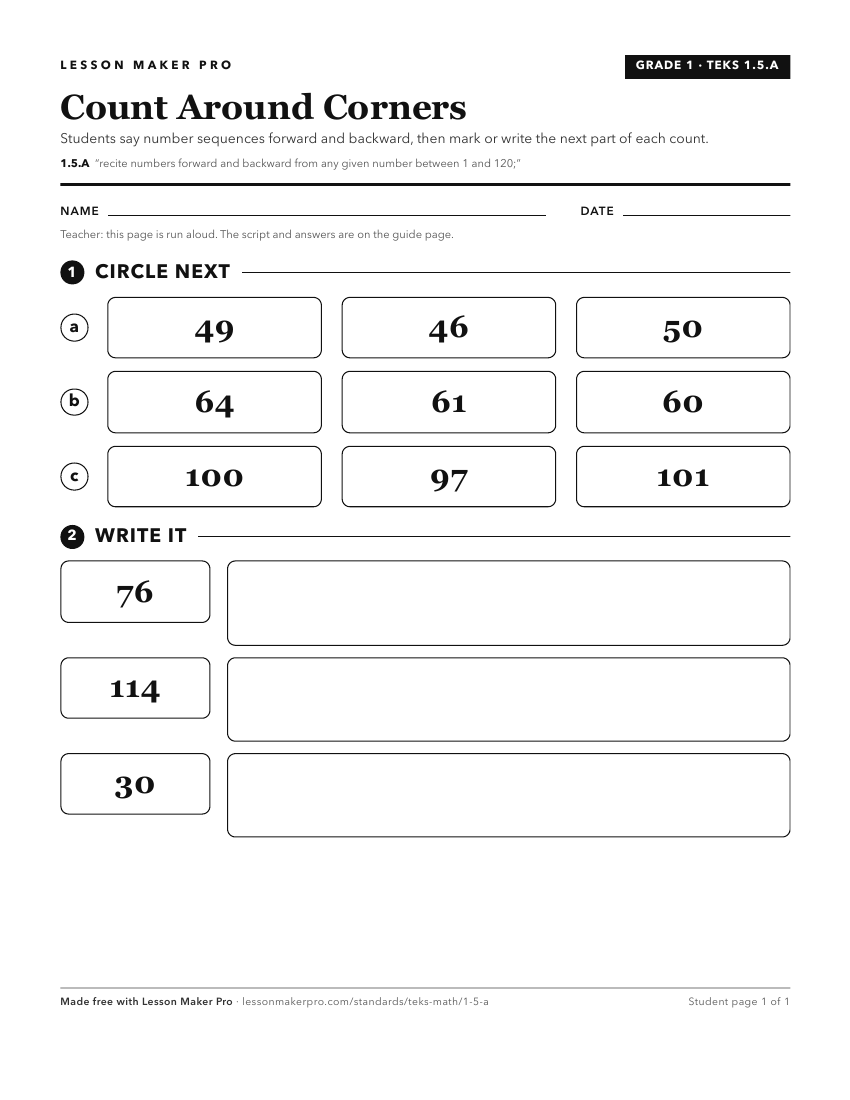
A ready-to-print activity worksheet aligned to 1.5.A, with an answer key for the teacher on its own page. No account needed.
PDF, US Letter, prints cleanly in black and white.
Download the worksheetKeep exploring
Related Standards
- 1.2.D
generate a number that is greater than or less than a given whole number up to 120
- 1.5.C
use relationships to determine the number that is 10 more and 10 less than a given number up to 120
- 2.2.C
generate a number that is greater than or less than a given whole number up to 1,200
- 1.2.F
order whole numbers up to 120 using place value and open number lines
Turn this exact standard into a lesson
Grade, subject, topic, and the complete standard are prefilled. Create one free, no account needed.
Also for this standard:Make a WorksheetMake a QuizMake a Sub Lesson