TEKS Math 1.2.D
The Standard
generate a number that is greater than or less than a given whole number up to 120
Texas Essential Knowledge and Skills for Mathematics
Teacher's field guide
What This Standard Means
What Students Need to Do
- Students produce a whole number that falls below or above a given number through 120. They use counting order, number lines, or place value to check their choice.
What Mastery Looks Like
- Given any number through 120, a student can name and write a smaller number and a larger number. The student can verify both choices with a number line, objects, or place-value reasoning.
Common Misconceptions
- Students may compare only the ones digits, so they think 49 is greater than 52. They may give the same number or assume they must use one more or one less.
How to Assess It
- Write 67 on an exit ticket. Ask students to write one smaller number and one larger number, then show each on a number line.
Lesson moves
Ways to Teach It
Give pairs base-ten blocks, name a target number, and have students build one smaller number and one larger number.
Ask students to explain in writing why 74 is smaller than 81, then name another number smaller than 81.
Play Number Card Challenge: reveal a target card, then students race to hold up a valid smaller or larger number.
Use classroom page numbers and ask students to find one page before and one page after a chosen page number.
Free download
Printable 1.2.D Worksheet
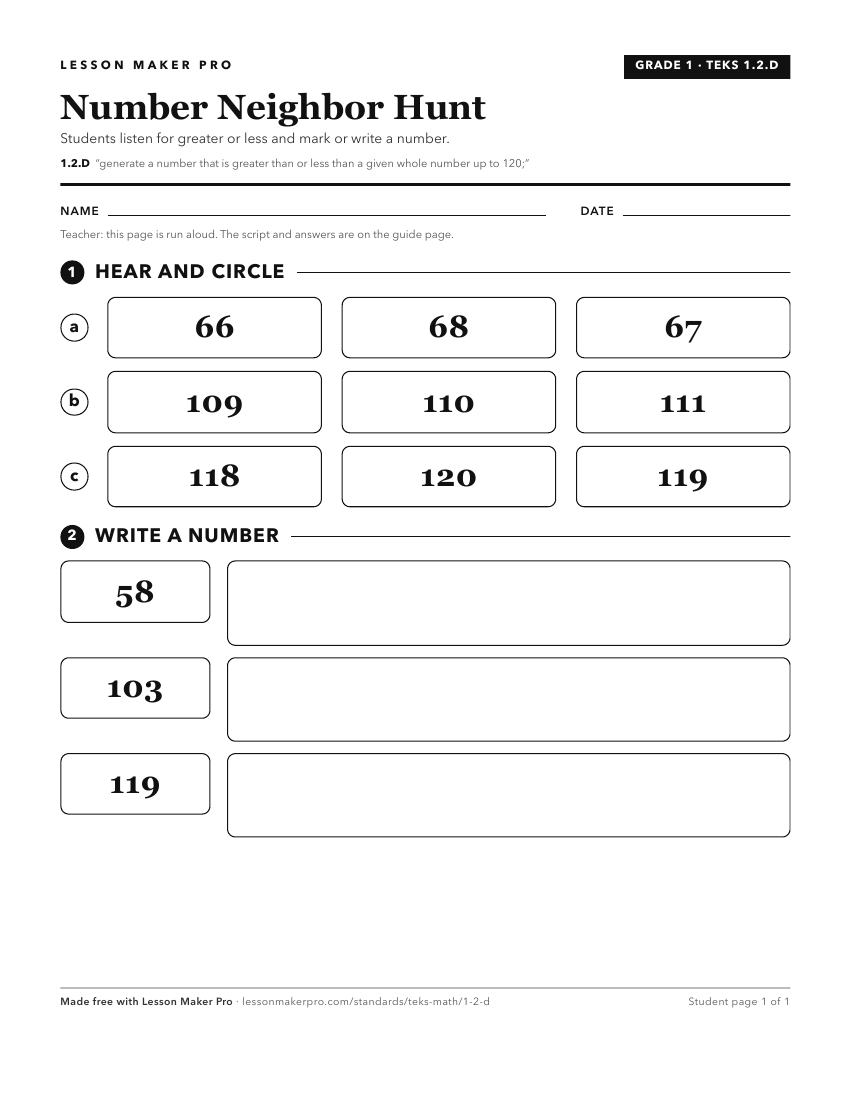
A ready-to-print activity worksheet aligned to 1.2.D, with an answer key for the teacher on its own page. No account needed.
PDF, US Letter, prints cleanly in black and white.
Download the worksheetKeep exploring
Related Standards
- 1.5.A
recite numbers forward and backward from any given number between 1 and 120
- K.2.F
generate a number that is one more than or one less than another number up to at least 20
- 2.2.C
generate a number that is greater than or less than a given whole number up to 1,200
- 1.2.F
order whole numbers up to 120 using place value and open number lines
Turn this exact standard into a lesson
Grade, subject, topic, and the complete standard are prefilled. Create one free, no account needed.
Also for this standard:Make a WorksheetMake a QuizMake a Sub Lesson