TEKS Math K.2.F
The Standard
generate a number that is one more than or one less than another number up to at least 20
Texas Essential Knowledge and Skills for Mathematics
Teacher's field guide
What This Standard Means
What Students Need to Do
- Given a number through 20, students name or write the number immediately before or after it. They connect one more with adding one and one less with taking one away.
What Mastery Looks Like
- Students quickly name or write the number just before or after any given number through 20. They can show the change with objects or a number line and explain that the amount changed by one.
Common Misconceptions
- Students may reverse the directions and give the number before when asked for one more. Some count the starting number as the added number or skip numbers near 10 and 20.
How to Assess It
- Exit ticket: Circle the number that is one more than 8: 7, 8, 9. Write the number that is one less than 17.
Lesson moves
Ways to Teach It
Give pairs numeral cards and linking cubes. Students build the number, then add or remove one cube and name the new total.
Ask, "Sam has 14 crayons. What would one more and one less look like?" Students draw both and label each amount.
Students draw a card from 1 to 19, spin "more" or "less," answer, then check with a number line.
Set out 12 cups for snack, then ask students how many cups there would be with one added or removed.
Free download
Printable K.2.F Worksheet
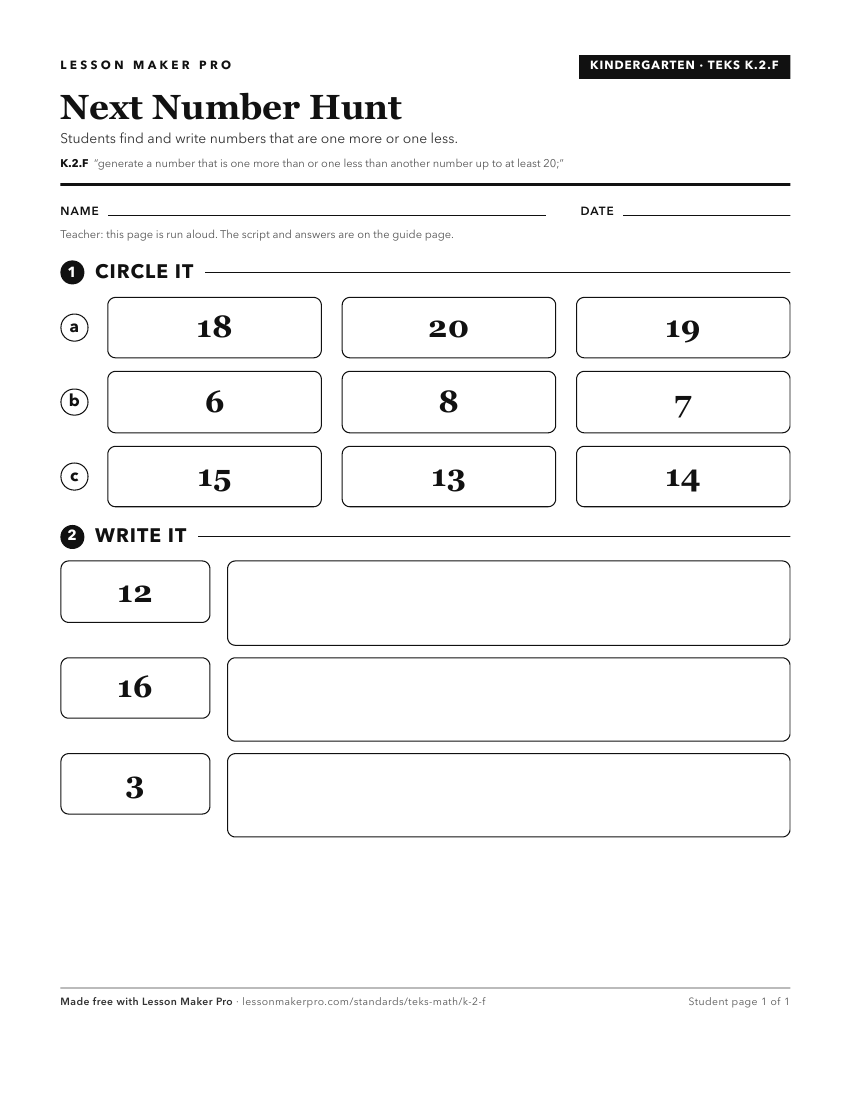
A ready-to-print activity worksheet aligned to K.2.F, with an answer key for the teacher on its own page. No account needed.
PDF, US Letter, prints cleanly in black and white.
Download the worksheetKeep exploring
Related Standards
- 1.2.D
generate a number that is greater than or less than a given whole number up to 120
- K.2.E
generate a set using concrete and pictorial models that represents a number that is more than, less than, and equal to a given number up to 20
- 2.2.C
generate a number that is greater than or less than a given whole number up to 1,200
- 1.3.F
generate and solve problem situations when given a number sentence involving addition or subtraction of numbers within 20
Turn this exact standard into a lesson
Grade, subject, topic, and the complete standard are prefilled. Create one free, no account needed.
Also for this standard:Make a WorksheetMake a QuizMake a Sub Lesson