TEKS Math 1.5.F
The Standard
determine the unknown whole number in an addition or subtraction equation when the unknown may be any one of the three or four terms in the equation
Texas Essential Knowledge and Skills for Mathematics
Teacher's field guide
What This Standard Means
What Students Need to Do
- Students find the number that makes an addition or subtraction equation true. The missing number may appear before, between, or after the other numbers.
What Mastery Looks Like
- Students correctly find a missing number in any position in an addition or subtraction equation. They can use objects, drawings, counting, or a related fact to check that both sides have the same value.
Common Misconceptions
- Students may assume the blank always comes after the equal sign. They may combine the visible numbers instead of finding the value that makes both sides equal.
How to Assess It
- Give an exit ticket with: 9 - □ = 5, □ + 3 = 8, and 6 = 10 - □. Ask students to solve and check each equation.
Lesson moves
Ways to Teach It
Build equations with counters and number cards, then cover one number with a cup and have students find the hidden value.
Ask students to explain how they know the missing number in 7 = □ + 2 without starting by adding 7 and 2.
Play Missing Number Match by pairing equation cards such as 9 - □ = 4 with answer cards showing 5.
Use a snack story: 8 crackers were packed, some were eaten, and 3 remain; write and solve 8 - □ = 3.
Free download
Printable 1.5.F Worksheet
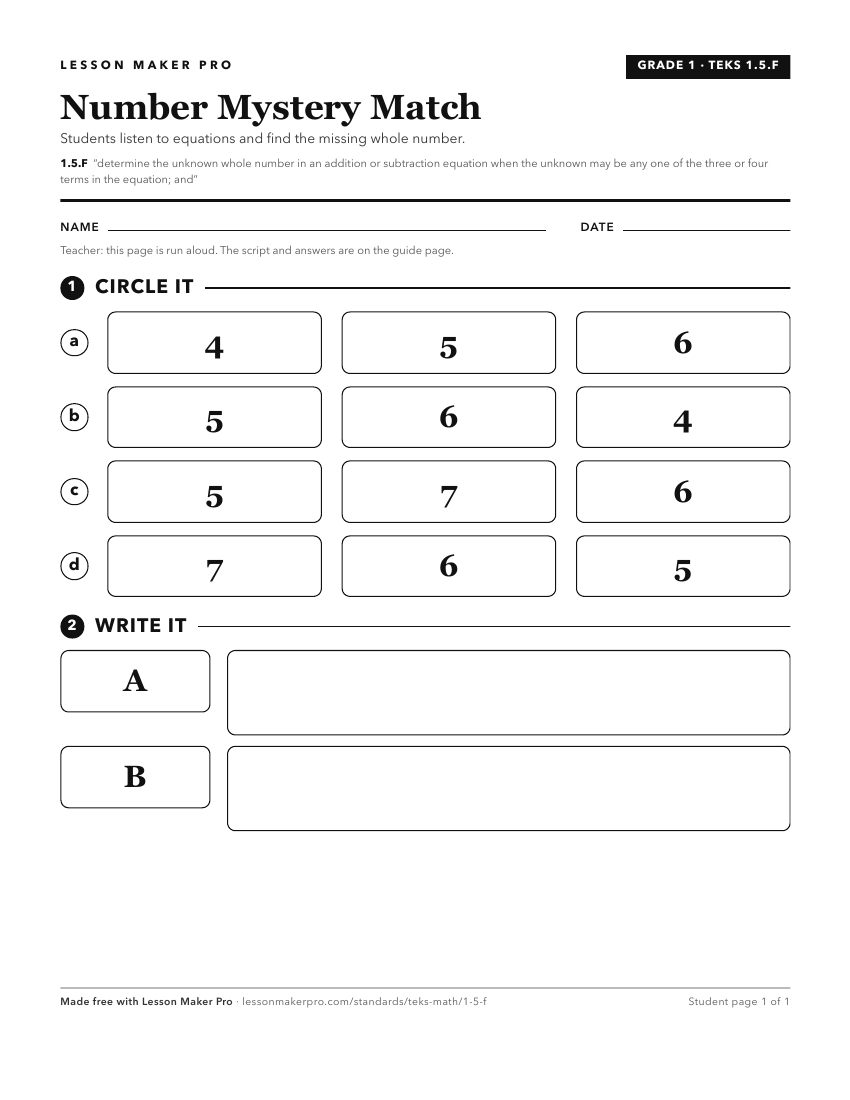
A ready-to-print activity worksheet aligned to 1.5.F, with an answer key for the teacher on its own page. No account needed.
PDF, US Letter, prints cleanly in black and white.
Download the worksheetKeep exploring
Related Standards
- 5.4.B
represent and solve multi-step problems involving the four operations with whole numbers using equations with a letter standing for the unknown quantity
- 2.7.C
represent and solve addition and subtraction word problems where unknowns may be any one of the terms in the problem
- 3.5.D
determine the unknown whole number in a multiplication or division equation relating three whole numbers when the unknown is either a missing factor or product
- 4.5.A
represent multi-step problems involving the four operations with whole numbers using strip diagrams and equations with a letter standing for the unknown quantit...
Turn this exact standard into a lesson
Grade, subject, topic, and the complete standard are prefilled. Create one free, no account needed.
Also for this standard:Make a WorksheetMake a QuizMake a Sub Lesson