TEKS Math 1.5.G
The Standard
apply properties of operations to add and subtract two or three numbers
Texas Essential Knowledge and Skills for Mathematics
Teacher's field guide
What This Standard Means
What Students Need to Do
- Students reorder or group numbers to make calculations easier. They explain why the answer stays the same and recognize that subtraction cannot be reversed freely.
What Mastery Looks Like
- Given 6 + 4 + 3, a student adds 6 + 4 first to make 10, then finds 13. For 13 − 3 − 2, the student subtracts 3 to reach 10, then subtracts 2.
Common Misconceptions
- Students may think changing the order of addends changes the sum, or that subtraction can be reversed like addition. They may drop or change a number when regrouping, such as rewriting 7 + 3 + 2 as 10 + 3.
How to Assess It
- Exit ticket: Solve 7 + 3 + 5 in two ways, then solve 15 − 5 − 2. Circle the step that made each problem easier.
Lesson moves
Ways to Teach It
Give pairs counters and cards showing 6, 4, and 3, then have them build and compare two different groupings.
Ask, “Why does 2 + 7 equal 7 + 2, but 7 − 2 does not equal 2 − 7?”
Play Make Ten Draw: students turn over three number cards, reorder or group them, and score when they can make ten first.
Pose: “Mia packs 4 red, 6 blue, and 2 green crayons. Which colors should she count first, and why?”
Free download
Printable 1.5.G Worksheet
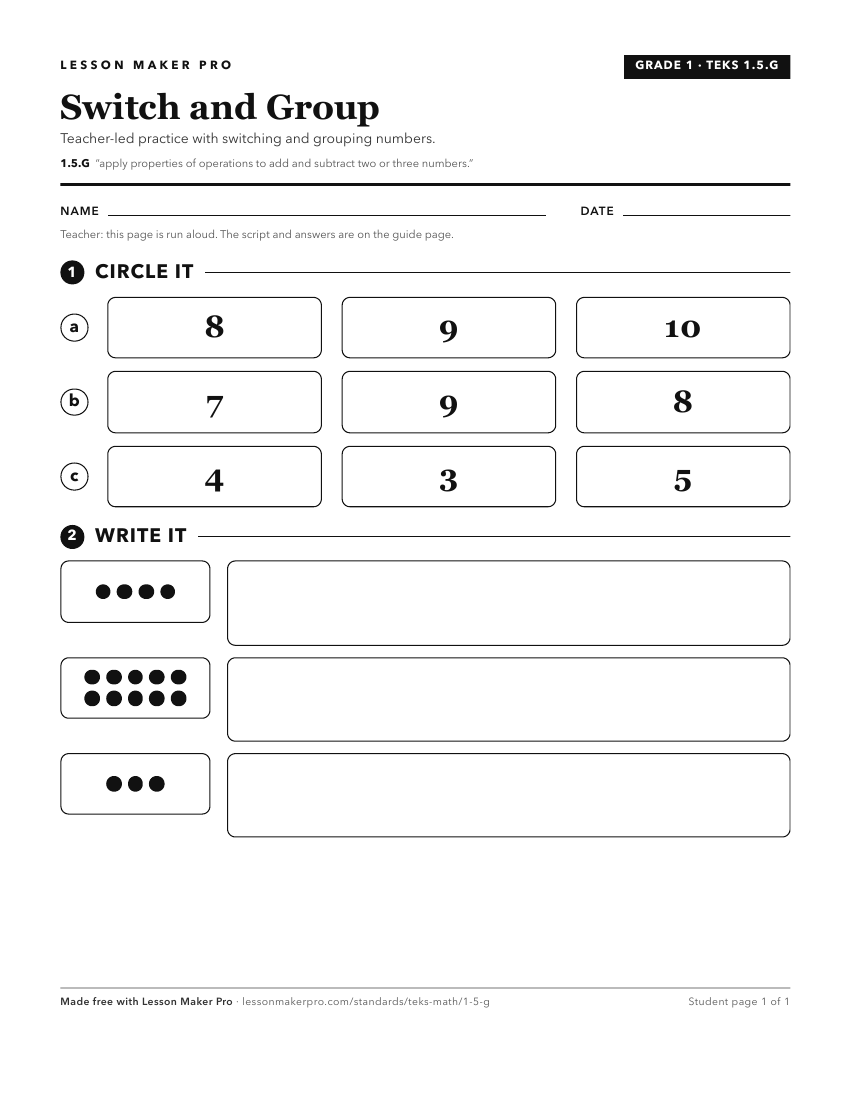
A ready-to-print activity worksheet aligned to 1.5.G, with an answer key for the teacher on its own page. No account needed.
PDF, US Letter, prints cleanly in black and white.
Download the worksheetKeep exploring
Related Standards
- 6.3.D
add, subtract, multiply, and divide integers fluently
- 5.3.K
add and subtract positive rational numbers fluently
- 2.4.B
add up to four two-digit numbers and subtract two-digit numbers using mental strategies and algorithms based on knowledge of place value and properties of opera...
- 7.3.B
apply and extend previous understandings of operations to solve problems using addition, subtraction, multiplication, and division of rational numbers
Turn this exact standard into a lesson
Grade, subject, topic, and the complete standard are prefilled. Create one free, no account needed.
Also for this standard:Make a WorksheetMake a QuizMake a Sub Lesson