TEKS Math 6.3.D
The Standard
add, subtract, multiply, and divide integers fluently
Texas Essential Knowledge and Skills for Mathematics
Teacher's field guide
What This Standard Means
What Students Need to Do
- Students calculate with positive and negative whole numbers in mixed problems. They choose the correct sign and find an accurate value for each result.
What Mastery Looks Like
- Students solve mixed integer calculations quickly and accurately. They apply sign rules correctly and can check multiplication with division or addition with subtraction.
Common Misconceptions
- Students may treat every pair of negative signs as positive, even in addition or subtraction. They may also confuse subtracting a negative with adding a negative or ignore the sign when dividing.
How to Assess It
- Give this exit ticket: solve −8 + 13, 6 − 15, (−4)(−7), and −36 ÷ 9, then explain one answer's sign.
Lesson moves
Ways to Teach It
Use two-color counters to model −4 + 7 and 3 − 8, then write an equation for each model.
Ask students to explain why (−6)(−3) is positive while −18 ÷ 3 is negative, using a pattern or number line.
Play integer operation bingo by calling expressions while students cover matching answers and justify disputed signs.
Give students a bank ledger with deposits, withdrawals, repeated fees, and equal repayments, then have them calculate each balance change.
Free download
Printable 6.3.D Worksheet
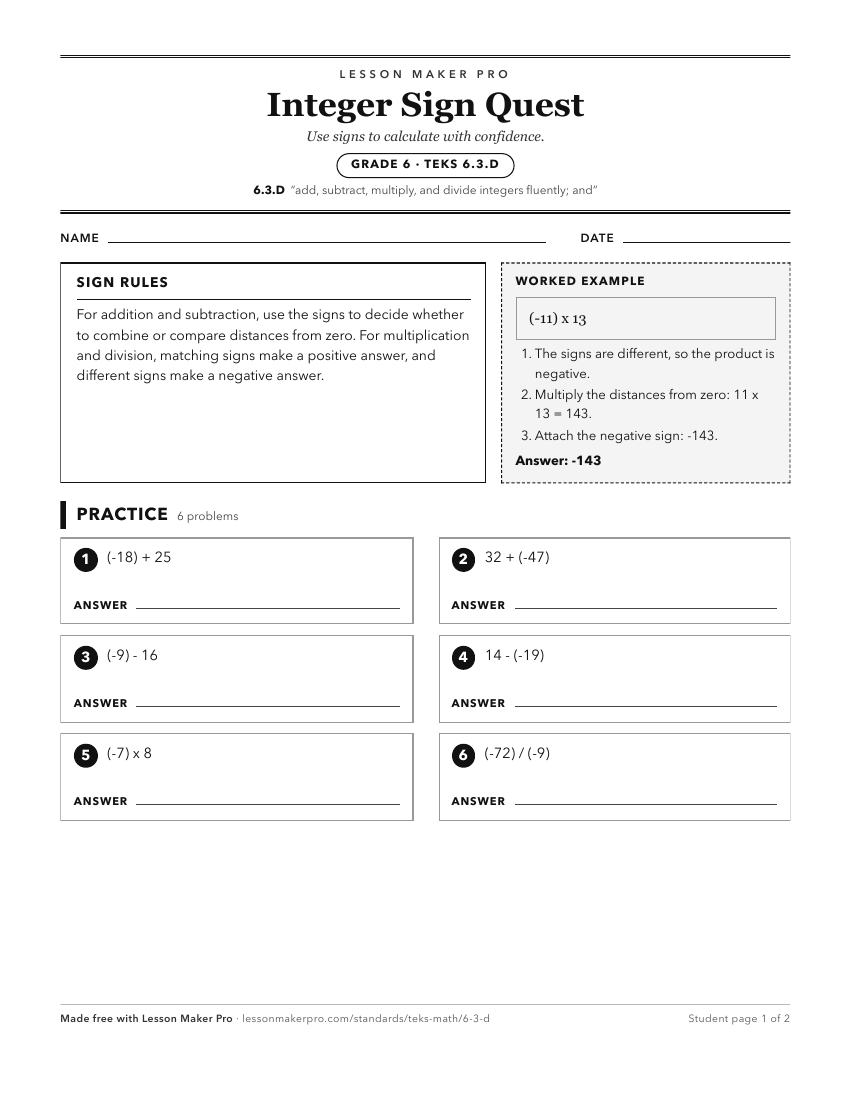
A ready-to-print activity worksheet aligned to 6.3.D, with an answer key for the teacher on its own page. No account needed.
PDF, US Letter, prints cleanly in black and white.
Download the worksheetKeep exploring
Related Standards
- 4.4.H
solve with fluency one- and two-step problems involving multiplication and division, including interpreting remainders
- 7.3.A
add, subtract, multiply, and divide rational numbers fluently
- 5.3.K
add and subtract positive rational numbers fluently
- 6.3.E
multiply and divide positive rational numbers fluently
Turn this exact standard into a lesson
Grade, subject, topic, and the complete standard are prefilled. Create one free, no account needed.
Also for this standard:Make a WorksheetMake a QuizMake a Sub Lesson