TEKS Math 4.4.H
The Standard
solve with fluency one- and two-step problems involving multiplication and division, including interpreting remainders
Texas Essential Knowledge and Skills for Mathematics
Teacher's field guide
What This Standard Means
What Students Need to Do
- Students choose multiplication or division to solve word problems with one or two steps. They decide what a remainder means in the situation and give a complete answer.
What Mastery Looks Like
- A student selects the needed operations, writes one or two equations, and calculates accurately. The student labels the answer and explains why the remainder is kept, dropped, or causes rounding up.
Common Misconceptions
- Students may choose an operation from a keyword instead of using the relationships in the story. They may stop after the first step in a two-step problem. They often write a remainder for every answer, even when another group is needed or only complete groups count.
How to Assess It
- Use this exit ticket: “Ninety-five students travel in vans that seat 8. Each van costs $35. How many vans are needed, and what is the total cost?” Require equations and one sentence explaining the remainder.
Lesson moves
Ways to Teach It
Give pairs 47 counters and six cups; students share evenly, record the quotient and remainder, then write two matching story answers.
Ask students when 38 ÷ 5 should mean 8 groups, 7 full groups, or 7 remainder 3, using matching contexts.
Play Remainder Match: students pair division cards with context cards, then explain whether to keep, drop, or round up the remainder.
Have students plan vans for 73 athletes and calculate the total rental cost when each eight-seat van costs $42.
Free download
Printable 4.4.H Worksheet
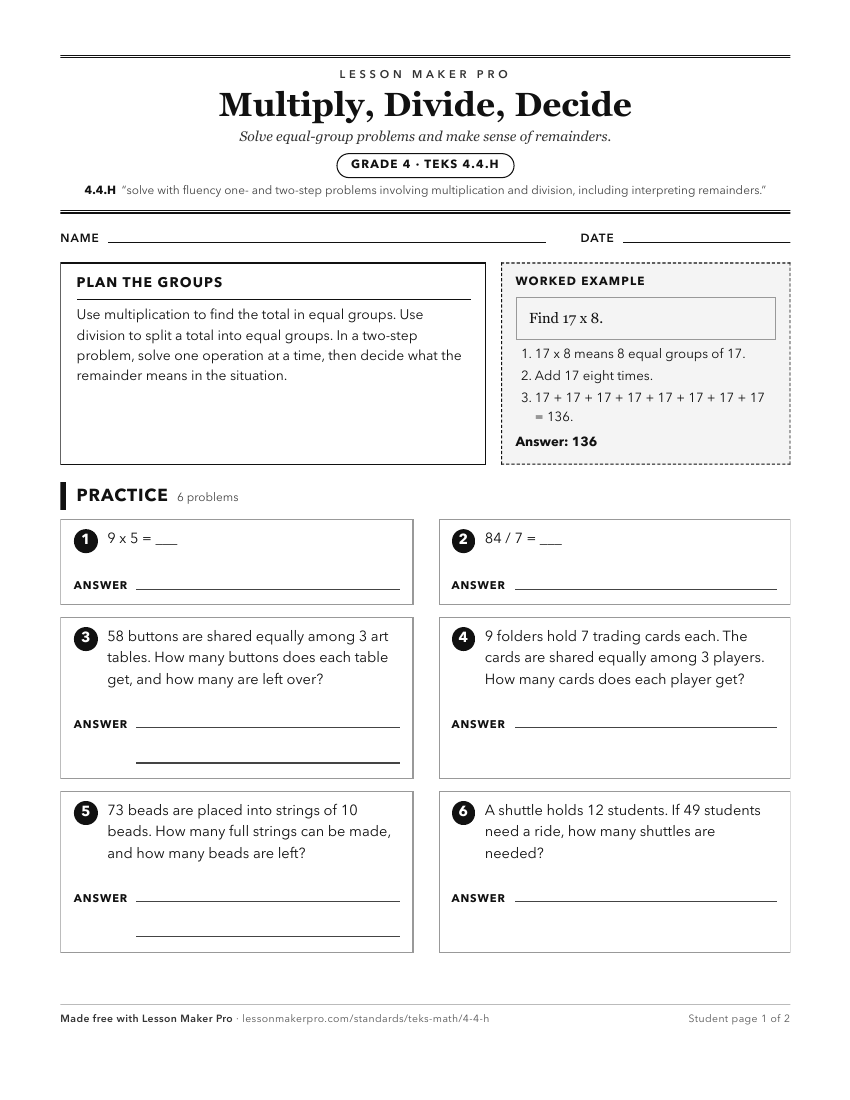
A ready-to-print activity worksheet aligned to 4.4.H, with an answer key for the teacher on its own page. No account needed.
PDF, US Letter, prints cleanly in black and white.
Download the worksheetKeep exploring
Related Standards
- 3.4.K
solve one-step and two-step problems involving multiplication and division within 100 using strategies based on objects; pictorial models, including arrays, are...
- 3.4.A
solve with fluency one-step and two-step problems involving addition and subtraction within 1,000 using strategies based on place value, properties of operation...
- 3.5.B
represent and solve one- and two-step multiplication and division problems within 100 using arrays, strip diagrams, and equations
- 6.3.E
multiply and divide positive rational numbers fluently
Turn this exact standard into a lesson
Grade, subject, topic, and the complete standard are prefilled. Create one free, no account needed.
Also for this standard:Make a WorksheetMake a QuizMake a Sub Lesson