TEKS Math 2.4.B
The Standard
add up to four two-digit numbers and subtract two-digit numbers using mental strategies and algorithms based on knowledge of place value and properties of operations
Texas Essential Knowledge and Skills for Mathematics
Teacher's field guide
What This Standard Means
What Students Need to Do
- Students combine several two-digit quantities and find differences between two-digit quantities. They use place value, regrouping, and number properties to choose and explain an efficient method.
What Mastery Looks Like
- Students solve accurately with drawings, mental strategies, or written steps. They align place values, regroup when needed, and explain how tens and ones changed.
Common Misconceptions
- Students may misalign tens and ones or combine each column without regrouping. In subtraction, they may subtract the smaller digit from the larger digit regardless of place or lose track when adding several numbers.
How to Assess It
- Give this exit ticket: Solve 27 + 36 + 14 + 23 and 72 − 48. Show your steps and label one place-value move.
Lesson moves
Ways to Teach It
Give pairs base-ten blocks to model 38 + 27 + 15, then record each regrouping with an equation.
Ask, “Which is easier for 46 + 29, making a ten or adding tens and ones separately, and why?”
Play a target-sum game where students draw four two-digit cards and choose an order that makes the addition easier.
Use a classroom store receipt with several prices, then have students find the total cost and change from a set amount.
Free download
Printable 2.4.B Worksheet
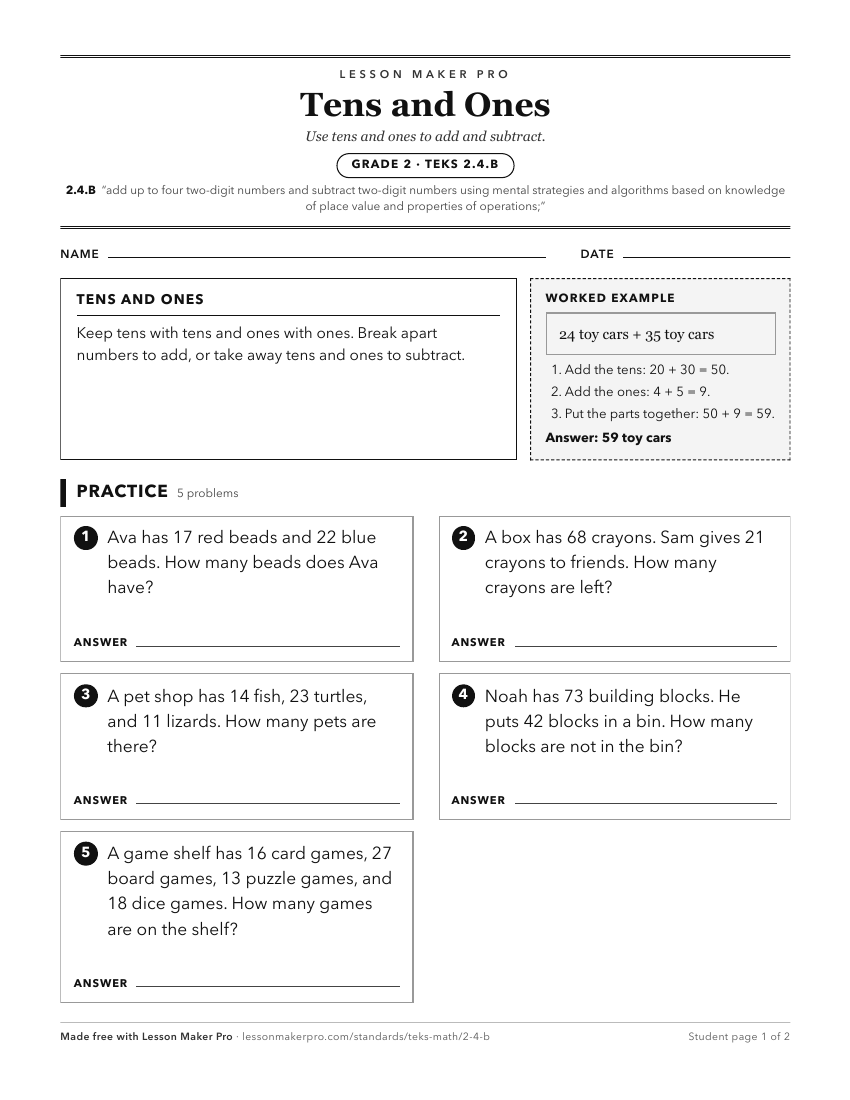
A ready-to-print activity worksheet aligned to 2.4.B, with an answer key for the teacher on its own page. No account needed.
PDF, US Letter, prints cleanly in black and white.
Download the worksheetKeep exploring
Related Standards
- 3.4.G
use strategies and algorithms, including the standard algorithm, to multiply a two-digit number by a one-digit number. Strategies may include mental math, parti...
- 4.4.D
use strategies and algorithms, including the standard algorithm, to multiply up to a four-digit number by a one-digit number and to multiply a two-digit number ...
- 1.5.G
apply properties of operations to add and subtract two or three numbers
- 2.4.C
solve one-step and multi-step word problems involving addition and subtraction within 1,000 using a variety of strategies based on place value, including algori...
Turn this exact standard into a lesson
Grade, subject, topic, and the complete standard are prefilled. Create one free, no account needed.
Also for this standard:Make a WorksheetMake a QuizMake a Sub Lesson