TEKS Math 4.4.D
The Standard
use strategies and algorithms, including the standard algorithm, to multiply up to a four-digit number by a one-digit number and to multiply a two-digit number by a two-digit number. Strategies may include mental math, partial products, and the commutative, associative, and distributive properties
Texas Essential Knowledge and Skills for Mathematics
Teacher's field guide
What This Standard Means
What Students Need to Do
- Students multiply larger whole numbers using mental math, partial products, number properties, and the standard algorithm. They break numbers apart by place value and combine the products correctly.
What Mastery Looks Like
- Students compute both types of products accurately and keep digits aligned by place value. They can show partial products, regroup correctly, and explain why their method works.
Common Misconceptions
- Students may treat a tens digit as ones, so 20 becomes 2 in a partial product. They may misalign place values, omit a partial product, or forget the zero placeholder in the standard algorithm.
How to Assess It
- Give an exit ticket: solve 3,407 × 6 with the standard algorithm and 27 × 34 with partial products, then check each answer with an estimate.
Lesson moves
Ways to Teach It
Use base-ten blocks and a place-value mat to build 23 × 14, then record the four partial products.
Ask why the 2 in 24 represents 20, then have students explain using 36 × 24 and compare two methods.
Play Product Match: students pair multiplication cards with correct partial-product cards, then verify each match using the standard algorithm.
Have students calculate the cost of 24 team shirts at $18 each and show two multiplication methods.
Free download
Printable 4.4.D Worksheet
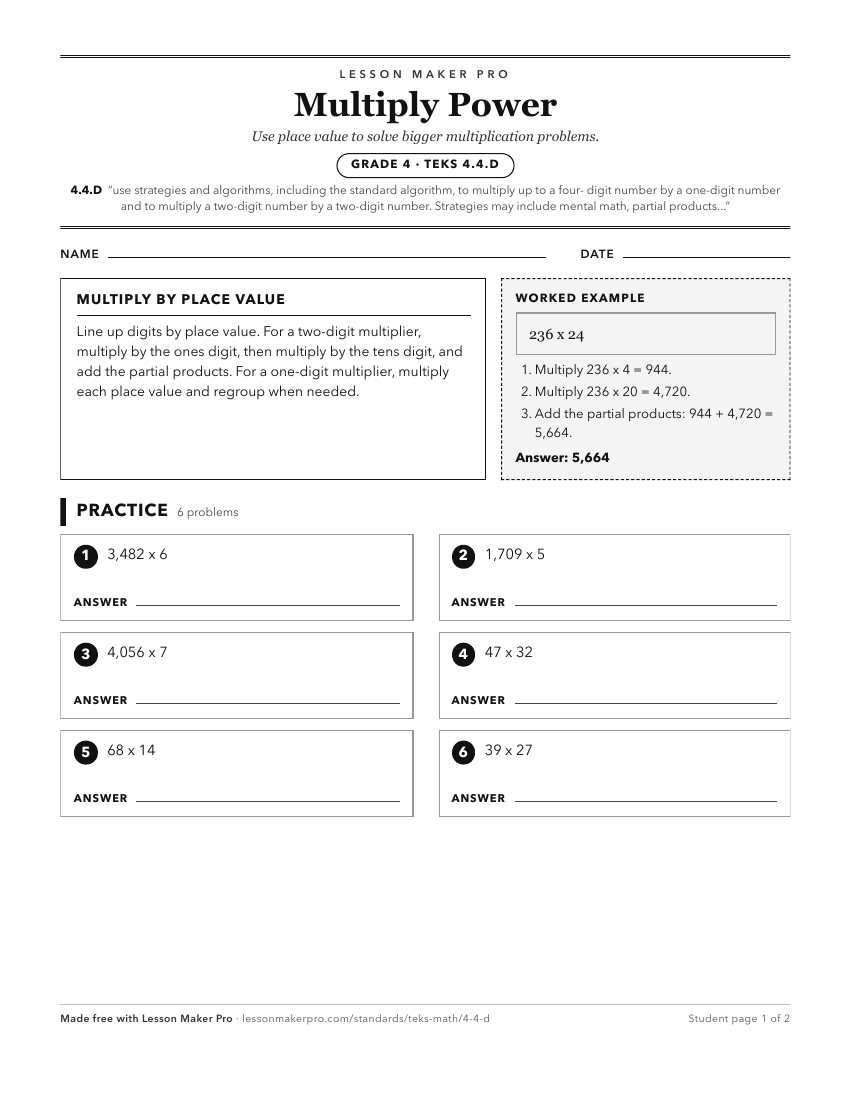
A ready-to-print activity worksheet aligned to 4.4.D, with an answer key for the teacher on its own page. No account needed.
PDF, US Letter, prints cleanly in black and white.
Download the worksheetKeep exploring
Related Standards
- 3.4.G
use strategies and algorithms, including the standard algorithm, to multiply a two-digit number by a one-digit number. Strategies may include mental math, parti...
- 4.4.F
use strategies and algorithms, including the standard algorithm, to divide up to a four-digit dividend by a one-digit divisor
- 2.4.B
add up to four two-digit numbers and subtract two-digit numbers using mental strategies and algorithms based on knowledge of place value and properties of opera...
- 5.3.C
solve with proficiency for quotients of up to a four-digit dividend by a two-digit divisor using strategies and the standard algorithm
Turn this exact standard into a lesson
Grade, subject, topic, and the complete standard are prefilled. Create one free, no account needed.
Also for this standard:Make a WorksheetMake a QuizMake a Sub Lesson