TEKS Math 5.3.C
The Standard
solve with proficiency for quotients of up to a four-digit dividend by a two-digit divisor using strategies and the standard algorithm
Texas Essential Knowledge and Skills for Mathematics
Teacher's field guide
What This Standard Means
What Students Need to Do
- Students estimate a reasonable quotient, then divide whole numbers using place-value strategies or the standard algorithm. They record remainders correctly and check answers with multiplication.
What Mastery Looks Like
- A student selects quotient digits that fit, subtracts accurately, brings down each next digit, and places zeros when needed. The answer matches a reasonable estimate, and any remainder is less than the divisor.
Common Misconceptions
- Students may divide each digit separately instead of treating the dividend by place value. They often omit a zero in the quotient or choose a quotient digit that is too large. They may leave a remainder equal to or greater than the divisor.
How to Assess It
- Give this exit ticket: Estimate 2,856 ÷ 24, solve with the standard algorithm, then multiply to check your answer.
Lesson moves
Ways to Teach It
Use 144 counters and 12 cups to make equal groups, then connect the grouping to partial quotients and the written algorithm.
Discuss why 1,764 ÷ 28 cannot equal 73, using an estimate and a multiplication check as evidence.
Play Quotient Match: students pair cards such as 3,024 ÷ 36 with quotient cards, then prove each match on paper.
Plan shipping for 2,365 cans packed 24 per case, finding full cases, leftover cans, and cases needed to ship everything.
Free download
Printable 5.3.C Worksheet
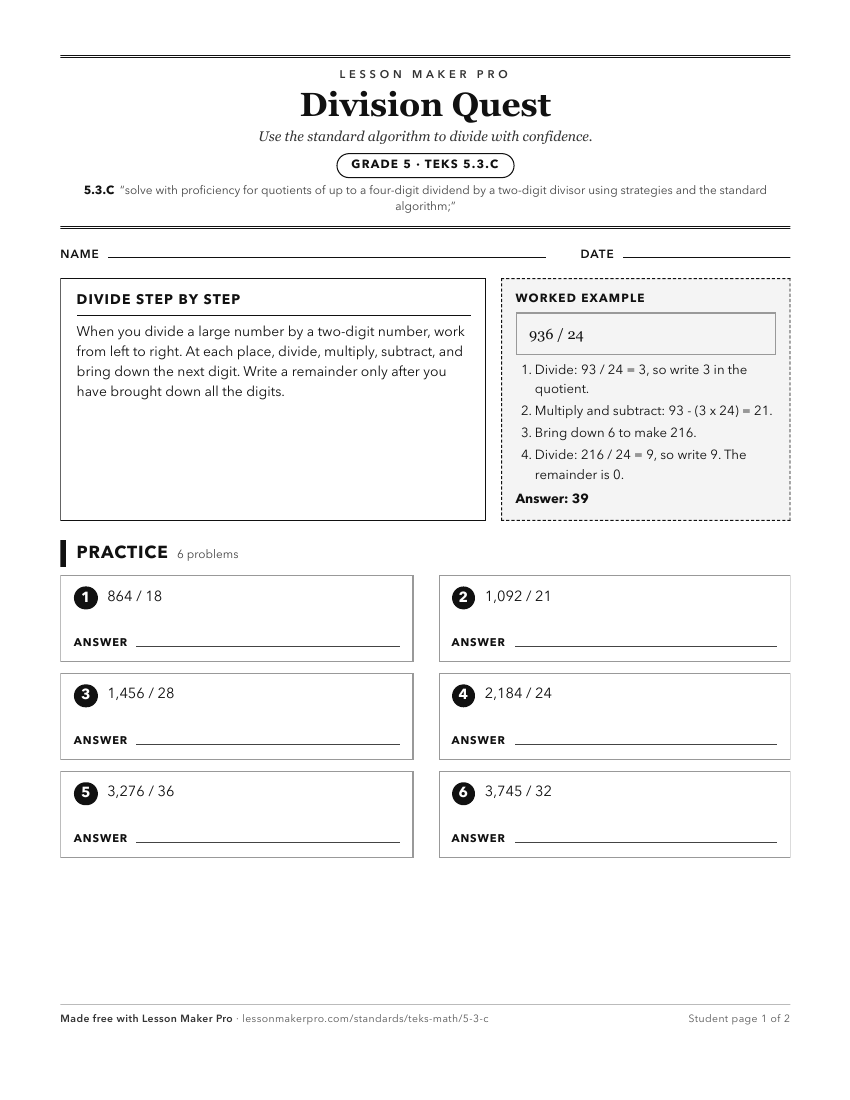
A ready-to-print activity worksheet aligned to 5.3.C, with an answer key for the teacher on its own page. No account needed.
PDF, US Letter, prints cleanly in black and white.
Download the worksheetKeep exploring
Related Standards
- 3.4.G
use strategies and algorithms, including the standard algorithm, to multiply a two-digit number by a one-digit number. Strategies may include mental math, parti...
- 4.4.F
use strategies and algorithms, including the standard algorithm, to divide up to a four-digit dividend by a one-digit divisor
- 5.3.G
solve for quotients of decimals to the hundredths, up to four-digit dividends and two-digit whole number divisors, using strategies and algorithms, including th...
- 4.4.D
use strategies and algorithms, including the standard algorithm, to multiply up to a four-digit number by a one-digit number and to multiply a two-digit number ...
Turn this exact standard into a lesson
Grade, subject, topic, and the complete standard are prefilled. Create one free, no account needed.
Also for this standard:Make a WorksheetMake a QuizMake a Sub Lesson