TEKS Math 3.4.G
The Standard
use strategies and algorithms, including the standard algorithm, to multiply a two-digit number by a one-digit number. Strategies may include mental math, partial products, and the commutative, associative, and distributive properties
Texas Essential Knowledge and Skills for Mathematics
Teacher's field guide
What This Standard Means
What Students Need to Do
- Students multiply a two-digit number by a one-digit number using place value. They break numbers apart, combine partial products, and use the standard written method.
What Mastery Looks Like
- Students accurately solve problems with and without regrouping. They record each step clearly, combine partial products correctly, and use estimation or another method to check the answer.
Common Misconceptions
- Students may multiply the ones but forget the tens, or treat 3 tens as 3 ones. They may also regroup incorrectly or place partial products in the wrong columns.
How to Assess It
- Give this exit ticket: Solve 27 × 6 using the standard algorithm and one other method. Show how both methods produce the same answer.
Lesson moves
Ways to Teach It
Build 23 × 4 with base-ten blocks, regroup the ones, then sketch the model and write matching equations.
Compare two solutions for 36 × 7 and discuss which steps show the tens, ones, and regrouped amount.
Draw one two-digit card and one one-digit card, multiply them, and earn a point after a partner checks each step.
Calculate how many juice boxes are needed for seven classes if each class receives 24 boxes.
Free download
Printable 3.4.G Worksheet
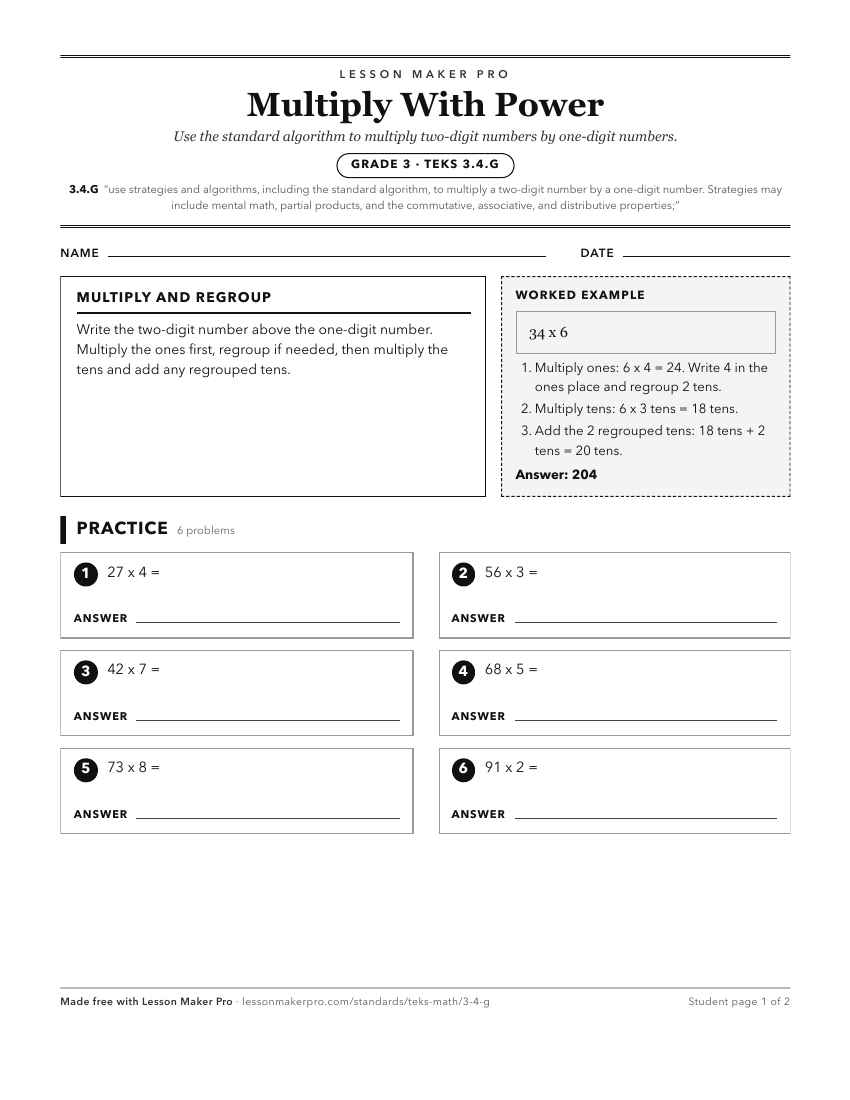
A ready-to-print activity worksheet aligned to 3.4.G, with an answer key for the teacher on its own page. No account needed.
PDF, US Letter, prints cleanly in black and white.
Download the worksheetKeep exploring
Related Standards
- 4.4.F
use strategies and algorithms, including the standard algorithm, to divide up to a four-digit dividend by a one-digit divisor
- 2.4.B
add up to four two-digit numbers and subtract two-digit numbers using mental strategies and algorithms based on knowledge of place value and properties of opera...
- 5.3.C
solve with proficiency for quotients of up to a four-digit dividend by a two-digit divisor using strategies and the standard algorithm
- 4.4.D
use strategies and algorithms, including the standard algorithm, to multiply up to a four-digit number by a one-digit number and to multiply a two-digit number ...
Turn this exact standard into a lesson
Grade, subject, topic, and the complete standard are prefilled. Create one free, no account needed.
Also for this standard:Make a WorksheetMake a QuizMake a Sub Lesson