TEKS Math K.2.B
The Standard
read, write, and represent whole numbers from 0 to at least 20 with and without objects or pictures
Texas Essential Knowledge and Skills for Mathematics
Teacher's field guide
What This Standard Means
What Students Need to Do
- Students name and write numerals from 0 through 20. They match each numeral to a quantity shown with objects, drawings, dots, or frames.
What Mastery Looks Like
- Students correctly name and write any numeral from 0 through 20. They can show each number with counters, drawings, or a ten-frame, including an empty set for zero.
Common Misconceptions
- Students may reverse numerals or confuse 12 with 21. They may count objects correctly but choose the wrong numeral. Some think zero means one object or skip zero entirely.
How to Assess It
- Give each student the numbers 0, 7, 14, and 20. Ask them to read each number, write it, and draw that many dots.
Lesson moves
Ways to Teach It
Give students numeral cards, counters, and ten-frames, then have them build and write each number they draw.
Show 16 dots and ask, “How do you know there are 16 without starting over?”
Play Number Match with numeral cards, dot cards, and ten-frame cards for quantities from 0 through 20.
Count classroom items, such as pencils or chairs, then make a label showing each total with a numeral and picture.
Free download
Printable K.2.B Worksheet
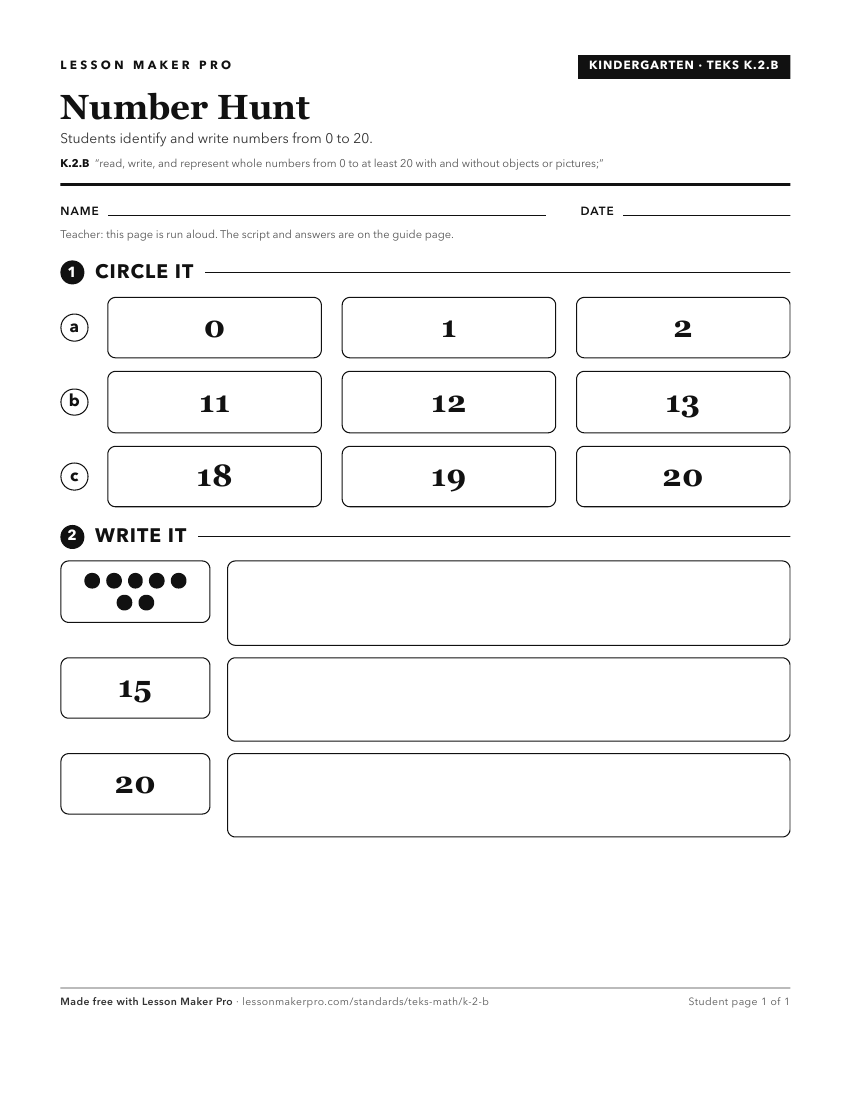
A ready-to-print activity worksheet aligned to K.2.B, with an answer key for the teacher on its own page. No account needed.
PDF, US Letter, prints cleanly in black and white.
Download the worksheetKeep exploring
Related Standards
- 1.2.C
use objects, pictures, and expanded and standard forms to represent numbers up to 120
- 1.5.D
represent word problems involving addition and subtraction of whole numbers up to 20 using concrete and pictorial models and number sentences
- K.2.E
generate a set using concrete and pictorial models that represents a number that is more than, less than, and equal to a given number up to 20
- K.2.I
compose and decompose numbers up to 10 with objects and pictures
Turn this exact standard into a lesson
Grade, subject, topic, and the complete standard are prefilled. Create one free, no account needed.
Also for this standard:Make a WorksheetMake a QuizMake a Sub Lesson