TEKS Math K.2.D
The Standard
recognize instantly the quantity of a small group of objects in organized and random arrangements
Texas Essential Knowledge and Skills for Mathematics
Teacher's field guide
What This Standard Means
What Students Need to Do
- Students look at a small set and quickly tell how many items are there. They use the whole visual pattern rather than touching or counting objects one by one.
What Mastery Looks Like
- After a brief look, a student correctly names the amount in familiar patterns and scattered layouts. The student does not point to each item and knows spacing does not change the total.
Common Misconceptions
- Some students count each object instead of seeing the amount as a whole. Others think a spread-out set has more than a close-together set, or guess based on space rather than quantity.
How to Assess It
- Flash two dot cards for two seconds, one patterned and one scattered. Have students say or write each amount without counting aloud.
Lesson moves
Ways to Teach It
Flash a dot card for two seconds, then have students build the same quantity with counters on a ten-frame.
Show two arrangements of five dots and ask, “How did you know both showed five without counting each dot?”
Play Quick Look: partners flip dot cards, name the quantity immediately, and keep the card after a correct response.
Briefly show a plate with four crackers, cover it, and ask students how many crackers they saw.
Free download
Printable K.2.D Worksheet
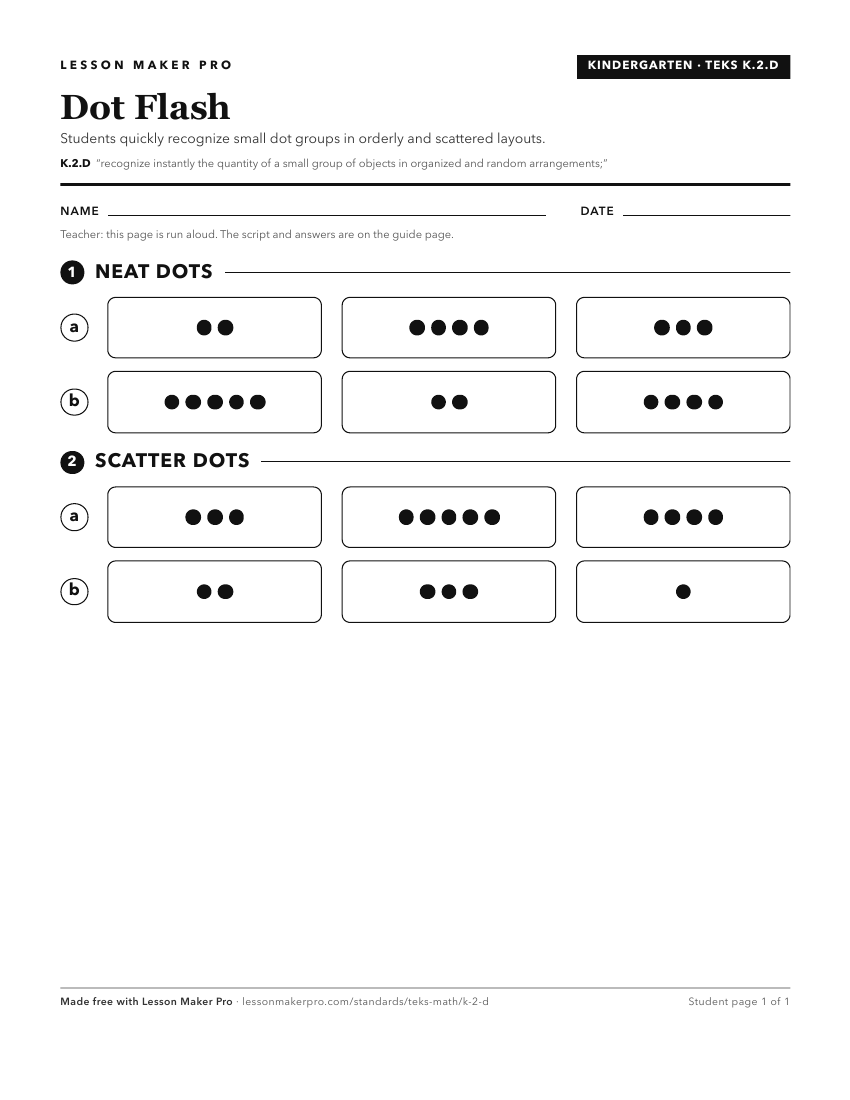
A ready-to-print activity worksheet aligned to K.2.D, with an answer key for the teacher on its own page. No account needed.
PDF, US Letter, prints cleanly in black and white.
Download the worksheetKeep exploring
Related Standards
- K.2.C
count a set of objects up to at least 20 and demonstrate that the last number said tells the number of objects in the set regardless of their arrangement or ord...
- 3.4.D
determine the total number of objects when equally-sized groups of objects are combined or arranged in arrays up to 10 by 10
- 3.4.H
determine the number of objects in each group when a set of objects is partitioned into equal shares or a set of objects is shared equally
- 1.2.A
recognize instantly the quantity of structured arrangements
Turn this exact standard into a lesson
Grade, subject, topic, and the complete standard are prefilled. Create one free, no account needed.
Also for this standard:Make a WorksheetMake a QuizMake a Sub Lesson