TEKS Math 3.4.D
The Standard
determine the total number of objects when equally-sized groups of objects are combined or arranged in arrays up to 10 by 10
Texas Essential Knowledge and Skills for Mathematics
Teacher's field guide
What This Standard Means
What Students Need to Do
- Students use multiplication to find totals in equal groups and rectangular arrays. They connect the number of groups and items in each group to the factors in an equation.
What Mastery Looks Like
- A student can find the total in a model with equal groups or rows and columns. The student writes a matching multiplication equation and explains how the factors describe the model.
Common Misconceptions
- Students may add the number of rows and columns instead of multiplying them. They may also count by ones, skip items, or use the wrong number in each group.
How to Assess It
- Give this exit ticket: Draw a 6 by 8 array, write a multiplication equation, and find the total.
Lesson moves
Ways to Teach It
Have students build a 7-row array with 6 counters in each row, then label the factors and product.
Ask students to explain in writing how 4 groups of 9 and a 4 by 9 array show the same total.
Students draw two number cards from 1 to 10, find the product, and verify it on a 10 by 10 grid.
Arrange classroom chairs in equal rows, then have students write an equation and calculate how many chairs are present.
Free download
Printable 3.4.D Worksheet
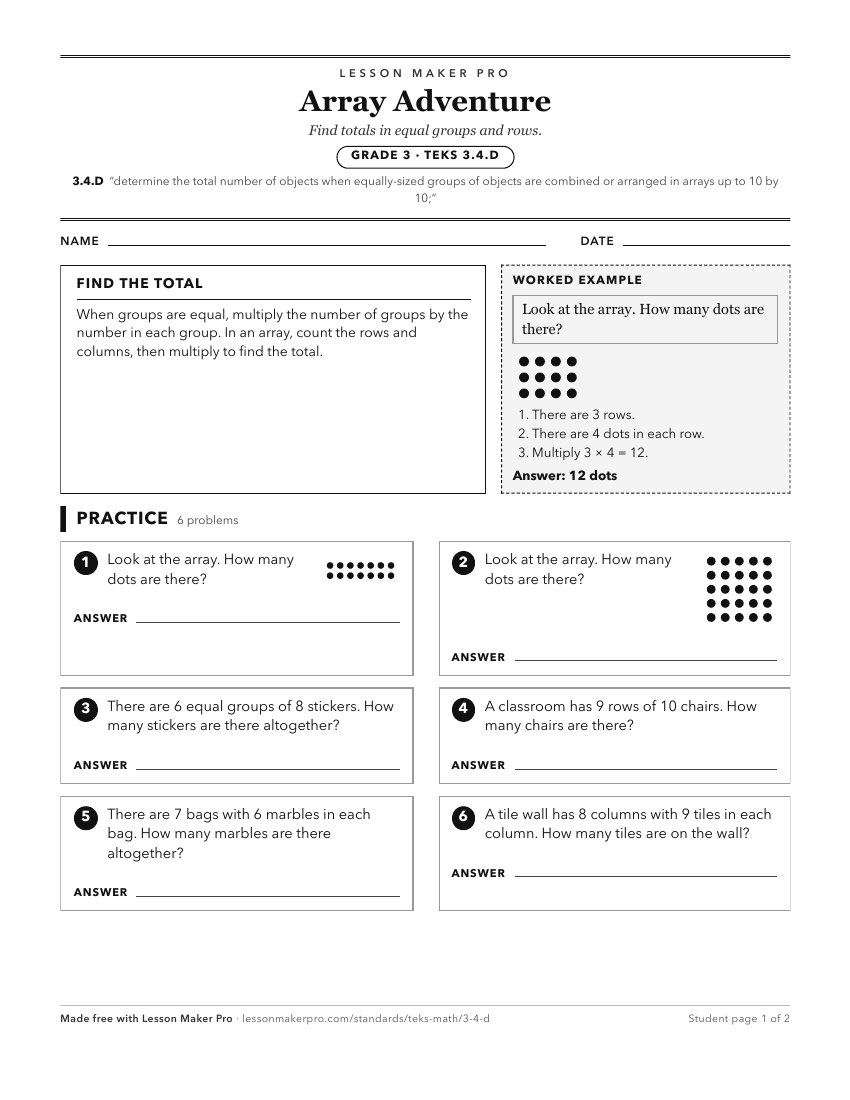
A ready-to-print activity worksheet aligned to 3.4.D, with an answer key for the teacher on its own page. No account needed.
PDF, US Letter, prints cleanly in black and white.
Download the worksheetKeep exploring
Related Standards
- K.2.C
count a set of objects up to at least 20 and demonstrate that the last number said tells the number of objects in the set regardless of their arrangement or ord...
- K.2.D
recognize instantly the quantity of a small group of objects in organized and random arrangements
- 1.5.B
skip count by twos, fives, and tens to determine the total number of objects up to 120 in a set
- 3.4.H
determine the number of objects in each group when a set of objects is partitioned into equal shares or a set of objects is shared equally
Turn this exact standard into a lesson
Grade, subject, topic, and the complete standard are prefilled. Create one free, no account needed.
Also for this standard:Make a WorksheetMake a QuizMake a Sub Lesson