TEKS Math 3.4.H
The Standard
determine the number of objects in each group when a set of objects is partitioned into equal shares or a set of objects is shared equally
Texas Essential Knowledge and Skills for Mathematics
Teacher's field guide
What This Standard Means
What Students Need to Do
- Students start with a total and a given number of equal groups. They find how many objects belong in each group and show that every group has the same amount.
What Mastery Looks Like
- Students can share or sort a total into a given number of equal groups. They use a drawing, objects, repeated subtraction, or a division equation to find and explain the group size.
Common Misconceptions
- Students may confuse the number of groups with the number in each group. They may make unequal groups, lose track while sharing, or ignore leftover objects.
How to Assess It
- Exit ticket: “Share 24 stickers equally among 6 students. Draw a model and write how many stickers each student receives.”
Lesson moves
Ways to Teach It
Give pairs 30 counters and task cards naming different numbers of groups, then have them share the counters equally and record each result.
Ask, “How are 18 objects in 3 groups different from groups of 3?” Students draw and explain both situations.
Play a card game where students draw total and group cards, build equal groups with cubes, and earn points for correct group sizes.
Plan equal snack bags by dividing 24 crackers among 4, 6, or 8 students and comparing how many crackers each receives.
Free download
Printable 3.4.H Worksheet
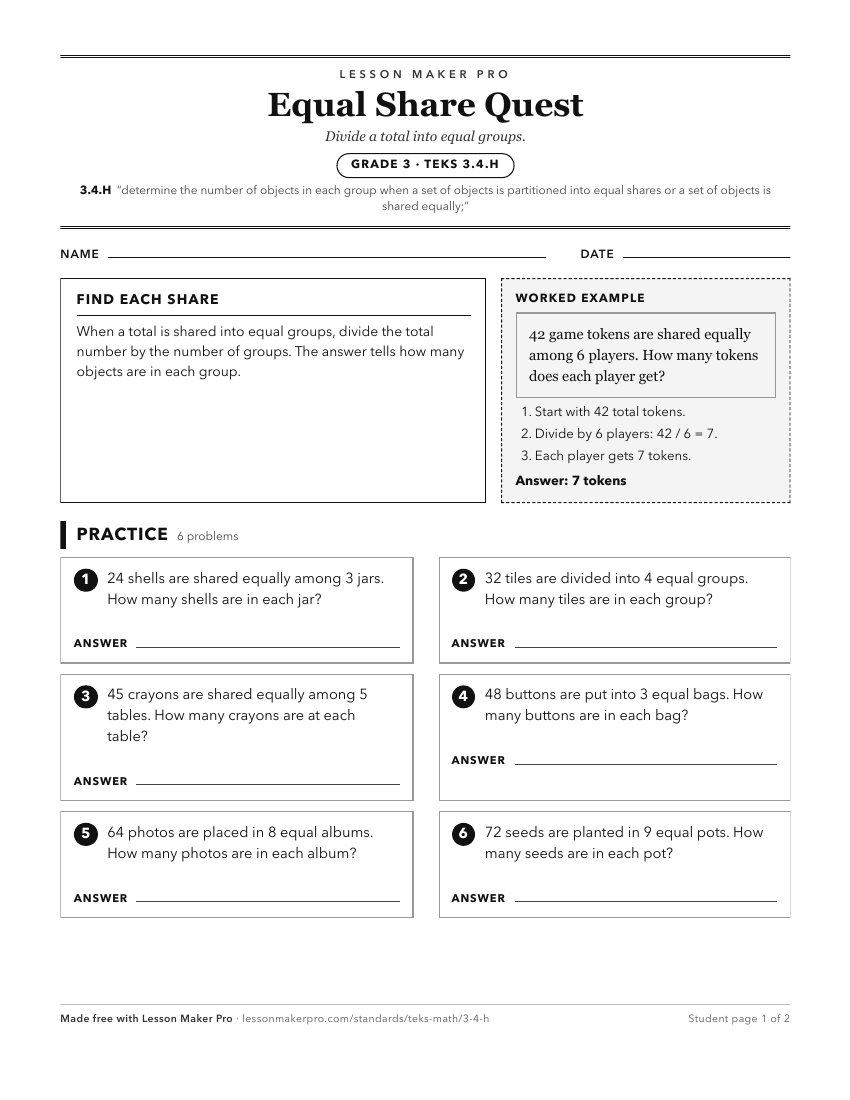
A ready-to-print activity worksheet aligned to 3.4.H, with an answer key for the teacher on its own page. No account needed.
PDF, US Letter, prints cleanly in black and white.
Download the worksheetKeep exploring
Related Standards
- 3.3.E
solve problems involving partitioning an object or a set of objects among two or more recipients using pictorial representations of fractions with denominators ...
- 1.6.G
partition two-dimensional figures into two and four fair shares or equal parts and describe the parts using words
- 3.4.D
determine the total number of objects when equally-sized groups of objects are combined or arranged in arrays up to 10 by 10
- 2.3.A
partition objects into equal parts and name the parts, including halves, fourths, and eighths, using words
Turn this exact standard into a lesson
Grade, subject, topic, and the complete standard are prefilled. Create one free, no account needed.
Also for this standard:Make a WorksheetMake a QuizMake a Sub Lesson