TEKS Math K.2.C
The Standard
count a set of objects up to at least 20 and demonstrate that the last number said tells the number of objects in the set regardless of their arrangement or order
Texas Essential Knowledge and Skills for Mathematics
Teacher's field guide
What This Standard Means
What Students Need to Do
- Students match one number word to each object by touching or moving objects as they count. They use the final number named as the total. They understand that moving the objects does not change how many there are.
What Mastery Looks Like
- A student touches or moves each object once while counting a set of up to 20. The student states the total without recounting. After the objects are rearranged, the student knows the quantity stays the same.
Common Misconceptions
- Some students say the number sequence correctly but skip objects or count one object twice. Others think rearranging a set changes its total. They may also believe a spread-out group has more objects than a close group.
How to Assess It
- Give each student 17 counters. Ask the student to count them, state the total, rearrange them, and explain whether the total changed.
Lesson moves
Ways to Teach It
Give pairs bags of 6 to 20 buttons; students count, record the total, rearrange the buttons, and confirm the same total.
Show 14 counters in a line and a circle, then ask, “How do you know both groups have the same amount?”
Play Count and Cover: students draw a numeral card, count that many cubes, then cover the matching picture card.
Count classroom supplies, such as 18 crayons, then spread them across a table and check whether the quantity changed.
Free download
Printable K.2.C Worksheet
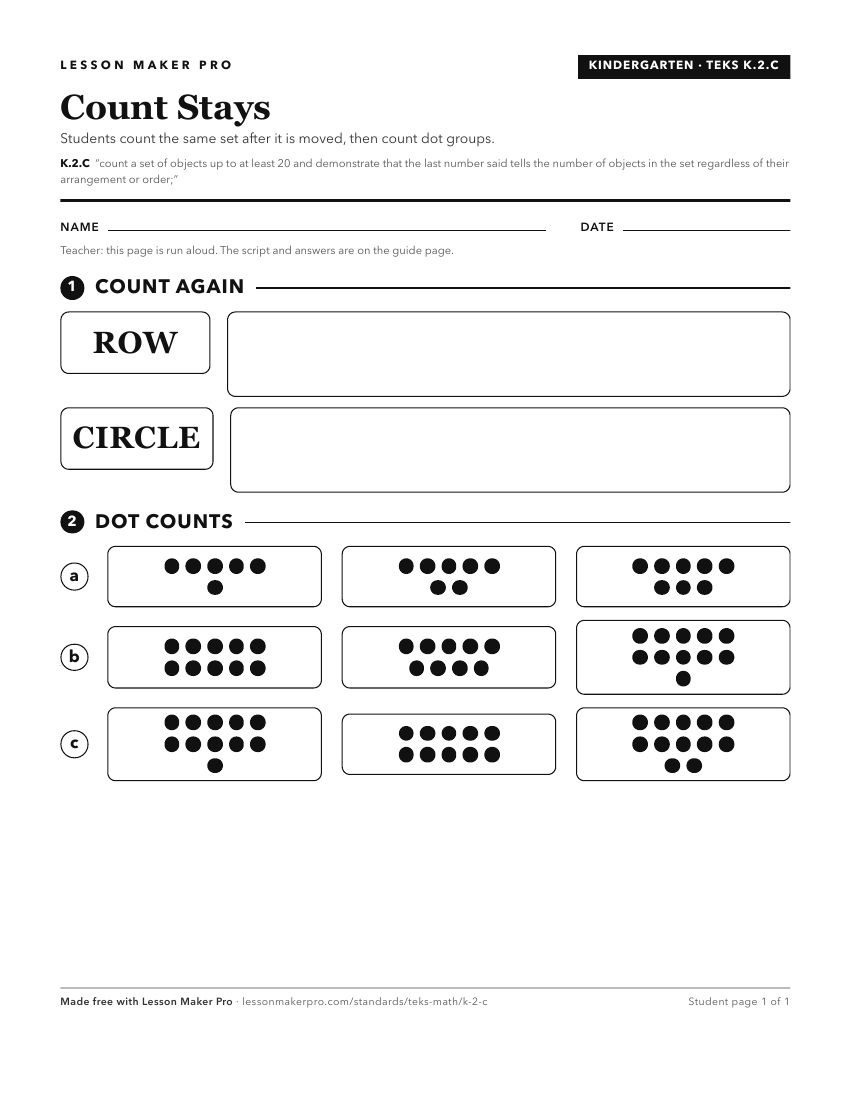
A ready-to-print activity worksheet aligned to K.2.C, with an answer key for the teacher on its own page. No account needed.
PDF, US Letter, prints cleanly in black and white.
Download the worksheetKeep exploring
Related Standards
- K.2.G
compare sets of objects up to at least 20 in each set using comparative language
- 3.4.D
determine the total number of objects when equally-sized groups of objects are combined or arranged in arrays up to 10 by 10
- K.2.A
count forward and backward to at least 20 with and without objects
- 1.5.B
skip count by twos, fives, and tens to determine the total number of objects up to 120 in a set
Turn this exact standard into a lesson
Grade, subject, topic, and the complete standard are prefilled. Create one free, no account needed.
Also for this standard:Make a WorksheetMake a QuizMake a Sub Lesson