TEKS Math 1.2.A
The Standard
recognize instantly the quantity of structured arrangements
Texas Essential Knowledge and Skills for Mathematics
Teacher's field guide
What This Standard Means
What Students Need to Do
- Students name how many objects they see in familiar patterns without counting each object one by one. They use smaller groups, such as 5 and 2, to explain how they knew.
What Mastery Looks Like
- Students quickly name the quantity shown on dot cards, dominoes, fingers, or ten-frames. They explain their thinking with parts, such as seeing 5 and 2 to make 7.
Common Misconceptions
- Some students still touch-count every dot. Others rely on one familiar position and hesitate when a pattern is rotated. They may see 5 and 3 but name only 5 instead of combining the groups.
How to Assess It
- Flash three dot cards for two seconds each. Students write each quantity, then explain the groups they saw on one card.
Lesson moves
Ways to Teach It
Give pairs counters and ten-frames; one student builds a quantity, covers it, then flashes it for a partner to name.
Flash a dot card, then ask students to write the number and explain which smaller groups they saw.
Play Quick Look: flash dominoes for two seconds, and students hold up matching numeral cards without touch-counting.
Show photos of egg cartons, muffin trays, and bus seats, then have students name quantities from the visible rows and groups.
Free download
Printable 1.2.A Worksheet
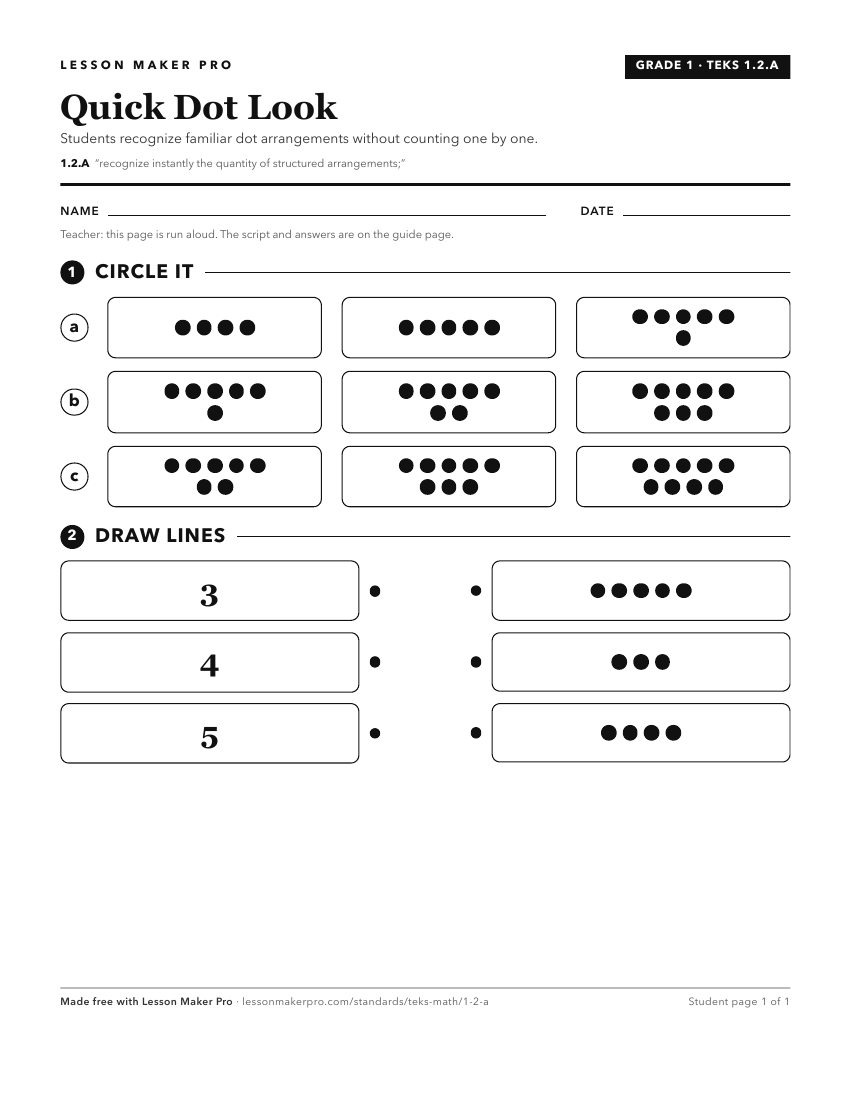
A ready-to-print activity worksheet aligned to 1.2.A, with an answer key for the teacher on its own page. No account needed.
PDF, US Letter, prints cleanly in black and white.
Download the worksheetKeep exploring
Related Standards
- K.2.D
recognize instantly the quantity of a small group of objects in organized and random arrangements
- 5.4.D
recognize the difference between additive and multiplicative numerical patterns given in a table or graph
- 3.4.D
determine the total number of objects when equally-sized groups of objects are combined or arranged in arrays up to 10 by 10
- 8.5.G
identify functions using sets of ordered pairs, tables, mappings, and graphs
Turn this exact standard into a lesson
Grade, subject, topic, and the complete standard are prefilled. Create one free, no account needed.
Also for this standard:Make a WorksheetMake a QuizMake a Sub Lesson