TEKS Math 5.4.D
The Standard
recognize the difference between additive and multiplicative numerical patterns given in a table or graph
Texas Essential Knowledge and Skills for Mathematics
Teacher's field guide
What This Standard Means
What Students Need to Do
- Students examine consecutive values in a table or points on a graph. They decide whether the pattern uses a constant added amount or a constant multiplication factor.
What Mastery Looks Like
- Students correctly classify a pattern and name the repeated operation. They use consecutive table values or graph points as evidence. They can continue the pattern accurately.
Common Misconceptions
- Students may call any increasing pattern additive. They may compare each input with its output instead of comparing consecutive values. They may also mistake doubling for adding two.
How to Assess It
- Exit ticket: Classify 3, 7, 11, 15 and 3, 6, 12, 24. Write the operation that proves each choice.
Lesson moves
Ways to Teach It
Give pairs tiles to build 2, 4, 8, 16 and counters to build 2, 4, 6, 8, then compare changes.
Ask students to explain why 5, 10, 20, 40 is not an add-five pattern, using two consecutive pairs as evidence.
Play Pattern Sort with cards showing tables and graphs, and have teams place each under additive or multiplicative headings.
Compare a savings plan adding $5 weekly with a video view count doubling daily, then create tables for both situations.
Free download
Printable 5.4.D Worksheet
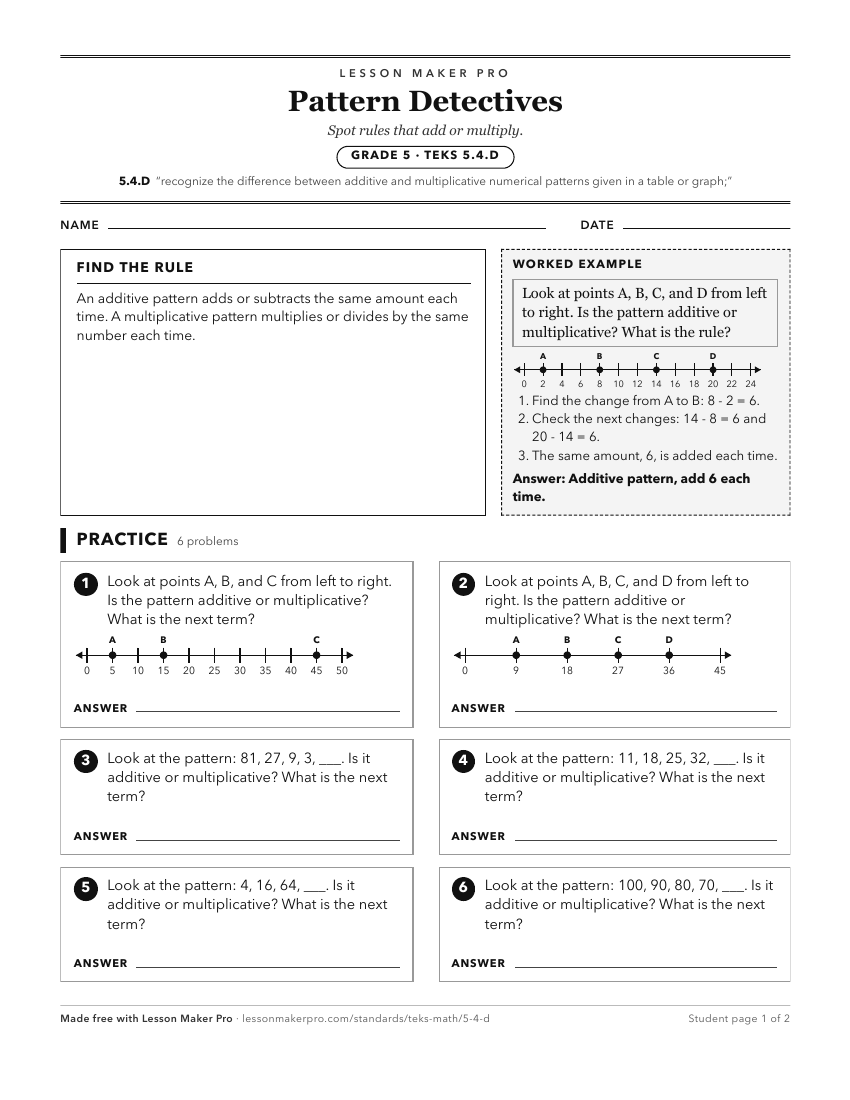
A ready-to-print activity worksheet aligned to 5.4.D, with an answer key for the teacher on its own page. No account needed.
PDF, US Letter, prints cleanly in black and white.
Download the worksheetKeep exploring
Related Standards
- 4.5.B
represent problems using an input-output table and numerical expressions to generate a number pattern that follows a given rule representing the relationship of...
- 6.4.A
compare two rules verbally, numerically, graphically, and symbolically in the form of y = ax or y = x + a in order to differentiate between additive and multipl...
- 5.4.C
generate a numerical pattern when given a rule in the form y = ax or y = x + a and graph
- 6.6.A
identify independent and dependent quantities from tables and graphs
Turn this exact standard into a lesson
Grade, subject, topic, and the complete standard are prefilled. Create one free, no account needed.
Also for this standard:Make a WorksheetMake a QuizMake a Sub Lesson