TEKS Math 4.5.B
The Standard
represent problems using an input-output table and numerical expressions to generate a number pattern that follows a given rule representing the relationship of the values in the resulting sequence and their position in the sequence
Texas Essential Knowledge and Skills for Mathematics
Teacher's field guide
What This Standard Means
What Students Need to Do
- Students connect each term's position to its value in a number pattern. They complete input-output tables and use the position number in a numerical expression to calculate terms.
What Mastery Looks Like
- Students complete missing values in a table and explain how each position produces its value. They can find a later term by writing and evaluating an expression instead of extending the pattern one step at a time.
Common Misconceptions
- Students may focus only on how much the terms increase and ignore the term's position. They may reverse the table columns or make an off-by-one error when the first value includes an added amount.
How to Assess It
- Give positions 1, 2, and 3 with values 7, 11, and 15. Ask students to find the sixth value and write the numerical expression 4 × 6 + 3.
Lesson moves
Ways to Teach It
Build growing cube towers, label each stage, record cube totals in a table, and write a numerical expression for stage 6.
Compare 4, 7, 10 and 3, 6, 9, then explain why equal increases can still produce different position rules.
Play Rule Detective with cards showing partial tables, and have pairs identify the rule and calculate two missing values.
Use an $8 ticket price plus a $5 booking fee, then make a table for ticket quantities and total costs.
Free download
Printable 4.5.B Worksheet
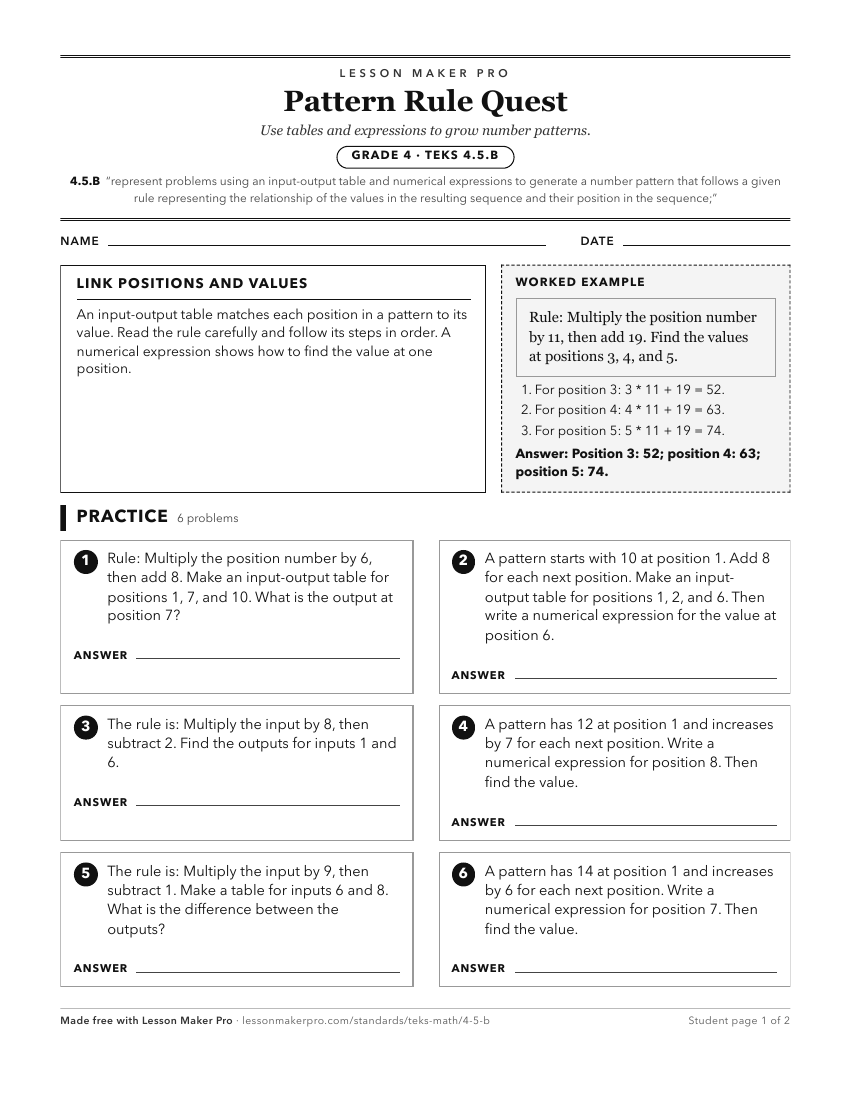
A ready-to-print activity worksheet aligned to 4.5.B, with an answer key for the teacher on its own page. No account needed.
PDF, US Letter, prints cleanly in black and white.
Download the worksheetKeep exploring
Related Standards
- 1.5
The student applies mathematical process standards to identify and apply number patterns within properties of numbers and operations in order to describe relati...
- 5.4.D
recognize the difference between additive and multiplicative numerical patterns given in a table or graph
- 5.4.C
generate a numerical pattern when given a rule in the form y = ax or y = x + a and graph
- 4.5.A
represent multi-step problems involving the four operations with whole numbers using strip diagrams and equations with a letter standing for the unknown quantit...
Turn this exact standard into a lesson
Grade, subject, topic, and the complete standard are prefilled. Create one free, no account needed.
Also for this standard:Make a WorksheetMake a QuizMake a Sub Lesson