TEKS Math 1.2
Knowledge and Skills Statement (Standard Cluster)
The student applies mathematical process standards to represent and compare whole numbers, the relative position and magnitude of whole numbers, and relationships within the numeration system related to place value
Texas Essential Knowledge and Skills for Mathematics
Cluster contents
Student Expectations in This Statement
1.2 is a knowledge and skills statement. These are the student expectations under it.
- 1.2.A
recognize instantly the quantity of structured arrangements
- 1.2.B
use concrete and pictorial models to compose and decompose numbers up to 120 in more than one way as so many hundreds, so many tens, and so many ones
- 1.2.C
use objects, pictures, and expanded and standard forms to represent numbers up to 120
- 1.2.D
generate a number that is greater than or less than a given whole number up to 120
- 1.2.E
use place value to compare whole numbers up to 120 using comparative language
- 1.2.F
order whole numbers up to 120 using place value and open number lines
- 1.2.G
represent the comparison of two numbers to 100 using the symbols >, <, or =
Teacher's field guide
What This Cluster Means
What Students Need to Do
- Students quickly name how many objects appear in familiar patterns without counting one by one. They build, draw, write, compare, and order numbers through 120 using hundreds, tens, ones, and number lines. They use >, <, and = to record comparisons through 100.
What Mastery Looks Like
- A student sees structured dot groups and names the total without counting each dot. Given 114, the student can build or draw it, write 100 + 10 + 4 and 114, and regroup it as 11 tens and 4 ones. The student orders numbers on an open number line and explains comparisons using place value.
Common Misconceptions
- Students may count every dot even when the arrangement shows clear groups of five or ten. They often read 102 as 12, ignore zero as a placeholder, or think 98 is greater than 102 because 8 is greater than 2. They may reverse < and > or space numbers incorrectly on an open number line.
How to Assess It
- Exit ticket: Show 64 with tens and ones in two ways, write its expanded form, and name one smaller and one larger number. Then complete 64 __ 46 and place 46, 64, and 70 on an open number line.
Lesson moves
Ways to Teach It
Give pairs base-ten blocks to build 114, then rebuild it as 11 tens and 4 ones and sketch both models.
Ask which is greater, 102 or 98; students write two sentences using hundreds, tens, and ones to justify their answer.
Flash dot cards arranged in fives and tens for two seconds; students call the total and earn a point for explaining the groups.
Bundle 83 craft sticks into tens and ones, label the amount, then compare it with a classmate’s bundle using a symbol.
Free download
Printable 1.2 Worksheet
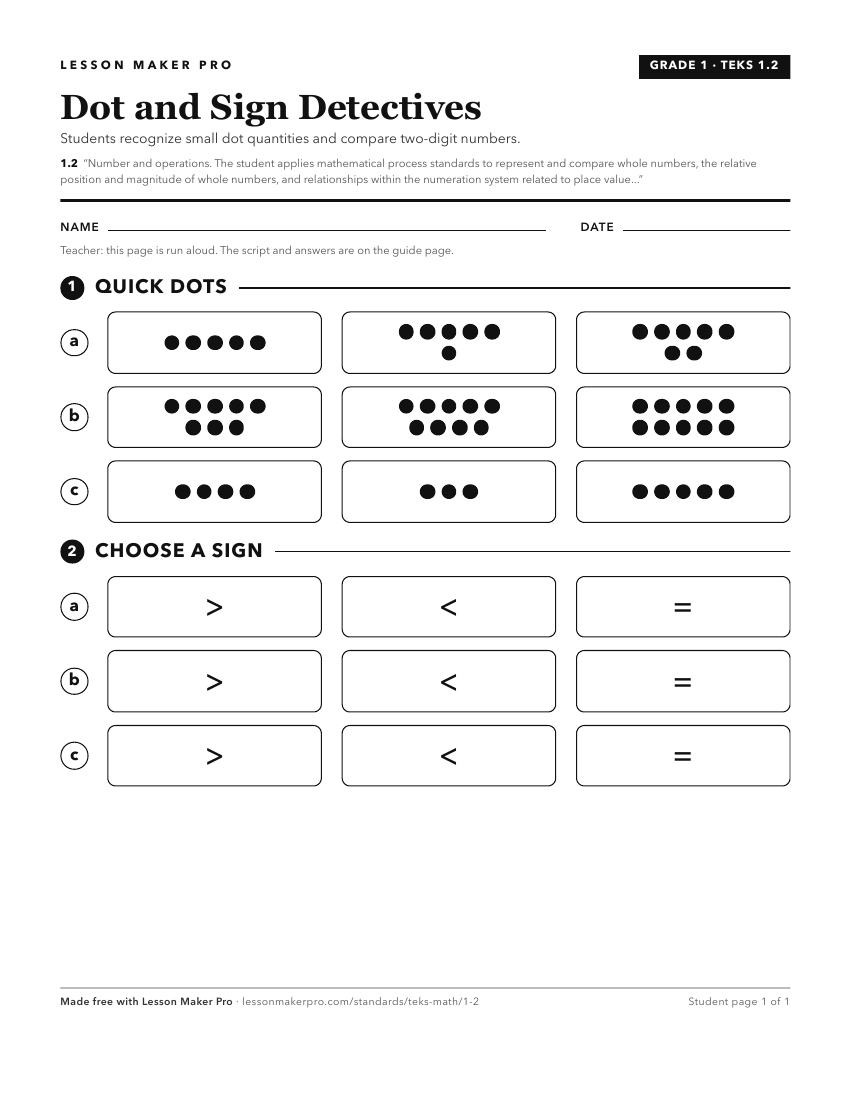
A ready-to-print activity worksheet aligned to 1.2, with an answer key for the teacher on its own page. No account needed.
PDF, US Letter, prints cleanly in black and white.
Download the worksheetKeep exploring
Related Standards
- 5.2
The student applies mathematical process standards to represent, compare, and order positive rational numbers and understand relationships as related to place v...
- K.2
The student applies mathematical process standards to understand how to represent and compare whole numbers, the relative position and magnitude of whole number...
- 4.2
The student applies mathematical process standards to represent, compare, and order whole numbers and decimals and understand relationships related to place val...
- 8.2
The student applies mathematical process standards to represent and use real numbers in a variety of forms
Turn this cluster into a lesson
Grade, subject, topic, and the complete cluster are prefilled. Create one free, no account needed.
Also for this cluster:Make a WorksheetMake a QuizMake a Sub Lesson