TEKS Math 4.4
Knowledge and Skills Statement (Standard Cluster)
The student applies mathematical process standards to develop and use strategies and methods for whole number computations and decimal sums and differences in order to solve problems with efficiency and accuracy
Texas Essential Knowledge and Skills for Mathematics
Cluster contents
Student Expectations in This Statement
4.4 is a knowledge and skills statement. These are the student expectations under it.
- 4.4.A
add and subtract whole numbers and decimals to the hundredths place using the standard algorithm
- 4.4.B
determine products of a number and 10 or 100 using properties of operations and place value understandings
- 4.4.C
represent the product of 2 two-digit numbers using arrays, area models, or equations, including perfect squares through 15 by 15
- 4.4.D
use strategies and algorithms, including the standard algorithm, to multiply up to a four-digit number by a one-digit number and to multiply a two-digit number ...
- 4.4.E
represent the quotient of up to a four-digit whole number divided by a one-digit whole number using arrays, area models, or equations
- 4.4.F
use strategies and algorithms, including the standard algorithm, to divide up to a four-digit dividend by a one-digit divisor
- 4.4.G
round to the nearest 10, 100, or 1,000 or use compatible numbers to estimate solutions involving whole numbers
- 4.4.H
solve with fluency one- and two-step problems involving multiplication and division, including interpreting remainders
Teacher's field guide
What This Cluster Means
What Students Need to Do
- Students add and subtract whole numbers and decimals through hundredths, then estimate to check their answers. They multiply larger whole numbers and divide up to four-digit numbers using models, properties, and written methods. They solve one-step and two-step problems and interpret remainders.
What Mastery Looks Like
- Students line up decimal places, regroup accurately, and choose an efficient multiplication or division method. They connect arrays and area models to equations, check answers with estimates, and explain what remainders mean in context.
Common Misconceptions
- Students may line up decimal digits instead of decimal points or shift digits without using place value. They may omit a partial product or skip a zero in a quotient. They often report a remainder without deciding whether to round up, drop it, or name it.
How to Assess It
- Use a four-item exit ticket: 46.38 − 7.9, 28 × 34, 1,248 ÷ 6, and “How many 8-seat vans are needed for 59 students?” Require an estimate for one calculation.
Lesson moves
Ways to Teach It
Use base-ten blocks and grid paper to model 23 × 14, then match the model to partial products and the written algorithm.
Ask, “A bus holds 36 people; how many buses carry 250 people?” and have students defend how they handled the remainder.
Deal digit cards to build two-digit factors; partners solve, estimate, and verify each product with an area model.
Give pairs a grocery ad and $20; they total three prices to the hundredths, find change, and check by estimating.
Free download
Printable 4.4 Worksheet
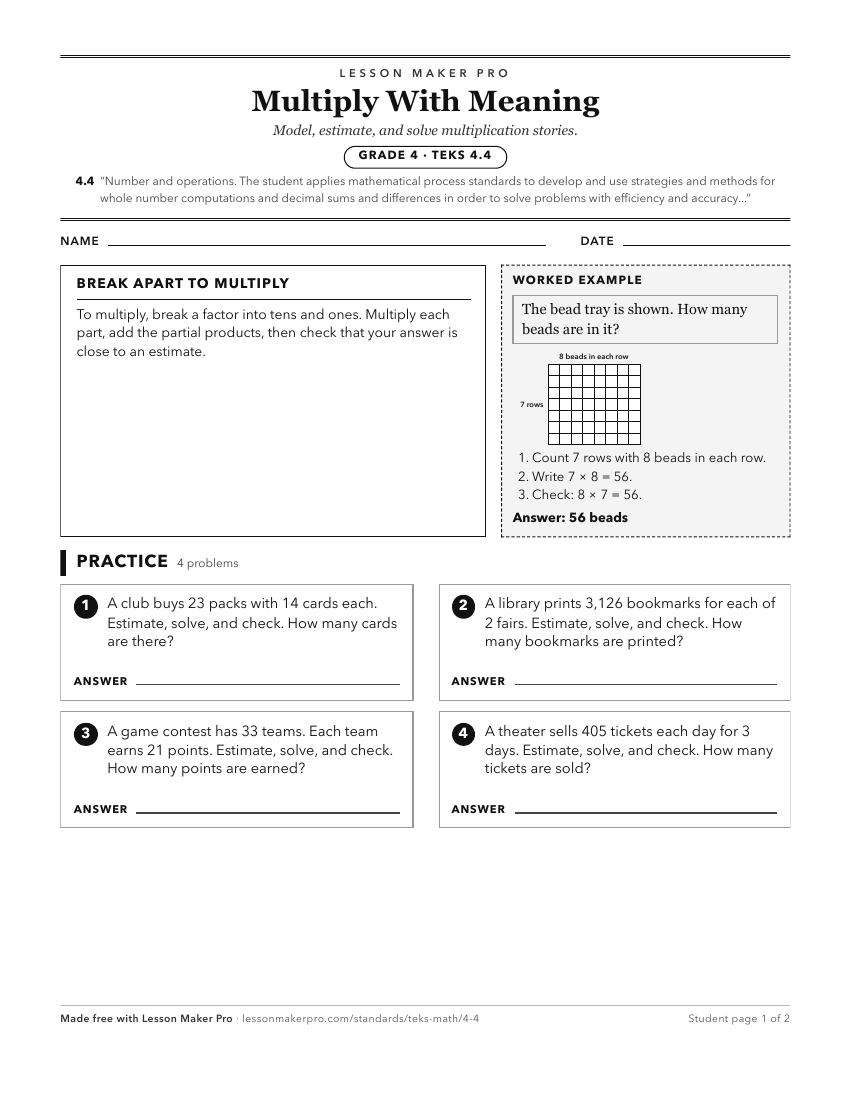
A ready-to-print activity worksheet aligned to 4.4, with an answer key for the teacher on its own page. No account needed.
PDF, US Letter, prints cleanly in black and white.
Download the worksheetKeep exploring
Related Standards
- K.2
The student applies mathematical process standards to understand how to represent and compare whole numbers, the relative position and magnitude of whole number...
- 5.3
The student applies mathematical process standards to develop and use strategies and methods for positive rational number computations in order to solve problem...
- 1.3
The student applies mathematical process standards to develop and use strategies for whole number addition and subtraction computations in order to solve proble...
- 4.2
The student applies mathematical process standards to represent, compare, and order whole numbers and decimals and understand relationships related to place val...
Turn this cluster into a lesson
Grade, subject, topic, and the complete cluster are prefilled. Create one free, no account needed.
Also for this cluster:Make a WorksheetMake a QuizMake a Sub Lesson