TEKS Math 1.3
Knowledge and Skills Statement (Standard Cluster)
The student applies mathematical process standards to develop and use strategies for whole number addition and subtraction computations in order to solve problems
Texas Essential Knowledge and Skills for Mathematics
Cluster contents
Student Expectations in This Statement
1.3 is a knowledge and skills statement. These are the student expectations under it.
- 1.3.A
use concrete and pictorial models to determine the sum of a multiple of 10 and a one-digit number in problems up to 99
- 1.3.B
use objects and pictorial models to solve word problems involving joining, separating, and comparing sets within 20 and unknowns as any one of the terms in the ...
- 1.3.C
compose 10 with two or more addends with and without concrete objects
- 1.3.D
apply basic fact strategies to add and subtract within 20, including making 10 and decomposing a number leading to a 10
- 1.3.E
explain strategies used to solve addition and subtraction problems up to 20 using spoken words, objects, pictorial models, and number sentences
- 1.3.F
generate and solve problem situations when given a number sentence involving addition or subtraction of numbers within 20
Teacher's field guide
What This Cluster Means
What Students Need to Do
- Students model and solve addition and subtraction situations with numbers within 20. They find missing numbers in any position, make 10, break numbers apart, and explain their strategy. They also combine a multiple of 10 with a one-digit number, such as 30 + 8.
What Mastery Looks Like
- Students solve addition and subtraction problems within 20, including equations with the unknown in different places. They use make-ten or break-apart strategies and explain their work with objects, drawings, words, and equations. They also solve a multiple of 10 plus one digit and create a matching story problem.
Common Misconceptions
- Students may treat 40 as 4 ones, or solve 40 + 6 as 100 by adding 4 + 6 and attaching a zero. They may assume the blank always comes last, or choose addition whenever a story says “more.” They may make 10 correctly but forget to add the remaining part.
How to Assess It
- Give an exit ticket with three prompts: draw and solve 50 + 7, find the missing number in 8 + ___ = 13, and write a story for 14 - 6. Ask students to label or explain one strategy.
Lesson moves
Ways to Teach It
Build 40 + 7 with bundled straws and single straws, then draw the model and write the equation.
Ask students to solve 8 + 7 two ways, then write which strategy was easier and why.
Play Missing Number Match by pairing equation cards such as 6 + ___ = 14 with cards showing the correct missing number.
Set up a class snack shop where students write and solve joining, separating, or comparing stories using item counts within 20.
Free download
Printable 1.3 Worksheet
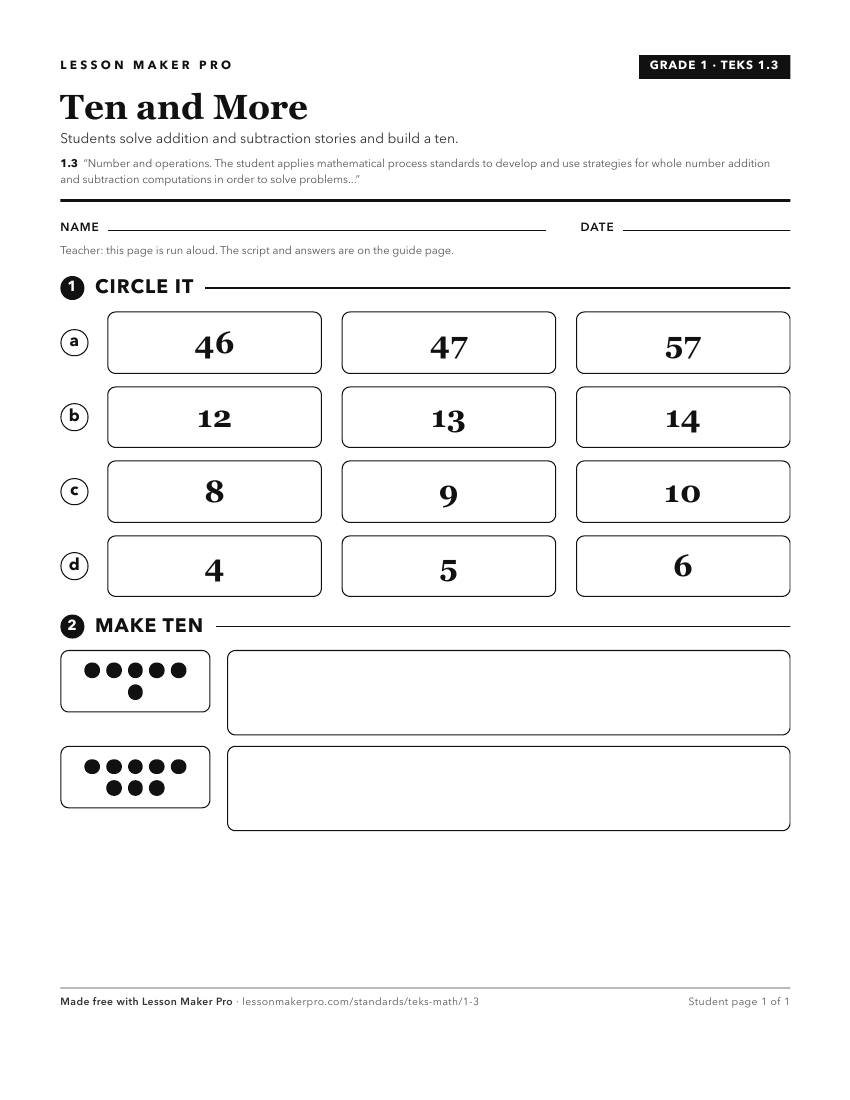
A ready-to-print activity worksheet aligned to 1.3, with an answer key for the teacher on its own page. No account needed.
PDF, US Letter, prints cleanly in black and white.
Download the worksheetKeep exploring
Related Standards
- 4.4
The student applies mathematical process standards to develop and use strategies and methods for whole number computations and decimal sums and differences in o...
- 6.3
The student applies mathematical process standards to represent addition, subtraction, multiplication, and division while solving problems and justifying soluti...
- 7.3
The student applies mathematical process standards to add, subtract, multiply, and divide while solving problems and justifying solutions
- K.3
The student applies mathematical process standards to develop an understanding of addition and subtraction situations in order to solve problems
Turn this cluster into a lesson
Grade, subject, topic, and the complete cluster are prefilled. Create one free, no account needed.
Also for this cluster:Make a WorksheetMake a QuizMake a Sub Lesson