TEKS Math 1.3.D
The Standard
apply basic fact strategies to add and subtract within 20, including making 10 and decomposing a number leading to a 10
Texas Essential Knowledge and Skills for Mathematics
Teacher's field guide
What This Standard Means
What Students Need to Do
- Students solve addition and subtraction facts within 20 by using 10 as a helpful stopping point. They split one number into parts, make or reach 10, then finish the calculation.
What Mastery Looks Like
- Students solve addition and subtraction facts within 20 by making or using 10. They break apart numbers accurately, record their steps, and explain why the answer stays the same.
Common Misconceptions
- Students may count every object instead of using a known fact or making 10. They may split the wrong number, change the total, or confuse addition and subtraction steps.
How to Assess It
- Give students 8 + 7 and 14 - 6. Ask them to solve each by making 10 and show how they split a number.
Lesson moves
Ways to Teach It
Give students two-color counters and ten-frames to model 8 + 6, moving counters to fill the first frame before finding the total.
Ask, “How can making 10 help solve 13 - 5?” Have partners draw a model and explain each step.
Play Make Ten Match with cards showing facts, decompositions, and answers, such as 9 + 6, 9 + 1 + 5, and 15.
Set up a pretend store where students combine or remove up to 20 small items and record each calculation using a make-10 strategy.
Free download
Printable 1.3.D Worksheet
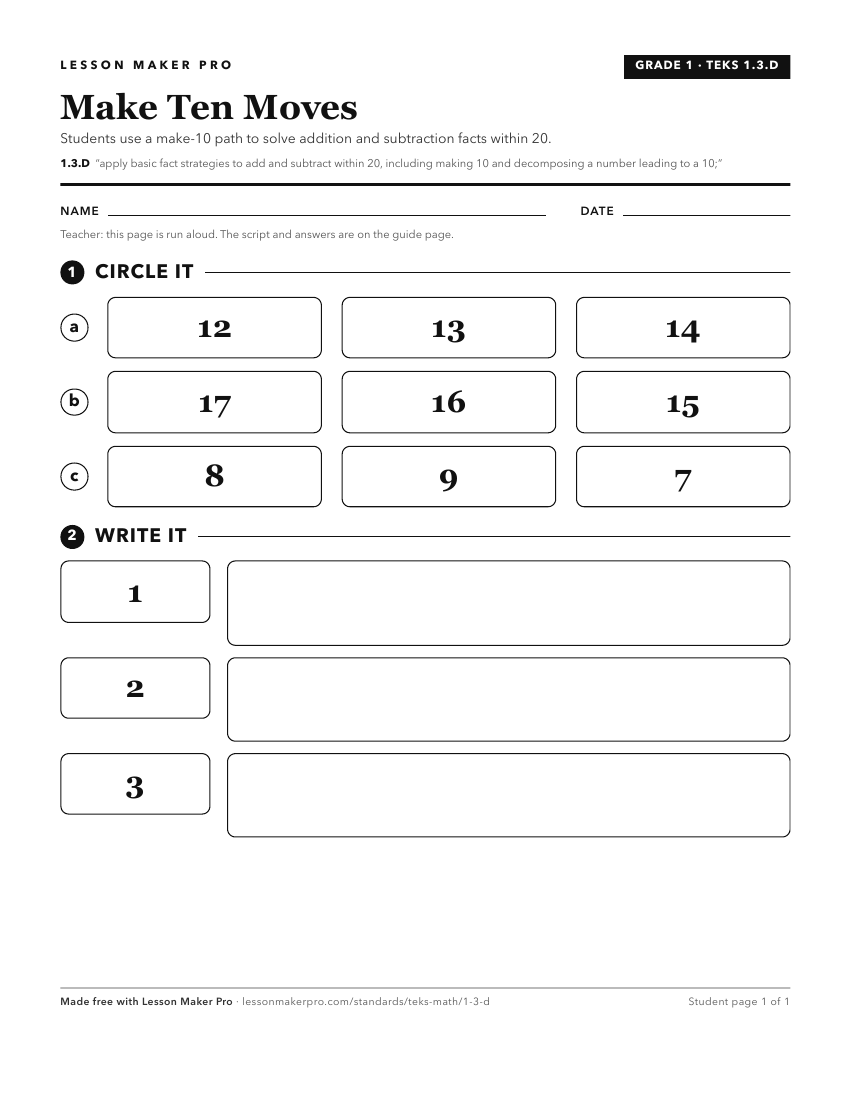
A ready-to-print activity worksheet aligned to 1.3.D, with an answer key for the teacher on its own page. No account needed.
PDF, US Letter, prints cleanly in black and white.
Download the worksheetKeep exploring
Related Standards
- K.3.C
explain the strategies used to solve problems involving adding and subtracting within 10 using spoken words, concrete and pictorial models, and number sentences
- 1.3.E
explain strategies used to solve addition and subtraction problems up to 20 using spoken words, objects, pictorial models, and number sentences
- 2.4.A
recall basic facts to add and subtract within 20 with automaticity
- 1.3.F
generate and solve problem situations when given a number sentence involving addition or subtraction of numbers within 20
Turn this exact standard into a lesson
Grade, subject, topic, and the complete standard are prefilled. Create one free, no account needed.
Also for this standard:Make a WorksheetMake a QuizMake a Sub Lesson