TEKS Math 6.3
Knowledge and Skills Statement (Standard Cluster)
The student applies mathematical process standards to represent addition, subtraction, multiplication, and division while solving problems and justifying solutions
Texas Essential Knowledge and Skills for Mathematics
Cluster contents
Student Expectations in This Statement
6.3 is a knowledge and skills statement. These are the student expectations under it.
- 6.3.A
recognize that dividing by a rational number and multiplying by its reciprocal result in equivalent values
- 6.3.B
determine, with and without computation, whether a quantity is increased or decreased when multiplied by a fraction, including values greater than or less than ...
- 6.3.C
represent integer operations with concrete models and connect the actions with the models to standardized algorithms
- 6.3.D
add, subtract, multiply, and divide integers fluently
- 6.3.E
multiply and divide positive rational numbers fluently
Teacher's field guide
What This Cluster Means
What Students Need to Do
- Students use models and standard algorithms to add, subtract, multiply, and divide integers. They multiply and divide positive fractions and decimals, connect division to multiplying by a reciprocal, and predict how fractional factors change a positive quantity.
What Mastery Looks Like
- A student predicts whether a fractional factor makes a positive quantity larger or smaller and explains why. They model integer operations, compute integer and positive rational operations accurately, and rewrite division as multiplication by the reciprocal.
Common Misconceptions
- Students often think multiplying by any fraction makes a number smaller and division always makes it smaller. They may flip the first number, or both numbers, when rewriting division as multiplication by a reciprocal. Integer sign rules, subtracting a negative, and decimal placement are common trouble spots.
How to Assess It
- Use a five-part exit ticket: rewrite 3 ÷ 2/5 as multiplication, compare 12 × 3/4 and 12 × 5/4 with 12, model -3 + 5, calculate -18 ÷ 3, and find 2.4 × 0.35.
Lesson moves
Ways to Teach It
Use two-color counters to model -4 + 7 and 5 - 8, then match each model to steps in the standard algorithm.
Ask, “Will 18 × 3/4 and 18 × 5/3 increase or decrease 18?” Have students explain using the size of each factor.
Play Operation Match: students pair integer and fraction problem cards with answers, earning a point only after explaining the sign or reciprocal.
Give a recipe for four servings and ask students to scale it by 3/2, then divide ingredient amounts among equal portions.
Free download
Printable 6.3 Worksheet
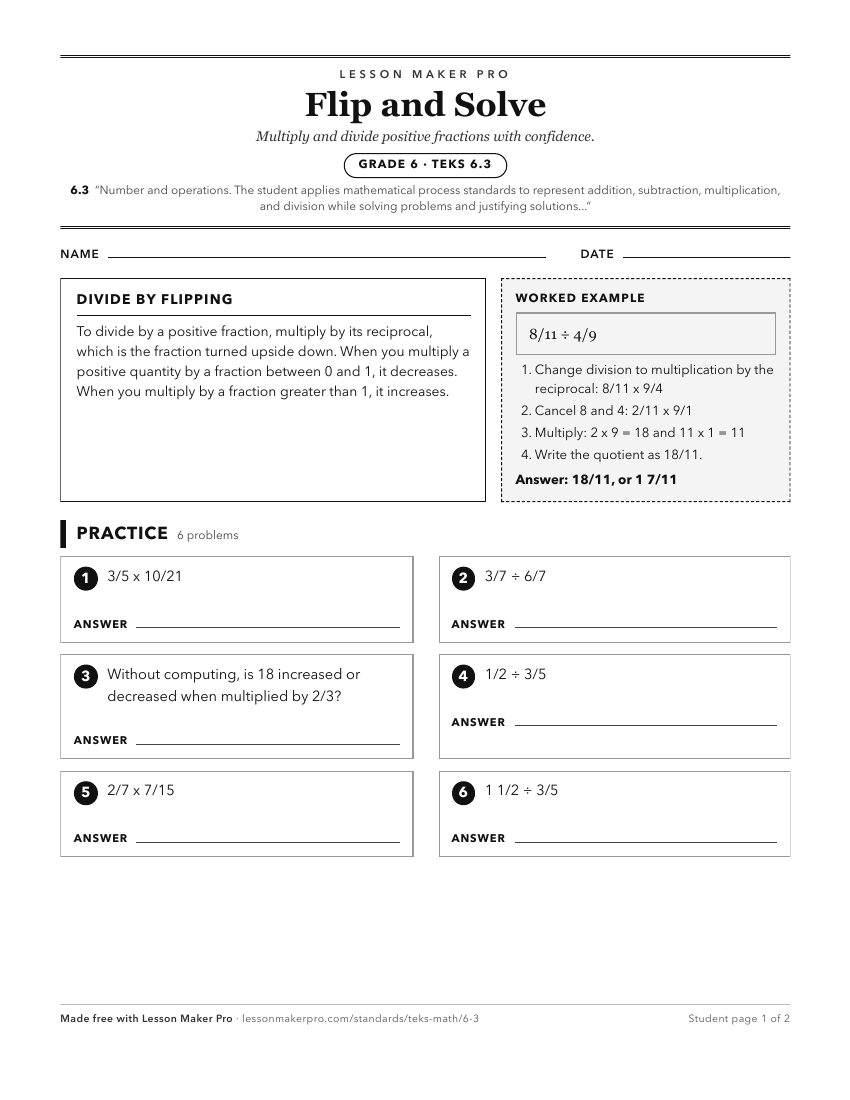
A ready-to-print activity worksheet aligned to 6.3, with an answer key for the teacher on its own page. No account needed.
PDF, US Letter, prints cleanly in black and white.
Download the worksheetKeep exploring
Related Standards
- 6.10
The student applies mathematical process standards to use equations and inequalities to solve problems
- 1.3
The student applies mathematical process standards to develop and use strategies for whole number addition and subtraction computations in order to solve proble...
- 7.3
The student applies mathematical process standards to add, subtract, multiply, and divide while solving problems and justifying solutions
- K.3
The student applies mathematical process standards to develop an understanding of addition and subtraction situations in order to solve problems
Turn this cluster into a lesson
Grade, subject, topic, and the complete cluster are prefilled. Create one free, no account needed.
Also for this cluster:Make a WorksheetMake a QuizMake a Sub Lesson