TEKS Math 6.3.B
The Standard
determine, with and without computation, whether a quantity is increased or decreased when multiplied by a fraction, including values greater than or less than one
Texas Essential Knowledge and Skills for Mathematics
Teacher's field guide
What This Standard Means
What Students Need to Do
- Students decide whether multiplying a positive quantity by a fraction makes it larger, smaller, or unchanged. They use the fraction's relationship to one before calculating, then check when needed.
What Mastery Looks Like
- Students correctly predict how a factor less than, greater than, or equal to one affects a positive quantity. They support predictions with a model, comparison, or calculation.
Common Misconceptions
- Students may think multiplication always makes a number larger. They may also judge a fraction by its numerator or denominator alone instead of comparing it with one.
How to Assess It
- Give this exit ticket: Without calculating, decide whether 24 × 7/8 and 24 × 9/8 are less than or greater than 24. Explain each choice.
Lesson moves
Ways to Teach It
Use fraction strips to model 12 multiplied by 1/2 and 3/2, then place both products beside 12 on a number line.
Ask, “Will 18 × 5/6 be greater or less than 18?” Students write a prediction and explain without multiplying.
Students sort quantity-and-factor cards into increase, decrease, or stay the same, then calculate each product to check.
Scale an eight-cup recipe by 3/4 and 5/4, then compare each new amount with the original recipe.
Free download
Printable 6.3.B Worksheet
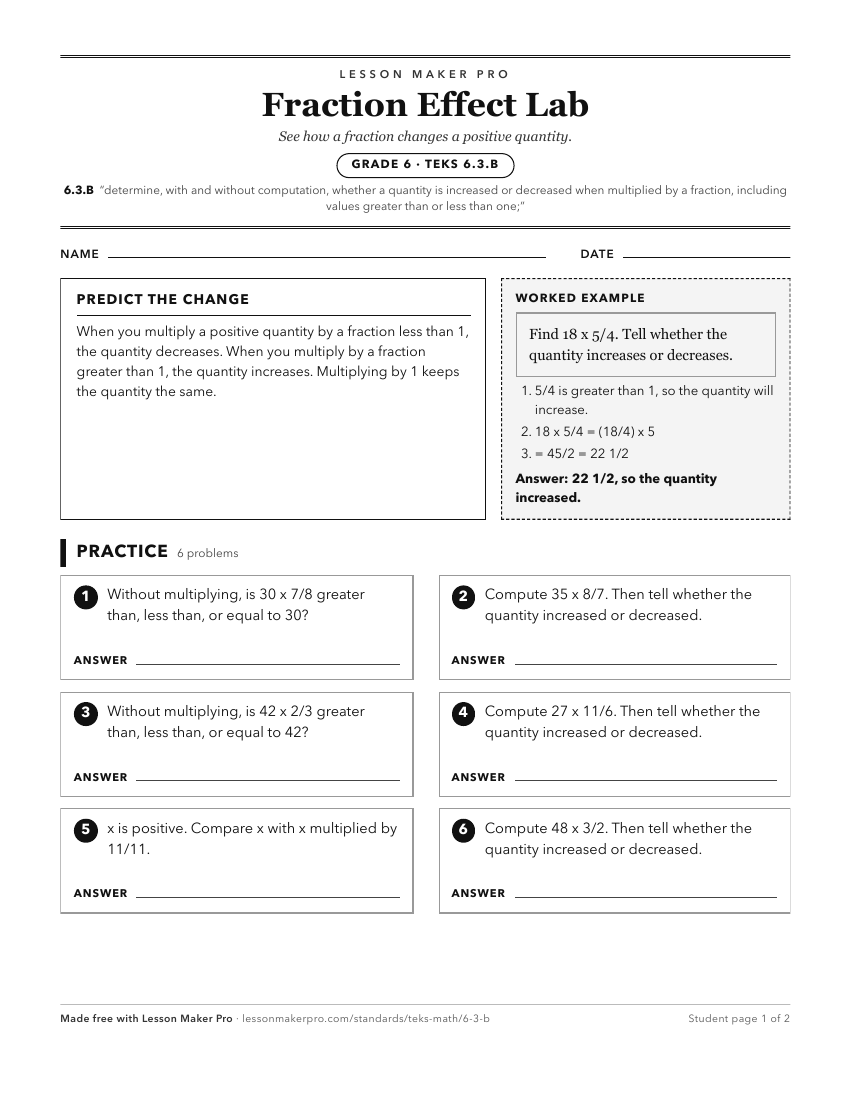
A ready-to-print activity worksheet aligned to 6.3.B, with an answer key for the teacher on its own page. No account needed.
PDF, US Letter, prints cleanly in black and white.
Download the worksheetKeep exploring
Related Standards
- 4.3.F
evaluate the reasonableness of sums and differences of fractions using benchmark fractions 0, 1/4, 1/2, 3/4, and 1, referring to the same whole
- 3.4.J
determine a quotient using the relationship between multiplication and division
- 3.3.H
compare two fractions having the same numerator or denominator in problems by reasoning about their sizes and justifying the conclusion using symbols, words, ob...
- 4.3.D
compare two fractions with different numerators and different denominators and represent the comparison using the symbols >, =, or <
Turn this exact standard into a lesson
Grade, subject, topic, and the complete standard are prefilled. Create one free, no account needed.
Also for this standard:Make a WorksheetMake a QuizMake a Sub Lesson