TEKS Math 3.3.H
The Standard
compare two fractions having the same numerator or denominator in problems by reasoning about their sizes and justifying the conclusion using symbols, words, objects, and pictorial models
Texas Essential Knowledge and Skills for Mathematics
Teacher's field guide
What This Standard Means
What Students Need to Do
- Students decide which fraction in a pair is greater, less, or equal when one number in the fractions matches. They explain their choice with comparison symbols, words, fraction pieces, or drawings.
What Mastery Looks Like
- With matching denominators, students identify the fraction with more selected parts as greater. With matching numerators, they know fewer equal parts means larger pieces. They justify answers with correct symbols, words, and accurate models.
Common Misconceptions
- Students may think a larger denominator always means a larger fraction. They may also reverse the comparison symbol or compare numbers without considering equal-sized wholes.
How to Assess It
- Give students 3/8 and 3/5, then 2/6 and 5/6. Ask them to compare each pair with a symbol and draw one model that proves each answer.
Lesson moves
Ways to Teach It
Fold equal paper strips into fourths and eighths, shade one part on each, then compare 1/4 and 1/8.
Ask, “Mia says 3/8 is greater than 3/5 because 8 is greater than 5. How would you correct her?”
Play Fraction Compare War with cards sharing a numerator or denominator, placing >, <, or = and explaining each choice.
Compare portions of identical granola bars to decide whether 2/6 or 4/6 gives a larger serving, then sketch the proof.
Free download
Printable 3.3.H Worksheet
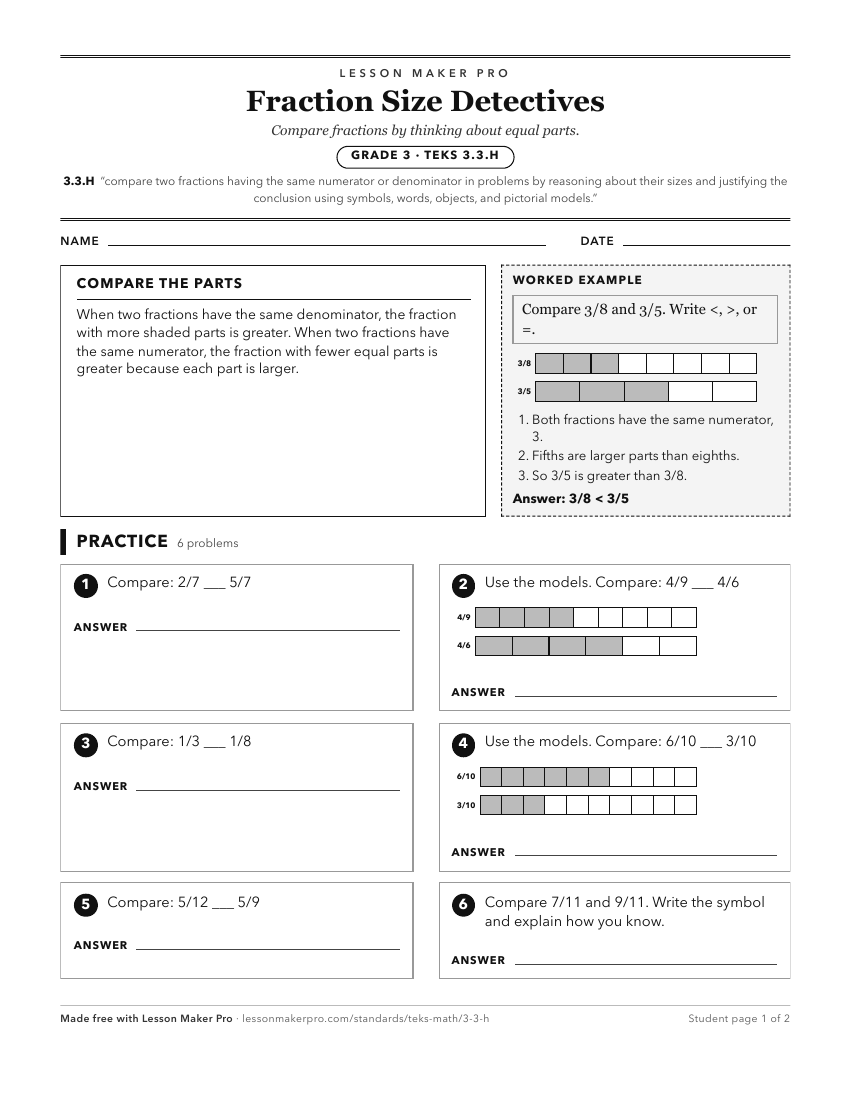
A ready-to-print activity worksheet aligned to 3.3.H, with an answer key for the teacher on its own page. No account needed.
PDF, US Letter, prints cleanly in black and white.
Download the worksheetKeep exploring
Related Standards
- 4.3.B
decompose a fraction in more than one way into a sum of fractions with the same denominator using concrete and pictorial models and recording results with symbo...
- 3.3.G
explain that two fractions are equivalent if and only if they are both represented by the same point on the number line or represent the same portion of a same ...
- 5.3.H
represent and solve addition and subtraction of fractions with unequal denominators referring to the same whole using objects and pictorial models and propertie...
- 4.3.D
compare two fractions with different numerators and different denominators and represent the comparison using the symbols >, =, or <
Turn this exact standard into a lesson
Grade, subject, topic, and the complete standard are prefilled. Create one free, no account needed.
Also for this standard:Make a WorksheetMake a QuizMake a Sub Lesson