TEKS Math 5.3.H
The Standard
represent and solve addition and subtraction of fractions with unequal denominators referring to the same whole using objects and pictorial models and properties of operations
Texas Essential Knowledge and Skills for Mathematics
Teacher's field guide
What This Standard Means
What Students Need to Do
- Students model fraction sums and differences with fraction strips, area models, or number lines. They rename each fraction in equal-sized parts, then add or subtract those parts. Every model must use the same-sized whole.
What Mastery Looks Like
- A student can solve 2/3 plus 1/4 by partitioning both fractions into twelfths and showing 11/12. The student can model subtraction the same way and connect each model to an equation. Answers are simplified and checked for reasonableness.
Common Misconceptions
- Students may add or subtract both numerators and denominators. They may change a denominator without scaling the numerator, or draw wholes of different sizes.
How to Assess It
- Give students 3/4 minus 2/3. Ask them to draw a model, write an equivalent-fraction equation, and explain why the answer is reasonable.
Lesson moves
Ways to Teach It
Fold two same-sized paper strips to model 2/3 plus 1/4, then partition both into twelfths and record the equation.
Have students answer the prompt, “Why must 2/3 and 1/4 be renamed before adding?” using a labeled model.
Play a matching game with cards showing fraction expressions, common-denominator models, and solutions; students justify each three-card set.
Use a recipe calling for 2/3 cup oats and 3/4 cup nuts, then find the combined amount with measuring-cup drawings.
Free download
Printable 5.3.H Worksheet
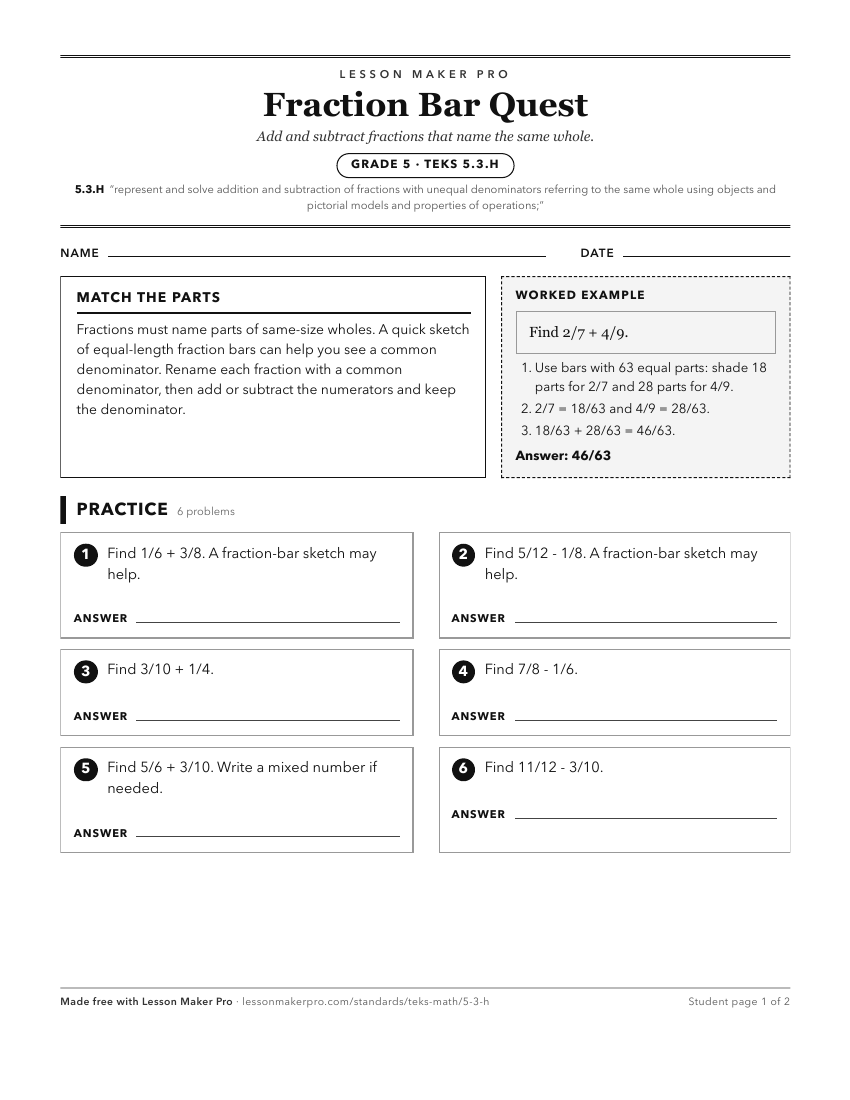
A ready-to-print activity worksheet aligned to 5.3.H, with an answer key for the teacher on its own page. No account needed.
PDF, US Letter, prints cleanly in black and white.
Download the worksheetKeep exploring
Related Standards
- 4.3.E
represent and solve addition and subtraction of fractions with equal denominators using objects and pictorial models that build to the number line and propertie...
- 3.3.F
represent equivalent fractions with denominators of 2, 3, 4, 6, and 8 using a variety of objects and pictorial models, including number lines
- 3.3.A
represent fractions greater than zero and less than or equal to one with denominators of 2, 3, 4, 6, and 8 using concrete objects and pictorial models, includin...
- 5.3.I
represent and solve multiplication of a whole number and a fraction that refers to the same whole using objects and pictorial models, including area models
Turn this exact standard into a lesson
Grade, subject, topic, and the complete standard are prefilled. Create one free, no account needed.
Also for this standard:Make a WorksheetMake a QuizMake a Sub Lesson