TEKS Math 3.3.A
The Standard
represent fractions greater than zero and less than or equal to one with denominators of 2, 3, 4, 6, and 8 using concrete objects and pictorial models, including strip diagrams and number lines
Texas Essential Knowledge and Skills for Mathematics
Teacher's field guide
What This Standard Means
What Students Need to Do
- Students represent fractions greater than 0 and up to 1 using equal parts. They use objects, drawings, strip diagrams, and number lines with denominators 2, 3, 4, 6, and 8.
What Mastery Looks Like
- Students build or draw a fraction with the correct number of equal parts and identify the selected parts. They place the same fraction accurately between 0 and 1 on a number line.
Common Misconceptions
- Students may count partition lines instead of equal parts when naming the denominator. They may accept unequal pieces or place fractions incorrectly on a number line.
How to Assess It
- Give students a strip divided into eight equal parts and a number line from 0 to 1. Ask them to represent 5/8 on both models.
Lesson moves
Ways to Teach It
Give pairs fraction strips to fold into halves, thirds, fourths, sixths, and eighths, then shade a fraction named on a card.
Show two models of 3/4, one with equal parts and one with unequal parts, and ask students which is valid and why.
Play Fraction Match by pairing cards showing symbols, shaded strip diagrams, object models, and number-line points for the same fraction.
Use measuring cups to model fractions of one cup, then draw each amount as a strip diagram and mark it on a number line.
Free download
Printable 3.3.A Worksheet
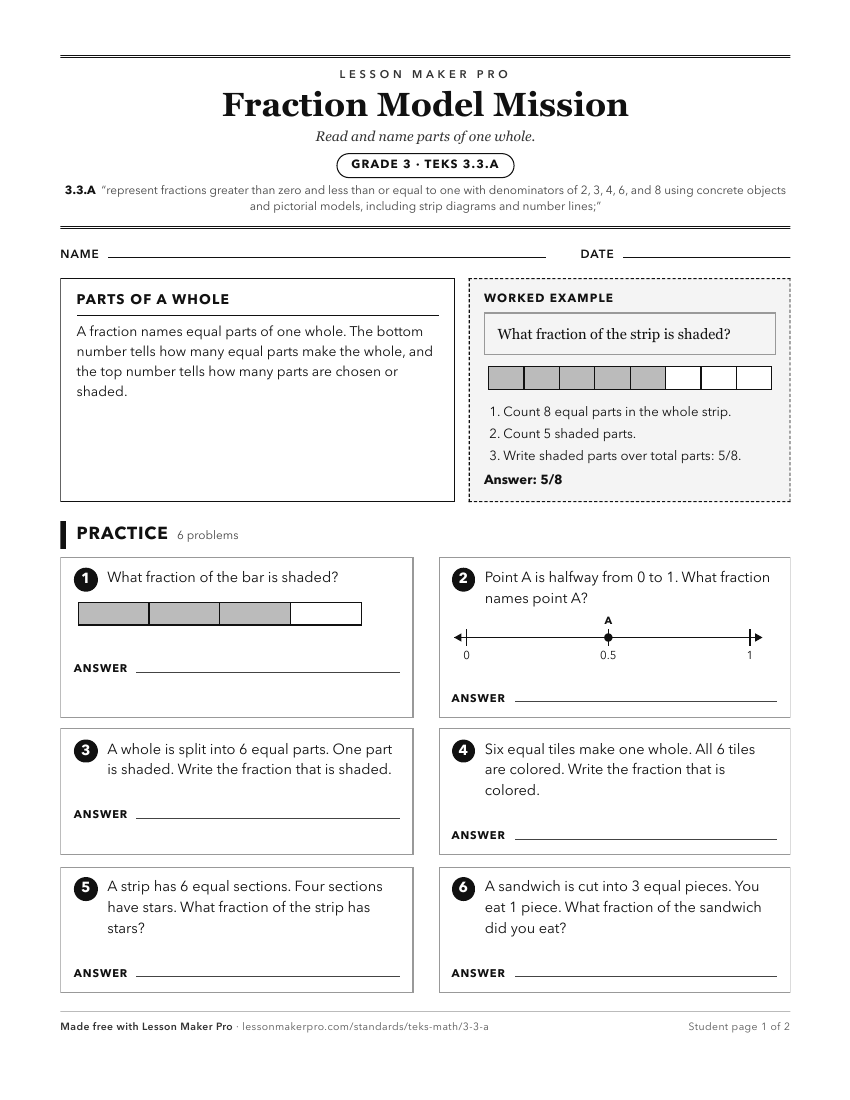
A ready-to-print activity worksheet aligned to 3.3.A, with an answer key for the teacher on its own page. No account needed.
PDF, US Letter, prints cleanly in black and white.
Download the worksheetKeep exploring
Related Standards
- 4.3.E
represent and solve addition and subtraction of fractions with equal denominators using objects and pictorial models that build to the number line and propertie...
- 3.3.F
represent equivalent fractions with denominators of 2, 3, 4, 6, and 8 using a variety of objects and pictorial models, including number lines
- 6.4.F
represent benchmark fractions and percents such as 1%, 10%, 25%, 33 1/3%, and multiples of these values using 10 by 10 grids, strip diagrams, number lines, and ...
- 5.3.H
represent and solve addition and subtraction of fractions with unequal denominators referring to the same whole using objects and pictorial models and propertie...
Turn this exact standard into a lesson
Grade, subject, topic, and the complete standard are prefilled. Create one free, no account needed.
Also for this standard:Make a WorksheetMake a QuizMake a Sub Lesson