TEKS Math 4.3.B
The Standard
decompose a fraction in more than one way into a sum of fractions with the same denominator using concrete and pictorial models and recording results with symbolic representations
Texas Essential Knowledge and Skills for Mathematics
Teacher's field guide
What This Standard Means
What Students Need to Do
- Students split one fraction into two or more addends while keeping the denominator the same. They use objects or drawings to show each split, then write a matching equation.
What Mastery Looks Like
- A student can show, for example, that 5/8 equals 1/8 + 4/8 and also 2/8 + 3/8. Their models use equal parts, and each equation matches the shaded sections.
Common Misconceptions
- Students may change the denominator when splitting a fraction, or make parts that are not equal in the model. Some think a fraction has only one possible decomposition or add both numerators and denominators.
How to Assess It
- Give students 6/8. Ask them to draw two different models and write a matching addition equation for each model.
Lesson moves
Ways to Teach It
Cut paper strips into eight equal sections, shade five, then cut the shaded amount into groups to show three different sums.
Ask, "How are 1/6 + 4/6 and 2/6 + 3/6 alike?" Students draw models and explain in writing.
Play Fraction Split: draw a fraction card, write two different same-denominator sums, and earn a point for each accurate model.
Present a pizza with 7/8 remaining, then have students show two ways the slices could be divided between two plates.
Free download
Printable 4.3.B Worksheet
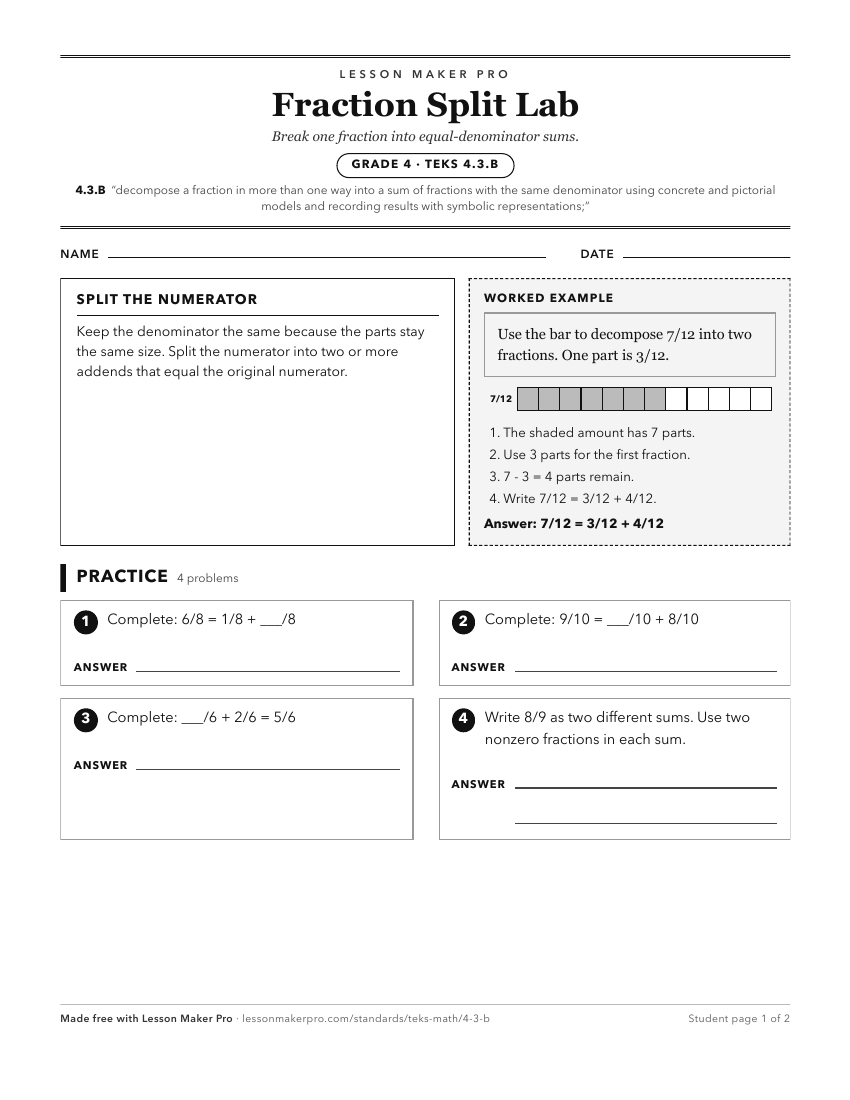
A ready-to-print activity worksheet aligned to 4.3.B, with an answer key for the teacher on its own page. No account needed.
PDF, US Letter, prints cleanly in black and white.
Download the worksheetKeep exploring
Related Standards
- 4.3.E
represent and solve addition and subtraction of fractions with equal denominators using objects and pictorial models that build to the number line and propertie...
- 3.3.A
represent fractions greater than zero and less than or equal to one with denominators of 2, 3, 4, 6, and 8 using concrete objects and pictorial models, includin...
- 5.3.H
represent and solve addition and subtraction of fractions with unequal denominators referring to the same whole using objects and pictorial models and propertie...
- 3.3.H
compare two fractions having the same numerator or denominator in problems by reasoning about their sizes and justifying the conclusion using symbols, words, ob...
Turn this exact standard into a lesson
Grade, subject, topic, and the complete standard are prefilled. Create one free, no account needed.
Also for this standard:Make a WorksheetMake a QuizMake a Sub Lesson