TEKS Math 3.3.G
The Standard
explain that two fractions are equivalent if and only if they are both represented by the same point on the number line or represent the same portion of a same size whole for an area model
Texas Essential Knowledge and Skills for Mathematics
Teacher's field guide
What This Standard Means
What Students Need to Do
- Students decide whether two fractions name the same amount by using number lines or area models with equal-sized wholes. They explain why the fractions are equivalent or not equivalent.
What Mastery Looks Like
- Students identify equivalent fractions on number lines and area models. They explain that equivalent fractions name the same point or the same amount of equal-sized wholes.
Common Misconceptions
- Students may compare shaded pieces without checking that the wholes are the same size. They may also think fractions with different numerators or denominators cannot be equivalent.
How to Assess It
- Give students area models and a number line showing 1/2, 2/4, and 3/4. Ask them to circle the equivalent pair and explain using both representations.
Lesson moves
Ways to Teach It
Have students fold equal-sized paper strips into halves, fourths, and eighths, then match sections that cover the same length.
Ask students to explain why 2/4 equals 1/2 using a number line and two same-sized rectangles.
Play a matching game with fraction cards, area models, and number-line points that represent equivalent amounts.
Compare two same-sized pizzas cut into different numbers of equal slices, and identify servings that contain the same amount.
Free download
Printable 3.3.G Worksheet
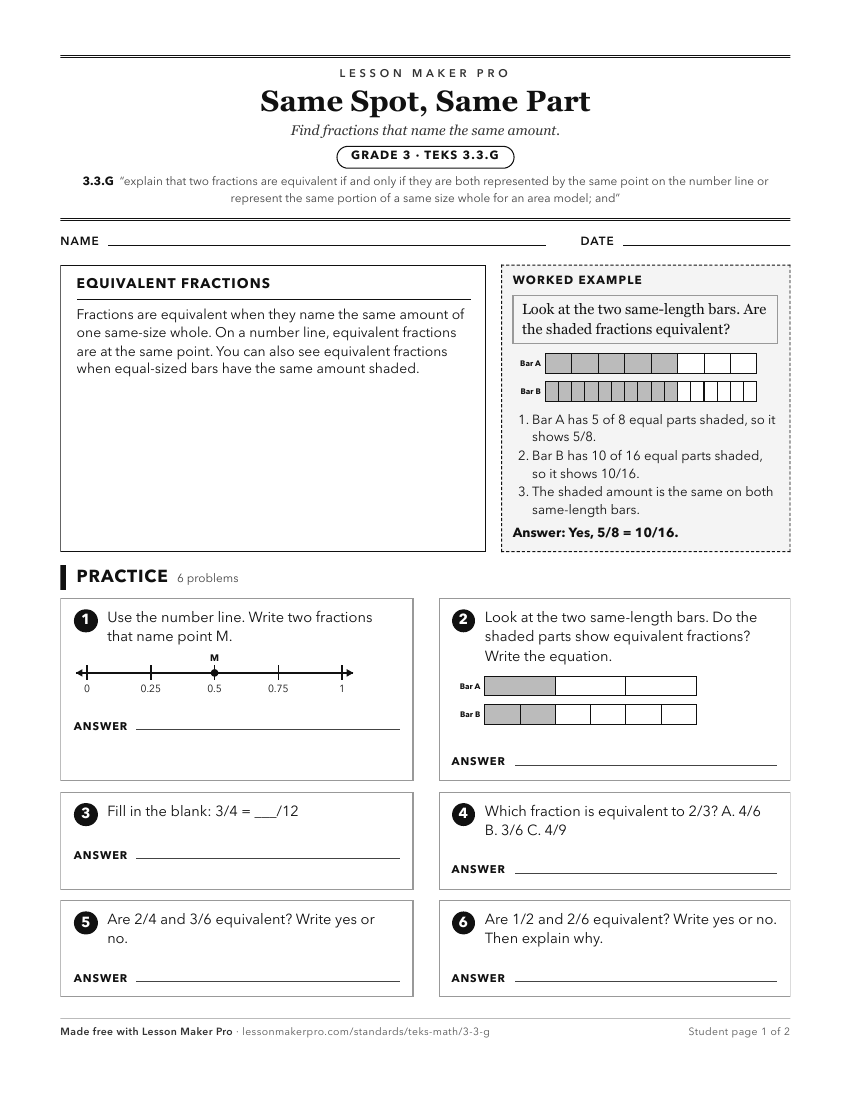
A ready-to-print activity worksheet aligned to 3.3.G, with an answer key for the teacher on its own page. No account needed.
PDF, US Letter, prints cleanly in black and white.
Download the worksheetKeep exploring
Related Standards
- 3.6.E
decompose two congruent two-dimensional figures into parts with equal areas and express the area of each part as a unit fraction of the whole and recognize that...
- 6.5.C
use equivalent fractions, decimals, and percents to show equal parts of the same whole
- 5.3.I
represent and solve multiplication of a whole number and a fraction that refers to the same whole using objects and pictorial models, including area models
- 3.3.H
compare two fractions having the same numerator or denominator in problems by reasoning about their sizes and justifying the conclusion using symbols, words, ob...
Turn this exact standard into a lesson
Grade, subject, topic, and the complete standard are prefilled. Create one free, no account needed.
Also for this standard:Make a WorksheetMake a QuizMake a Sub Lesson