TEKS Math 3.6.E
The Standard
decompose two congruent two-dimensional figures into parts with equal areas and express the area of each part as a unit fraction of the whole and recognize that equal shares of identical wholes need not have the same shape
Texas Essential Knowledge and Skills for Mathematics
Teacher's field guide
What This Standard Means
What Students Need to Do
- Students partition matching shapes into equal-area parts. They label one part as 1/n of the whole and explain why equal shares may have different shapes.
What Mastery Looks Like
- Given two same-size rectangles, a student can divide each into four equal-area pieces in different ways. The student labels each piece 1/4 and proves equality by counting grid squares.
Common Misconceptions
- Students may call pieces equal because they look similar, even when their areas differ. They may think fourths must have the same shape or label each of four parts 4/1.
How to Assess It
- Give students two identical 4-by-4 grid rectangles. Ask them to divide one into four strips and the other into four squares, label each share, and explain why both show fourths.
Lesson moves
Ways to Teach It
Give pairs two identical paper squares; fold one into four strips and the other into four small squares, then label each share 1/4.
Show a striped fourth and a square fourth; ask, “How can both be 1/4 when their shapes differ?”
Play Fraction Match: students pair partition cards showing identical wholes with the same number of equal-area shares but different piece shapes.
Use two same-size sandwiches, cut one into four strips and one into four squares, and compare each person’s share.
Free download
Printable 3.6.E Worksheet
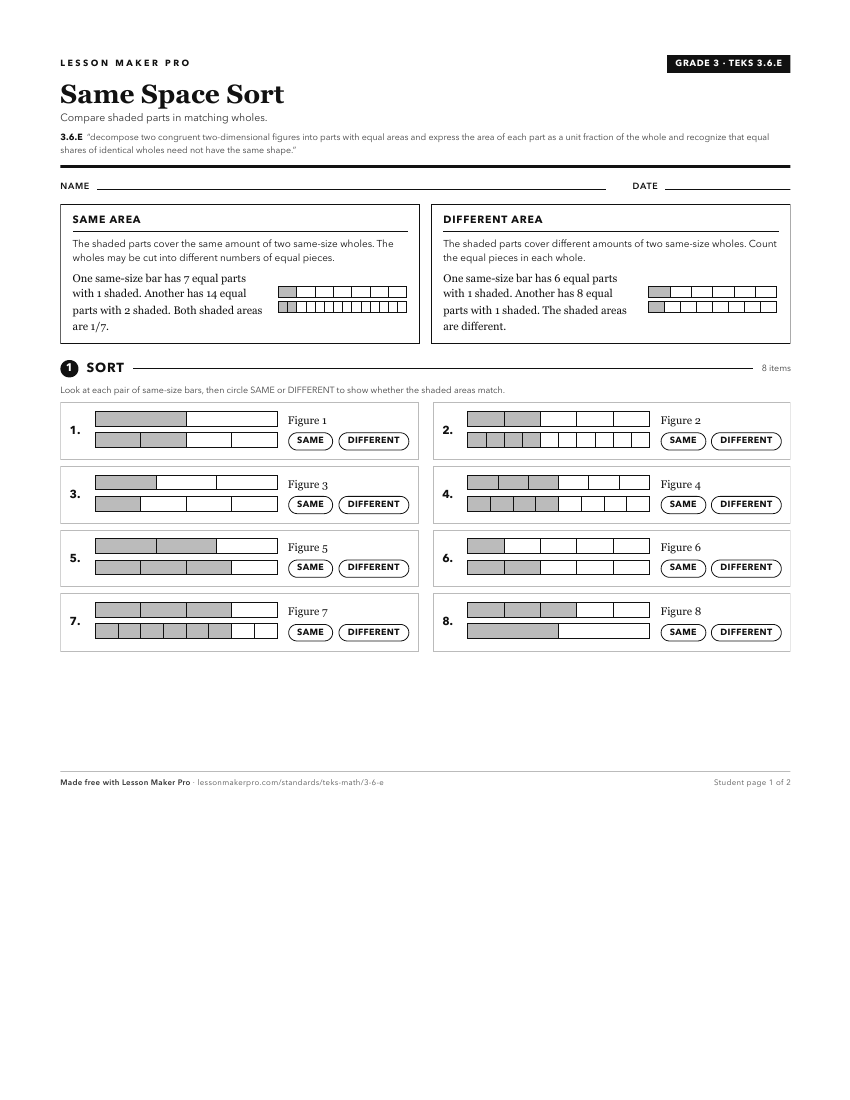
A ready-to-print activity worksheet aligned to 3.6.E, with an answer key for the teacher on its own page. No account needed.
PDF, US Letter, prints cleanly in black and white.
Download the worksheetKeep exploring
Related Standards
- 1.6.G
partition two-dimensional figures into two and four fair shares or equal parts and describe the parts using words
- 2.8.E
decompose two-dimensional shapes such as cutting out a square from a rectangle, dividing a shape in half, or partitioning a rectangle into identical triangles a...
- 3.3.G
explain that two fractions are equivalent if and only if they are both represented by the same point on the number line or represent the same portion of a same ...
- 6.5.C
use equivalent fractions, decimals, and percents to show equal parts of the same whole
Turn this exact standard into a lesson
Grade, subject, topic, and the complete standard are prefilled. Create one free, no account needed.
Also for this standard:Make a WorksheetMake a QuizMake a Sub Lesson